

• Skip to primary navigation
  • Skip to main content
  • Skip to primary sidebar
  • Skip to secondary sidebar
  • Skip to footer
  • NEWS:
  • SatNews
  • SatMagazine
  • MilSatMagazine
  • SmallSat News
  • |     EVENTS:
  • SmallSat Symposium
  • Satellite Innovation
  • MilSat Symposium
  • SmallSat Europe

SatNews

Satellite Industry Intelligence Since 1983

Subscribe
  • LATEST
  • SatNews Events
  • Magazines
  • Calendar
  • Subscribe
  • Missions & Constellations
    • Exploration & Science Missions
    • In-Orbit Servicing & Orbital Operations
    • LEO Constellations
    • Mission Autonomy & Onboard Systems
    • Mission Deployments & Manifests
    • Navigation & PNT
    • SmallSat
    • Spacecraft & Payload Technology
    View All in Missions & Constellations →
    NASA Shuts Off Instrument on Voyager 1 to Extend Interstellar MissionNASA Shuts Off Instrument on Voyager 1 to Extend Interstellar Mission
    Starlink Outages Disrupt Navy Drone Tests as Pentagon Dependency GrowsStarlink Outages Disrupt Navy Drone Tests as Pentagon Dependency Grows
    Iridium Unveils Role in Artemis II and Next-Gen PNT at Space Symposium 2026Iridium Unveils Role in Artemis II and Next-Gen PNT at Space Symposium 2026
    Boeing and Millennium Unveil Resolute Mid-Class Satellite PlatformBoeing and Millennium Unveil Resolute Mid-Class Satellite Platform
  • Business
    • Contracts & Commercial Deals
    • Earnings & Financial Reporting
    • Events & Conferences
    • Funding & Venture Capital
    • Market Forecasts
    • Mergers & Acquisitions
    • Personnel Moves & Appointments
    View All in Business & Finance →
    Meink: Space Force Programs Ready to Execute Once FY27 Budget LandsMeink: Space Force Programs Ready to Execute Once FY27 Budget Lands
    SDA’s Sandhoo: Tranche 1 Launches Resume in May or JuneSDA’s Sandhoo: Tranche 1 Launches Resume in May or June
    Gen. Stephen Whiting: First USSPACECOM Operational Staff Arrive at Redstone This WeekGen. Stephen Whiting: First USSPACECOM Operational Staff Arrive at Redstone This Week
    Saltzman Rolls Out Space Force Objective Force, Flags CR as Top RiskSaltzman Rolls Out Space Force Objective Force, Flags CR as Top Risk
  • Defense
    • Counterspace & ASAT
    • Defense Budgets & Procurement
    • ISR & Reconnaissance
    • MILSATCOM
    • Missile Warning & Defense
    • National Security Programs
    • Space Domain Awareness
    View All in Military & Defense →
    GMV Secures Lead Role in Seven 2025 European Defence Fund InitiativesGMV Secures Lead Role in Seven 2025 European Defence Fund Initiatives
    SmallSat Europe Speaker Focus: Gen. Michel Friedling, Look Up SpaceSmallSat Europe Speaker Focus: Gen. Michel Friedling, Look Up Space
    Saltzman Unveils 2040 Blueprint to Scale Space Force for Great Power CompetitionSaltzman Unveils 2040 Blueprint to Scale Space Force for Great Power Competition
    The Rise of Grey Zone Satellites: Ambiguity as a Tactical AdvantageThe Rise of Grey Zone Satellites: Ambiguity as a Tactical Advantage
  • Gov
    • Export Controls & Compliance
    • International Space Agreements
    • National Space Policy
    • Space Law & Treaties
    • Space Sustainability & Debris Policy
    • Space Traffic Management / Debris Removal
    View All in Government & Regulation →
    SmallSat Europe Speaker Focus: Col. Marcin Mazur, Polish Space AgencySmallSat Europe Speaker Focus: Col. Marcin Mazur, Polish Space Agency
    SmallSat Europe Speaker Focus: Chris Quilty, Quilty SpaceSmallSat Europe Speaker Focus: Chris Quilty, Quilty Space
    NRL to Showcase Sovereign Space Capabilities at 41st Space SymposiumNRL to Showcase Sovereign Space Capabilities at 41st Space Symposium
    FCC Modernizes Satellite Spectrum Rules to Unleash Next-Generation BroadbandFCC Modernizes Satellite Spectrum Rules to Unleash Next-Generation Broadband
  • Launch
    • Launch Providers
    • Launch Schedule & Calendars
    • Launch Sites & Infrastructure
    • Rocket Technology & Vehicles
    View All in Launch →
    Blue Origin Achieves First Booster Reuse but Satellite Enters Off-Nominal OrbitBlue Origin Achieves First Booster Reuse but Satellite Enters Off-Nominal Orbit
    Ensign-Bickford Hardware Supports Successful Artemis II Lunar MissionEnsign-Bickford Hardware Supports Successful Artemis II Lunar Mission
    China Accelerates Orbital Internet Deployment with Successful Smart Dragon-3 Sea LaunchChina Accelerates Orbital Internet Deployment with Successful Smart Dragon-3 Sea Launch
    What the SpaceX IPO Changes for Every Satellite OperatorWhat the SpaceX IPO Changes for Every Satellite Operator
  • Software
    • Autonomous Ground Operations
    • Data Processing & AI/ML
    • Digital Twins & Modeling
    • Ground Segment & Teleports
    • Mission Planning & Simulation
    • Space Systems Software Engineering
    • Spectrum & Licensing
    View All in Software Automation & Ground Systems →
    Sat-Lite Technologies adds  Richard Rader to Spearhead Sales ExpansionSat-Lite Technologies adds Richard Rader to Spearhead Sales Expansion
    Blue Origin Unveils Project Quartz Global Ground Station NetworkBlue Origin Unveils Project Quartz Global Ground Station Network
    Cloudcomputing Targets 1.5M Identities in Spain and Finalizes Innovate IT AcquisitionCloudcomputing Targets 1.5M Identities in Spain and Finalizes Innovate IT Acquisition
    Archangel Lightworks Secures £10M Series A to Scale Optical Ground InfrastructureArchangel Lightworks Secures £10M Series A to Scale Optical Ground Infrastructure
  • Services & Apps
    • Climate & Environmental Monitoring
    • Disaster Response & Security Mapping
    • Earth Observation & Imaging
    • Maritime & Aviation Satcom
    • Satellite Communications
    View All in Services & Applications →
    SmallSat Europe Speaker Focus: Martin Langer, OroraTechSmallSat Europe Speaker Focus: Martin Langer, OroraTech
    SmallSat Europe Speaker Focus: Jaume Sanpera, SateliotSmallSat Europe Speaker Focus: Jaume Sanpera, Sateliot
    NASA Targets Commercial Relays to Replace Aging TDRSS InfrastructureNASA Targets Commercial Relays to Replace Aging TDRSS Infrastructure
    OQ Technology Awarded ESA Contract to Adapt 5G Beamforming for SpaceOQ Technology Awarded ESA Contract to Adapt 5G Beamforming for Space

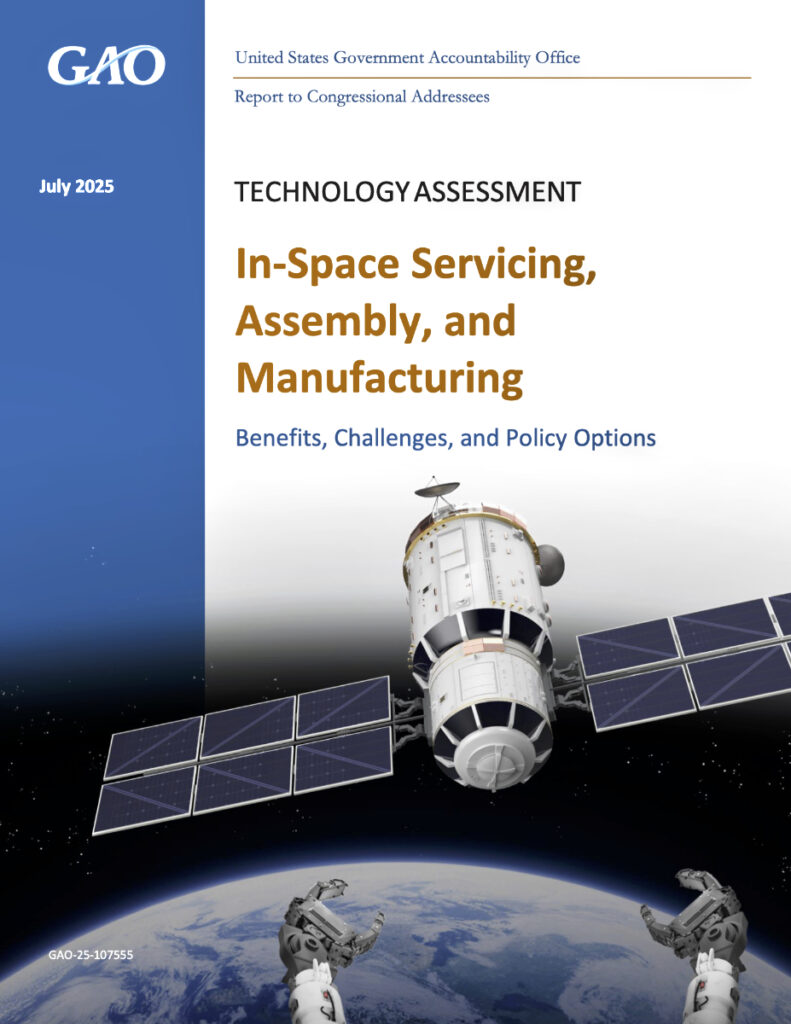
Government Accountability Office: In-Space Servicing, Assembly, + Manufacturing: Benefits, Challenges, + Policy Options

July 13, 2025

Satellites are used for GPS, weather forecasts, and more. Generally, satellites have to be small and tough enough to withstand launch. Repairing or upgrading them involves sending people to space—so they usually aren’t made to be serviced. In-space robotic servicing could change this and open the door to other advances, like in-space assembly and manufacturing. However, the technology is mostly unproven in space. Companies and U.S. agencies are hesitant to commit resources to it.

We offered policy options to address this and other challenges. For example, requiring satellites to be serviceable could create a user base for in-space service companies.

Space is increasingly important to the daily lives of Americans, to the economy, and to national defense. The number of active satellites in space providing critical services increased from 1,400 in 2015 to more than 11,000 in 2025. An additional 18,000 or more are projected to be launched by 2030, according to market analyses.

In-space servicing, assembly, and manufacturing (ISAM) technology has the potential to improve current satellite capabilities and to open new capabilities, such as orbital debris removal, space-based solar energy, larger space telescopes, and human deep-space space exploration.

In 2022, the Office of Science and Technology Policy published a national strategy and an implementation plan to guide federal ISAM activities. The plan named various agencies, including the Department of Defense (DOD) and the National Aeronautics and Space Administration (NASA), to lead these activities. DOD and NASA have spent more than $2 billion developing in-space servicing demonstration missions over the past decade, according to agency documentation and officials. Other countries are also developing and demonstrating ISAM technologies.

Definitions of in-space servicing, assembly, and manufacturing
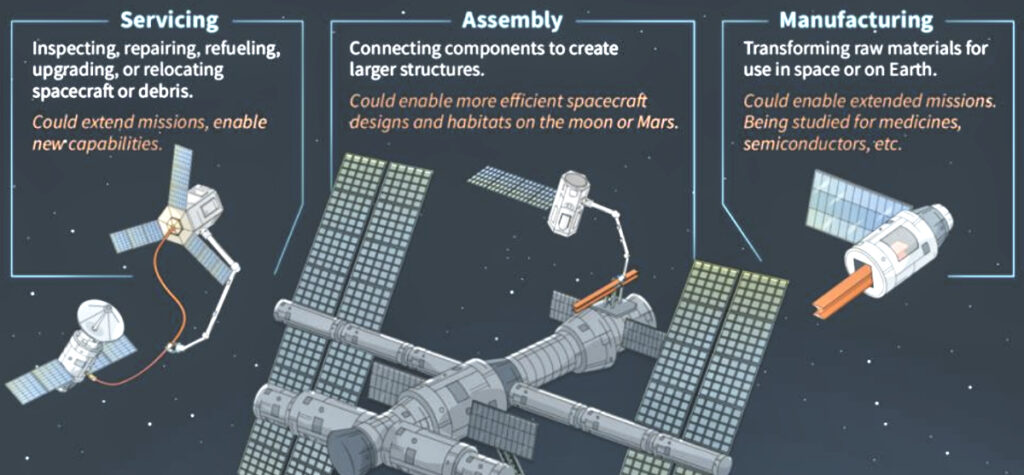
While astronauts have repaired the Hubble Space Telescope and assembled and maintained the International Space Station, robotic ISAM functions are less mature. Robotic in-space servicing is not routinely used and has only been demonstrated on a handful of missions, but it is more mature than assembly and manufacturing.

Development of ISAM technology faces challenges largely related to what experts called a chicken-and-egg problem. Potential ISAM service providers are hesitant to develop the technology into servicing products (e.g., a satellite that can bring fuel to other satellites) until there is a user base (e.g., a refuelable satellite). Similarly, potential users are hesitant to design and deploy satellites that can be serviced until those products are available.

GAO identified four challenges contributing to this situation:

  • Government agencies and industry have differing priorities for ISAM technology, and a single technology is unlikely to meet all priorities. This situation fragments demand for any given technology.
  • Government and private satellite operators are generally not requiring that satellites be designed for future servicing, such as refueling or upgrading.
  • Few in-space test opportunities are available for developers to test ISAM technology. As a result, ISAM providers have generally not demonstrated the capability to perform satellite servicing, which deters risk-averse satellite operators from committing to purchasing such servicing.
  • Regulations and standards are unclear or emerging, both for space activities broadly and ISAM specifically.

GAO developed five policy options that could help address these challenges. These policy options are not recommendations. GAO presents them to help policymakers consider and choose options appropriate to the goals they hope to achieve. Policymakers may include legislative bodies, government agencies, standards-setting organizations, and industry.

Policy options to help address challenges with in-space servicing, assembly, and manufacturing (ISAM) technology development and use

Policy Option Opportunities Considerations

Maintain status quo efforts (report p. 24)

For example, federal agencies, ISAM providers, and other policymakers could sustain current planned demonstration missions and ISAM community efforts.

  • Current efforts may address some challenges without additional resources.
  • Resources that would have been allocated to further developing ISAM could be used for other opportunities.
  • Current efforts are not likely to address all challenges, such as not being able to promptly respond to changing mission needs or satellite failures.

Evaluate, and potentially promote serviceability (report p. 25)

For example, federal agencies could study the economic benefits and costs of serviceability and then take actions, such as requiring that satellites be serviceable to enable repair, maintenance, or future technology upgrades.

  • Evaluations of benefits could clarify whether and when serviceability can generate return on investment, which would help inform decisions about which other policy options to pursue.
  • Requirements could establish a user base and incentivize servicing providers.
  • Could be relatively inexpensive compared to the overall cost of a satellite.
  • Historical data may not be sufficient to generate reliable evaluations.Some benefits of satellite servicing may not be easily quantifiable.

Support technology development and testing (report p. 27)

For example, the ISAM community could take steps to support testing opportunities on the ground and in space.

  • More testing could enable smaller companies and academic research groups to participate in developing ISAM capabilities.

Could reduce technical risk, satisfy many potential users, and encourage adoption.

Resources dedicated to test facilities and demonstrations would not be available for other agency or company priorities.

Demonstrations would not guarantee adoption by users.

Develop or clarify regulations and standards (report p. 28)

For example, government agencies and standards organizations could clarify licensing or promulgate standards.

  • Could lower barriers for ISAM providers.
  • Government and industry may not be prepared to specify regulations or standards.
  • The ISAM industry is still developing, and regulations may inadvertently create unnecessary barriers to developing technology.

Designate a government champion (report p. 29)

For example, Congress or the White House could designate a government champion to support ISAM development and coordinate with the Consortium for Space Mobility and ISAM Capabilities.

  • The government champion could oversee and coordinate activities described in the ISAM National Strategy and the National ISAM Implementation Plan, and the policy options identified in this report.
  • A government champion without sufficient authority, resources, and clear direction could be ineffective.

Why GAO Did This Study
ISAM technology and capabilities could change the paradigm of how spacecraft are designed, built, operated, and discarded. Since the advent of artificial satellites, almost all have been “single use”: assembled on Earth, sustained in space with no outside intervention beyond communication, and discarded or abandoned when no longer functional. ISAM could reduce cost and risk, increase flexibility, and help to better address failures after launch.

NASA and others have used ISAM capabilities for more than 40 years, but largely involving crewed missions rather than uncrewed robotic missions. For example, astronauts repaired or upgraded the Hubble Space Telescope five times between 1993 and 2009.

This report describes potential benefits and status of ISAM capabilities as well as challenges facing their development and use. It also identifies options policymakers could consider that might help realize benefits and address challenges.

To conduct this technology assessment, GAO searched the relevant literature; reviewed documents and reports; interviewed federal officials, industry representatives, and stakeholders in academia and at federally funded research and development centers; conducted site visits; attended conferences and workshops; and convened a 2-day meeting of 20 experts from government, industry, academia, and federally funded research and development centers. GAO excluded sensitive and classified information. GAO is identifying policy options in this report.

View the PDF report at this direct link…

Filed Under: Government & Regulation, SmallSat

Primary Sidebar

Coverage

  • Missions & Constellations
  • Business & Finance
  • Military & Defense
  • Launch
  • Software Automation & Ground Systems
  • Government & Regulation
  • Services & Applications

Most Read Stories

  • SpaceX Loses Contact With Starlink Satellite
  • Rocket Lab Emerging as Potential Bus Provider for 2,800-Satellite Equatys Constellation
  • SpaceX Accelerates Record-Breaking IPO Following Trillion-Dollar xAI Merger
  • Planet Labs Imposes Indefinite Blackout on Iran Satellite Imagery at U.S. Request
  • Amazon in Reported Talks to Acquire Globalstar in $9 Billion Move to Challenge Starlink

Secondary Sidebar

Footer


Satnews is a leading provider of satellite news, events, publications, research and other satellite industry information in both commercial and military enterprises worldwide.

Stories By Category

  • Business & Finance
  • Government & Regulation
  • Launch
  • Military & Defense
  • Missions & Constellations
  • Services & Applications
  • Software Automation & Ground Systems
  • Spectrum & Licensing
  • Startups & NewSpace Business

About Us

  • Leadership & Editorial Team
  • SatNews History
  • Free Satnews Subscription
  • SatNews Events
  • Magazines

Navigation

  • Latest Stories
  • Magazines
  • Events
  • Contact
  • Cookie & Privacy Policy for Satnews

We use cookies to ensure that we give you the best experience on our website. If you continue to use this site we will assume that you are happy with it.
x
Sign up Now (For Free)
Access daily or weekly satellite news updates covering all aspects of the commercial and military satellite industry.
Invalid email address
Notify Me Regarding ( At least one ):
We value your privacy and will not sell or share your email or other information with any other company. You may also unsubscribe at anytime.

Click Here to see our full privacy policy.
Thanks for subscribing!