

• Skip to primary navigation
  • Skip to main content
  • Skip to primary sidebar
  • Skip to secondary sidebar
  • Skip to footer
  • NEWS:
  • SatNews
  • SatMagazine
  • MilSatMagazine
  • SmallSat News
  • |     EVENTS:
  • SmallSat Symposium
  • Satellite Innovation
  • MilSat Symposium
  • SmallSat Europe

SatNews

Satellite Industry Intelligence Since 1983

Subscribe
  • LATEST
  • SatNews Events
  • Magazines
  • Calendar
  • Subscribe
  • Missions & Constellations
    • Exploration & Science Missions
    • In-Orbit Servicing & Orbital Operations
    • LEO Constellations
    • Mission Autonomy & Onboard Systems
    • Mission Deployments & Manifests
    • Navigation & PNT
    • SmallSat
    • Spacecraft & Payload Technology
    View All in Missions & Constellations →
    Direct-to-Device Momentum: AST SpaceMobile Successfully Launches Giant Next-Gen BlueBird Satellites Atop SpaceX Falcon 9Direct-to-Device Momentum: AST SpaceMobile Successfully Launches Giant Next-Gen BlueBird Satellites Atop SpaceX Falcon 9
    Orbital Compute vs. Dark Skies: The Astronomy Crisis Behind SpaceX’s One-Million AI Satellite PlanOrbital Compute vs. Dark Skies: The Astronomy Crisis Behind SpaceX’s One-Million AI Satellite Plan
    Pittsburgh’s Moonshot: Astrobotic Unveils Griffin-1 Lander Ahead of Historic NASA ‘Moon Base II’ MissionPittsburgh’s Moonshot: Astrobotic Unveils Griffin-1 Lander Ahead of Historic NASA ‘Moon Base II’ Mission
    Rapid Deployment: ZeroUSV Streamlines Uncrewed Vessel Portability for Defense and Survey MissionsRapid Deployment: ZeroUSV Streamlines Uncrewed Vessel Portability for Defense and Survey Missions
  • Business
    • Contracts & Commercial Deals
    • Earnings & Financial Reporting
    • Events & Conferences
    • Funding & Venture Capital
    • Market Forecasts
    • Mergers & Acquisitions
    • Personnel Moves & Appointments
    View All in Business & Finance →
    The Satnews offices Will Be Closed Friday, June 19 for the Juneteenth Holiday.The Satnews offices Will Be Closed Friday, June 19 for the Juneteenth Holiday.
    Rideshare Reinforcements: Private Equity Giant EQT Enters Space Sector with Exolaunch AcquisitionRideshare Reinforcements: Private Equity Giant EQT Enters Space Sector with Exolaunch Acquisition
    Space Weather Forecasting: Momentus Secures Commercial Payload Contract for Vigoride-9 OSVSpace Weather Forecasting: Momentus Secures Commercial Payload Contract for Vigoride-9 OSV
    Sovereign Microgravity: Elethron and ATMOS Space Cargo Finalize Low-Earth Orbit Payload Engineering CampaignSovereign Microgravity: Elethron and ATMOS Space Cargo Finalize Low-Earth Orbit Payload Engineering Campaign
  • Defense
    • Counterspace & ASAT
    • Defense Budgets & Procurement
    • ISR & Reconnaissance
    • MILSATCOM
    • Missile Warning & Defense
    • National Security Programs
    • Space Domain Awareness
    View All in Military & Defense →
    Sovereign Space Expansion: Portugal Procures Dual ICEYE Radar Satellites to Broaden Maritime SurveillanceSovereign Space Expansion: Portugal Procures Dual ICEYE Radar Satellites to Broaden Maritime Surveillance
    Space Force Awards Lockheed Martin $514M to Build Resilient GPS IIIF SatellitesSpace Force Awards Lockheed Martin $514M to Build Resilient GPS IIIF Satellites
    Sovereign Electronic Warfare: Eviden and Hexadrone Partner to Integrate Tactical SIGINT onto Modular Drone FleetSovereign Electronic Warfare: Eviden and Hexadrone Partner to Integrate Tactical SIGINT onto Modular Drone Fleet
    Space Logistics Pivot: USSF Launches Challenge to Develop Multi-Orbit ‘Warehouses’ and Fuel DepotsSpace Logistics Pivot: USSF Launches Challenge to Develop Multi-Orbit ‘Warehouses’ and Fuel Depots
  • Gov
    • Export Controls & Compliance
    • International Space Agreements
    • National Space Policy
    • Space Law & Treaties
    • Space Sustainability & Debris Policy
    • Space Traffic Management / Debris Removal
    View All in Government & Regulation →
    Orbital Paperwork War: China’s Spectrum Squatting Reserves 244,000 Satellite Slots to Combat SpaceX’s LEO MonopolyOrbital Paperwork War: China’s Spectrum Squatting Reserves 244,000 Satellite Slots to Combat SpaceX’s LEO Monopoly
    The Next Arena: Why the WRC-27 Summit in Shanghai is the New Space Tech FrontlineThe Next Arena: Why the WRC-27 Summit in Shanghai is the New Space Tech Frontline
    American military space closed around one company in seven daysAmerican military space closed around one company in seven days
    Major opportunities for 2 GHz over EuropeMajor opportunities for 2 GHz over Europe
  • Launch
    • Launch Providers
    • Launch Schedule & Calendars
    • Launch Sites & Infrastructure
    • Rocket Technology & Vehicles
    View All in Launch →
    SpaceX’s Secret ‘Starfall’ Capsule Wins FAA Approval for Pacific Reentry TestsSpaceX’s Secret ‘Starfall’ Capsule Wins FAA Approval for Pacific Reentry Tests
    Breaking the TRL Bottleneck: Space Phoenix Systems Debuts Cost-Effective Space Test-and-Return ServiceBreaking the TRL Bottleneck: Space Phoenix Systems Debuts Cost-Effective Space Test-and-Return Service
    Twelve Scientific Payloads Experience Microgravity Aboard SubOrbital Express-5Twelve Scientific Payloads Experience Microgravity Aboard SubOrbital Express-5
    Amazon Leo Constellation Surpasses 330 Satellites Following Latest Atlas V LaunchAmazon Leo Constellation Surpasses 330 Satellites Following Latest Atlas V Launch
  • Software
    • Autonomous Ground Operations
    • Data Processing & AI/ML
    • Digital Twins & Modeling
    • Ground Segment & Teleports
    • Mission Planning & Simulation
    • Space Systems Software Engineering
    • Spectrum & Licensing
    View All in Software Automation & Ground Systems →
    Poland Sovereignty: GMV to Develop Core Ground Control Platform for CAMILA ConstellationPoland Sovereignty: GMV to Develop Core Ground Control Platform for CAMILA Constellation
    Software Over the Air: FatPipe Launches Acceleration Tool to Unclog Starlink and Amazon LEO LinksSoftware Over the Air: FatPipe Launches Acceleration Tool to Unclog Starlink and Amazon LEO Links
    Three LEO Operators Bet 2026 on a Supply Chain Built for 2027Three LEO Operators Bet 2026 on a Supply Chain Built for 2027
    NASA Advances Interoperable Space Networks with Successful PExT DemonstrationNASA Advances Interoperable Space Networks with Successful PExT Demonstration
  • Services & Apps
    • Climate & Environmental Monitoring
    • Disaster Response & Security Mapping
    • Earth Observation & Imaging
    • Maritime & Aviation Satcom
    • Satellite Communications
    View All in Services & Applications →
    U.S. viewership of the 2026 World Cup via satellite television is strong and easily accessibleU.S. viewership of the 2026 World Cup via satellite television is strong and easily accessible
    Space-Based Underwriting: Liberty and ICEYE Launch Satellite-Powered Parametric Wildfire InsuranceSpace-Based Underwriting: Liberty and ICEYE Launch Satellite-Powered Parametric Wildfire Insurance
    Eutelsat and Tototheo Global Forge Partnership to Deliver LEO Connectivity Across Maritime and Government SectorsEutelsat and Tototheo Global Forge Partnership to Deliver LEO Connectivity Across Maritime and Government Sectors
    Marlink Equips Groupama-FDJ Cycling Team with Hybrid Starlink and LTE NetworkMarlink Equips Groupama-FDJ Cycling Team with Hybrid Starlink and LTE Network

The Stratospheric Toll of the Megaconstellation Era

May 18, 2026

The global space sector is in the midst of an unprecedented infrastructure boom. Driven by commercial operators racing to deploy thousands of low-Earth orbit (LEO) communication satellites, the number of operational payloads circling the globe has skyrocketed.
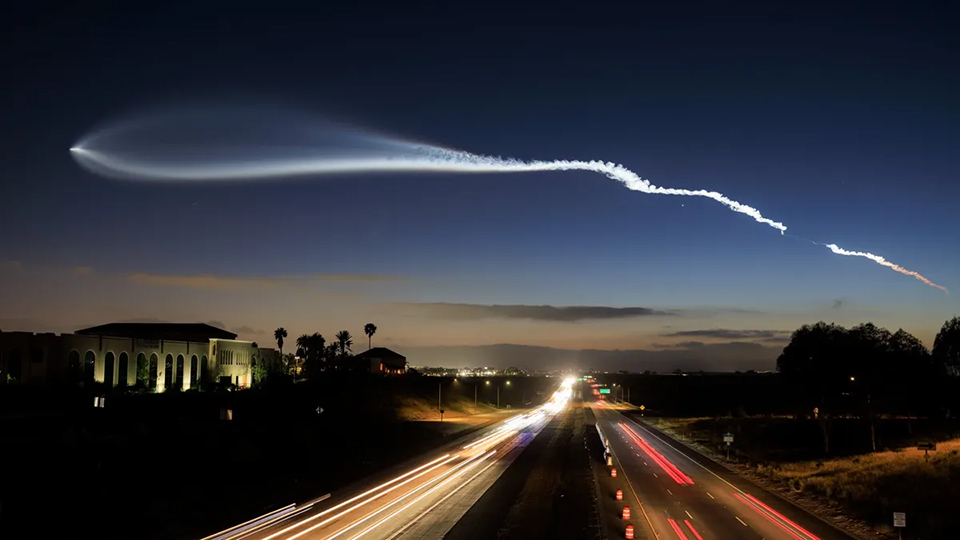
While this orbital network promises to close the digital divide and provide seamless global connectivity, a growing body of atmospheric research suggests these ambitions come with a hidden environmental cost.

A seminal study published in the journal Earth’s Future by atmospheric chemists at University College London (UCL) warns that the rapid rise in launch and re-entry frequencies is creating an “unregulated geoengineering experiment.” The research indicates that high-altitude air pollution from rockets could soon begin altering Earth’s climate and depleting the protective ozone layer at a pace that far outstrips current regulatory frameworks.

The Amplified Impact of Stratospheric Soot

The core concern for atmospheric scientists centers on the injection of black carbon, commonly known as soot, directly into the upper layers of the atmosphere. When a standard liquid-kerosene rocket—such as the SpaceX Falcon 9—ascends, it leaves a continuous trail of exhaust through the troposphere, stratosphere, and mesosphere.

On the Earth’s surface, black carbon emitted by cargo ships, diesel trucks, and coal-fired power plants is a well-known driver of global warming. However, surface-level soot is highly transient. It is injected into the weather-active troposphere, where rain, snow, and wind naturally wash the particles out of the atmosphere within a matter of days or weeks.

Rockets, conversely, deposit soot directly into the bone-dry, stagnant layers of the stratosphere and mesosphere. Lacking any vertical weather systems or precipitation to purge the particles, this high-altitude soot remains suspended for approximately three years. Because the black carbon persists in an environment with high solar exposure for a significantly longer duration, its cumulative capacity to trap heat and warm the surrounding atmosphere is amplified by an estimated factor of 540 compared to identical emissions produced at sea level.

The Lifecycle Traps of Low Earth Orbit Constellations

The threat posed by modern satellite fleets is fundamentally different from the environmental footprint of heritage space programs. Historically, satellite launches were sporadic events designed to deploy massive, highly expensive hardware into geostationary orbits where they would remain operational for decades.

Modern broadband networks rely on a completely different architecture:

  • High Deployment Volume: Delivering low-latency internet requires thousands of smaller satellites operating in close proximity to Earth.
  • Brief Operational Lifespans: Due to atmospheric drag and rapid hardware obsolescence, LEO satellites generally possess an operational lifespan of only five years.
  • Perpetual Replenishment Cycles: To prevent gaps in global service coverage, commercial operators must maintain a continuous, high-cadence launch manifest to replace dying assets.

This continuous lifecycle of deployment and decommissioning creates a permanent, self-sustaining belt of atmospheric pollution. The UCL study projects that if commercial launch manifests continue on their current trajectory, the space industry will inject over 870 tonnes of stratospheric soot into the air annually by the end of the decade, creating a global warming impact that rivals the total annual emissions of industrialized nations like the United Kingdom.

Vaporizing Metals and Ozone Layer Degradation

The climate threat is not limited to the ascent of the launch vehicles; the demise of the satellites poses an equally complex chemical challenge. To prevent the accumulation of dangerous space debris, operators design LEO satellites to intentionally drop out of orbit at the end of their lives and incinerate safely within the upper atmosphere.

However, this vaporization process does not cause the material to disappear. As tens of thousands of retired satellites burn up, the high aluminum content of their structural chassis undergoes thermal ablation, transforming into fine particles of aluminum oxide.

These metallic byproducts act as powerful catalysts for unintended chemical reactions. Suspended in the stratosphere, aluminum oxides provide a highly reactive surface area that accelerates the destruction of ambient ozone molecules by chlorine compounds. Scientists fear that decades of hard-won progress made under the Montreal Protocol to heal the global ozone layer could be inadvertently undermined by the sheer volume of metallic ash settling into the upper atmosphere from decaying commercial spacecraft.

An Accidental Solar Radiation Experiment

The accumulation of high-altitude particulates has led researchers to compare the megaconstellation boom to an accidental geoengineering scheme. Solar radiation management—an intentional, highly controversial climate intervention concept—involves deliberately spraying reflective aerosols into the stratosphere to dim a fraction of incoming sunlight and artificially cool the planet.

The space industry is effectively beginning to mimic this process, albeit completely by accident and without international scientific oversight. As soot and aluminum oxides accumulate, they alter the optical properties of the upper atmosphere, changing how much solar energy enters and exits the biosphere.

Atmospheric scientists warn that allowing high-altitude pollution to accumulate without strict regulatory thresholds is a dangerous gamble. Unlike localized surface pollution, stratospheric changes can trigger unpredictable, long-term shifts in global jet stream behavior, regional precipitation patterns, and agricultural growing seasons. As the space economy continues to expand toward trillions of dollars in value, bridging the governance gap between commercial orbital ambitions and the preservation of Earth’s delicate upper atmosphere is becoming an urgent environmental priority.

Filed Under: Launch, Rocket Technology & Vehicles

Primary Sidebar

Coverage

  • Missions & Constellations
  • Business & Finance
  • Military & Defense
  • Launch
  • Software Automation & Ground Systems
  • Government & Regulation
  • Services & Applications

Most Read Stories

  • SpaceX Is Worth $1.75 Trillion. Only 7% of That Is Real.
  • SpaceX: 10,000 Launches Annually
  • American military space closed around one company in seven days
  • Analyst Projects Massive Subscription Growth for Starlink Ahead of Imminent SpaceX IPO
  • Public Capital for Multi-Planetary Infrastructure: SpaceX Unveils Record $75 Billion IPO

Secondary Sidebar

Footer


Satnews is a leading provider of satellite news, events, publications, research and other satellite industry information in both commercial and military enterprises worldwide.

Stories By Category

  • Business & Finance
  • Government & Regulation
  • Launch
  • Military & Defense
  • Missions & Constellations
  • Services & Applications
  • Software Automation & Ground Systems
  • Spectrum & Licensing
  • Startups & NewSpace Business

About Us

  • Leadership & Editorial Team
  • SatNews History
  • Free Satnews Subscription
  • SatNews Events
  • Magazines

Navigation

  • Latest Stories
  • Magazines
  • Events
  • Contact
  • Cookie & Privacy Policy for Satnews

We use cookies to ensure that we give you the best experience on our website. If you continue to use this site we will assume that you are happy with it.
x
Sign up Now (For Free)
Access daily or weekly satellite news updates covering all aspects of the commercial and military satellite industry.
Invalid email address
Notify Me Regarding ( At least one ):
We value your privacy and will not sell or share your email or other information with any other company. You may also unsubscribe at anytime.

Click Here to see our full privacy policy.
Thanks for subscribing!