

• Skip to primary navigation
  • Skip to main content
  • Skip to primary sidebar
  • Skip to secondary sidebar
  • Skip to footer
  • NEWS:
  • SatNews
  • SatMagazine
  • MilSatMagazine
  • SmallSat News
  • |     EVENTS:
  • SmallSat Symposium
  • Satellite Innovation
  • MilSat Symposium
  • SmallSat Europe

SatNews

Satellite Industry Intelligence Since 1983

Subscribe
  • LATEST
  • SatNews Events
  • Magazines
  • Calendar
  • Subscribe
  • Missions & Constellations
    • Exploration & Science Missions
    • In-Orbit Servicing & Orbital Operations
    • LEO Constellations
    • Mission Autonomy & Onboard Systems
    • Mission Deployments & Manifests
    • Navigation & PNT
    • SmallSat
    • Spacecraft & Payload Technology
    View All in Missions & Constellations →
    Financial Modeling Validates SpaceX Falcon 9 Booster Economics and MarginsFinancial Modeling Validates SpaceX Falcon 9 Booster Economics and Margins
    LeoLabs Awarded $20.7 Million U.S. Space Force Contract for Mobile Scout-S Surveillance RadarLeoLabs Awarded $20.7 Million U.S. Space Force Contract for Mobile Scout-S Surveillance Radar
    Palladyne AI and NORDA Dynamics Partner to Integrate Autonomous Swarming and Terminal Guidance SoftwarePalladyne AI and NORDA Dynamics Partner to Integrate Autonomous Swarming and Terminal Guidance Software
    AST SpaceMobile’s AST5000 ASIC and Nvidia’s Vera CPU Serve Distinct Technical Roles in Space HardwareAST SpaceMobile’s AST5000 ASIC and Nvidia’s Vera CPU Serve Distinct Technical Roles in Space Hardware
  • Business
    • Contracts & Commercial Deals
    • Earnings & Financial Reporting
    • Events & Conferences
    • Funding & Venture Capital
    • Market Forecasts
    • Mergers & Acquisitions
    • Personnel Moves & Appointments
    View All in Business & Finance →
    Airbus Considers Sale of U.S. Satellite Manufacturing Facility in Strategic Shift Toward European ProductionAirbus Considers Sale of U.S. Satellite Manufacturing Facility in Strategic Shift Toward European Production
    Silicon Valley Space Week Speaker Focus: Ron Faith, RBC SignalsSilicon Valley Space Week Speaker Focus: Ron Faith, RBC Signals
    Saudi Space Investments Projected to Quadruple to $31.6 Billion by 2035, CST Report FindsSaudi Space Investments Projected to Quadruple to $31.6 Billion by 2035, CST Report Finds
    NASA Astronaut Jonny Kim Departs Agency as Civil Space Sector Navigates Broader Human Capital DemandsNASA Astronaut Jonny Kim Departs Agency as Civil Space Sector Navigates Broader Human Capital Demands
  • Defense
    • Counterspace & ASAT
    • Defense Budgets & Procurement
    • ISR & Reconnaissance
    • MILSATCOM
    • Missile Warning & Defense
    • National Security Programs
    • Space Domain Awareness
    View All in Military & Defense →
    How ICEYE Turned Sovereign SAR Into a 12-Month ProductHow ICEYE Turned Sovereign SAR Into a 12-Month Product
    Ground Infrastructure Vulnerabilities Accelerate Industry Transition to Cloud-Based SATCOM VirtualizationGround Infrastructure Vulnerabilities Accelerate Industry Transition to Cloud-Based SATCOM Virtualization
    ThinKom Awarded $49 Million U.S. Army OTA Contract for Mobile C-UAS High-Power Microwave PrototypeThinKom Awarded $49 Million U.S. Army OTA Contract for Mobile C-UAS High-Power Microwave Prototype
    Viasat Selects Rocket Lab to Build Small GEO Satellite Bus for Space Force PTS-G ProgramViasat Selects Rocket Lab to Build Small GEO Satellite Bus for Space Force PTS-G Program
  • Gov
    • Export Controls & Compliance
    • International Space Agreements
    • National Space Policy
    • Space Law & Treaties
    • Space Sustainability & Debris Policy
    • Space Traffic Management / Debris Removal
    View All in Government & Regulation →
    Satellite Industry Association Endorses White House Space Transportation Policy DirectiveSatellite Industry Association Endorses White House Space Transportation Policy Directive
    DarkSky International Petitions Full FCC to Overturn Approval of Reflect Orbital’s Space-Mirror SatelliteDarkSky International Petitions Full FCC to Overturn Approval of Reflect Orbital’s Space-Mirror Satellite
    FCC Opens Proceeding to Unlock 200 MHz of Unlicensed Spectrum for Direct-to-Device Satellite LinksFCC Opens Proceeding to Unlock 200 MHz of Unlicensed Spectrum for Direct-to-Device Satellite Links
    SpaceX Regulatory Strategy at the FCC: Disruptive Expansion Meets Administrative OversightSpaceX Regulatory Strategy at the FCC: Disruptive Expansion Meets Administrative Oversight
  • Launch
    • Launch Providers
    • Launch Schedule & Calendars
    • Launch Sites & Infrastructure
    • Rocket Technology & Vehicles
    View All in Launch →
    Firefly Aerospace CEO Cites Systemic Launch Vehicle Shortage Amid Expanding Satellite BacklogsFirefly Aerospace CEO Cites Systemic Launch Vehicle Shortage Amid Expanding Satellite Backlogs
    ESA Awards PLD Space €158.9M European Launcher Challenge Contract for MIURA 5 Scaling and ReusabilityESA Awards PLD Space €158.9M European Launcher Challenge Contract for MIURA 5 Scaling and Reusability
    Aurora Avionics Secures Contract to Supply Control and Power Electronics for Alpha Impulsion Autophage EngineAurora Avionics Secures Contract to Supply Control and Power Electronics for Alpha Impulsion Autophage Engine
    SpaceX and Louisiana State Officials Announce Major Aerospace Logistics and Spaceport Infrastructure DealSpaceX and Louisiana State Officials Announce Major Aerospace Logistics and Spaceport Infrastructure Deal
  • Software
    • Autonomous Ground Operations
    • Data Processing & AI/ML
    • Digital Twins & Modeling
    • Ground Segment & Teleports
    • Mission Planning & Simulation
    • Space Systems Software Engineering
    • Spectrum & Licensing
    View All in Software Automation & Ground Systems →
    Astrolight Advances End-to-End Lasercom Network to Address Orbital Bandwidth and Spectrum BottlenecksAstrolight Advances End-to-End Lasercom Network to Address Orbital Bandwidth and Spectrum Bottlenecks
    Intellian Unveils CM100 GMDSS Terminal Built for Iridium Certus 100 Safety NetworkIntellian Unveils CM100 GMDSS Terminal Built for Iridium Certus 100 Safety Network
    NASA Joins Federal Genesis Mission Initiative to Process 150 Petabytes of Space Data via AI ArchitecturesNASA Joins Federal Genesis Mission Initiative to Process 150 Petabytes of Space Data via AI Architectures
    IHI Corporation and Kuva Space Partner to Evaluate Japanese Sovereign Hyperspectral ConstellationIHI Corporation and Kuva Space Partner to Evaluate Japanese Sovereign Hyperspectral Constellation
  • Services & Apps
    • Climate & Environmental Monitoring
    • Disaster Response & Security Mapping
    • Earth Observation & Imaging
    • Maritime & Aviation Satcom
    • Satellite Communications
    View All in Services & Applications →
    Arianespace Launches Thales Alenia Space MTG-I2 Satellite Aboard Ariane 62 RocketArianespace Launches Thales Alenia Space MTG-I2 Satellite Aboard Ariane 62 Rocket
    a.i. solutions Debuts FreeFlyer 8 Astrodynamics Platform with Cross-Platform Support and Decoupled Graphicsa.i. solutions Debuts FreeFlyer 8 Astrodynamics Platform with Cross-Platform Support and Decoupled Graphics
    T-Mobile CFO Cites Physical Laws Limiting Satellite Direct-to-Device Networks to Complementary CoverageT-Mobile CFO Cites Physical Laws Limiting Satellite Direct-to-Device Networks to Complementary Coverage
    ICEYE Establishes Indian Subsidiary to Supply Sovereign SAR Intelligence and Domestic ManufacturingICEYE Establishes Indian Subsidiary to Supply Sovereign SAR Intelligence and Domestic Manufacturing

NASA’s EZIE launching to study magnetic fingerprints of Earth’s aurora

February 26, 2025

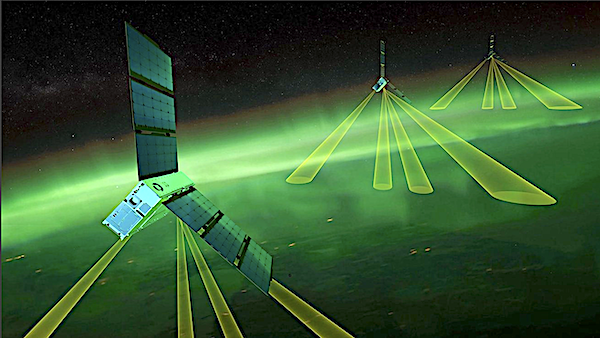
All three spacecraft carry an instrument called the Microwave Electrojet Magnetogram, built by NASA JPL, that will map electrojets to help uncover their structure and evolution.

High above Earth’s poles, intense electrical currents called electrojets flow through the upper atmosphere when auroras glow in the sky. These auroral electrojets push about a million amps of electrical charge around the poles every second. They can create some of the largest magnetic disturbances on the ground, and rapid changes in the currents can lead to effects such as power outages. In March, NASA plans to launch its EZIE (Electrojet Zeeman Imaging Explorer) mission to learn more about these powerful currents, in the hopes of ultimately mitigating the effects of such space weather for humans on Earth.

Results from EZIE will help NASA better understand the dynamics of the Earth-Sun connection and help improve predictions of hazardous space weather that can harm astronauts, interfere with satellites, and trigger power outages.

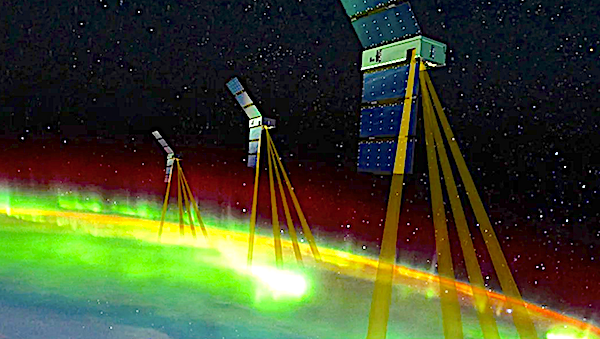
The EZIE mission includes three CubeSats, each about the size of a carry-on suitcase. These small satellites will fly in a string-of-pearls formation, following each other as they orbit Earth from pole to pole about 350 miles (550 kilometers) overhead. The spacecraft will look down toward the electrojets, which flow about 60 miles (100 kilometers) above the ground in an electrified layer of Earth’s atmosphere called the ionosphere.
EZIE Electrojet Zeeman Imaging Explorer

During every orbit, each EZIE spacecraft will map the electrojets to uncover their structure and evolution. The spacecraft will fly over the same region two to 10 minutes apart from one another, revealing how the electrojets change.

Previous ground-based experiments and spacecraft have observed auroral electrojets, which are a small part of a vast electric circuit that extends 100,000 miles (160,000 kilometers) from Earth to space. But for decades, scientists have debated what the overall system looks like and how it evolves. The mission team expects EZIE to resolve that debate.

“What EZIE does is unique,” said Larry Kepko, EZIE mission scientist at NASA’s Goddard Space Flight Center in Greenbelt, Maryland. “EZIE is the first mission dedicated exclusively to studying the electrojets, and it does so with a completely new measurement technique.”

This technique involves looking at microwave emission from oxygen molecules about 10 miles (16 kilometers) below the electrojets. Normally, oxygen molecules emit microwaves at a frequency of 118 gigahertz. However, the electrojets create a magnetic field that can split apart that 118 gigahertz emission line in a process called Zeeman splitting. The stronger the magnetic field, the farther apart the line is split.

Each of the three EZIE spacecraft will carry an instrument called the Microwave Electrojet Magnetogram to observe the Zeeman effect and measure the strength and direction of the electrojets’ magnetic fields. Built by NASA’s Jet Propulsion Laboratory in Southern California, each of these instruments will use four antennas pointed at different angles to survey the magnetic fields along four different tracks as EZIE orbits.

The technology used in the Microwave Electrojet Magnetograms was originally developed to study Earth’s atmosphere and weather systems. Engineers at JPL had reduced the size of the radio detectors so they could fit on small satellites, including NASA’s TEMPEST-D and CubeRRT missions, and improved the components that separate light into specific wavelengths.

The electrojets flow through a region that is difficult to study directly, as it’s too high for scientific balloons to reach but too low for satellites to dwell.

“The utilization of the Zeeman technique to remotely map current-induced magnetic fields is really a game-changing approach to get these measurements at an altitude that is notoriously difficult to measure,” said Sam Yee, EZIE’s principal investigator at the Johns Hopkins Applied Physics Laboratory in Laurel, Maryland.

The mission is also including citizen scientists to enhance its research, distributing dozens of EZIE-Mag magnetometer kits to students in the U.S. and volunteers around the world to compare EZIE’s observations to those from Earth. “EZIE scientists will be collecting magnetic field data from above, and the students will be collecting magnetic field data from the ground,” said Nelli Mosavi, EZIE project manager at APL.

The EZIE spacecraft will launch aboard a SpaceX Falcon 9 rocket from Vandenberg Space Force Base in California as part of the Transporter-13 rideshare mission with SpaceX via launch integrator Maverick Space Systems.

The mission will launch during what’s known as solar maximum — a phase during the 11-year solar cycle when the Sun’s activity is stronger and more frequent. This is an advantage for EZIE’s science.

“It’s better to launch during solar max,” Kepko said. “The electrojets respond directly to solar activity.”

The EZIE mission will also work alongside other NASA heliophysics missions, including PUNCH (Polarimeter to Unify the Corona and Heliosphere) mission, launching in late February to study how material in the Sun’s outer atmosphere becomes the solar wind.

According to Yee, EZIE’s CubeSat mission not only allows scientists to address compelling questions that have not been able to answer for decades but also demonstrates that great science can be achieved cost-effectively.

“We’re leveraging the new capability of CubeSats,” Kepko added. “This is a mission that couldn’t have flown a decade ago. It’s pushing the envelope of what is possible, all on a small satellite. It’s exciting to think about what we will discover.”

The EZIE mission is funded by the Heliophysics Division within NASA’s Science Mission Directorate and is managed by the Explorers Program Office at NASA Goddard. APL leads the mission for NASA. Blue Canyon Technologies in Boulder, Colorado, built the CubeSats.

Written by Vanessa Thomas NASA’s Goddard Space Flight Center, Greenbelt, Maryland, 2025-026

Filed Under: Climate & Environmental Monitoring, Earth Observation & Imaging

Primary Sidebar

Coverage

  • Missions & Constellations
  • Business & Finance
  • Military & Defense
  • Launch
  • Software Automation & Ground Systems
  • Government & Regulation
  • Services & Applications

Most Read Stories

  • SpaceX Finalizes Regulatory Procedures to Close $60 Billion Acquisition of AI Platform Cursor
  • Viasat Advances Equatys D2D Joint Venture Toward Initial Constellation Procurement
  • FCC Opens Proceeding to Unlock 200 MHz of Unlicensed Spectrum for Direct-to-Device Satellite Links
  • AST SpaceMobile Commences Direct-to-Cellular Operations in Japan Alongside Rakuten
  • SpaceX Regulatory Strategy at the FCC: Disruptive Expansion Meets Administrative Oversight

Secondary Sidebar

Footer


Satnews is a leading provider of satellite news, events, publications, research and other satellite industry information in both commercial and military enterprises worldwide.

Stories By Category

  • Business & Finance
  • Government & Regulation
  • Launch
  • Military & Defense
  • Missions & Constellations
  • Services & Applications
  • Software Automation & Ground Systems
  • Spectrum & Licensing
  • Startups & NewSpace Business

About Us

  • Leadership & Editorial Team
  • SatNews History
  • Free Satnews Subscription
  • SatNews Events
  • Magazines

Navigation

  • Latest Stories
  • Magazines
  • Events
  • Contact
  • Cookie & Privacy Policy for Satnews

We use cookies to ensure that we give you the best experience on our website. If you continue to use this site we will assume that you are happy with it.
x
Sign up Now (For Free)
Access daily or weekly satellite news updates covering all aspects of the commercial and military satellite industry.
Invalid email address
Notify Me Regarding ( At least one ):
We value your privacy and will not sell or share your email or other information with any other company. You may also unsubscribe at anytime.

Click Here to see our full privacy policy.
Thanks for subscribing!