

• Skip to primary navigation
  • Skip to main content
  • Skip to primary sidebar
  • Skip to secondary sidebar
  • Skip to footer
  • NEWS:
  • SatNews
  • SatMagazine
  • MilSatMagazine
  • SmallSat News
  • |     EVENTS:
  • SmallSat Symposium
  • Satellite Innovation
  • MilSat Symposium
  • SmallSat Europe

SatNews

Satellite Industry Intelligence Since 1983

Subscribe
  • LATEST
  • Missions & Constellations
    • Exploration & Science Missions
    • In-Orbit Servicing & Orbital Operations
    • LEO Constellations
    • Mission Autonomy & Onboard Systems
    • Mission Deployments & Manifests
    • Navigation & PNT
    • SmallSat
    • Spacecraft & Payload Technology
    View All in Missions & Constellations →
    CAS Space Successfully Launches Kinetica-2, Aiming for Global Cost LeadershipCAS Space Successfully Launches Kinetica-2, Aiming for Global Cost Leadership
    Can SMEs Compete in Starlink-Dominated Space?Can SMEs Compete in Starlink-Dominated Space?
    Liftoff: NASA Successfully Launches Artemis II to the MoonLiftoff: NASA Successfully Launches Artemis II to the Moon
    Spire Global Successfully Deploys Satellite for NGA MagQuest Geomagnetic ChallengeSpire Global Successfully Deploys Satellite for NGA MagQuest Geomagnetic Challenge
  • Business
    • Contracts & Commercial Deals
    • Earnings & Financial Reporting
    • Events & Conferences
    • Funding & Venture Capital
    • Market Forecasts
    • Mergers & Acquisitions
    • Personnel Moves & Appointments
    View All in Business & Finance →
    PMGC Holdings Launches NorthStrive Defense Tech to Capture Drone and Autonomous Systems MarketPMGC Holdings Launches NorthStrive Defense Tech to Capture Drone and Autonomous Systems Market
    Space42 and Viasat: Contract close for 2800 satellitesSpace42 and Viasat: Contract close for 2800 satellites
    L3Harris Taps Mercury Systems for High-Capacity Data Storage on SDA Tranche 3 SatellitesL3Harris Taps Mercury Systems for High-Capacity Data Storage on SDA Tranche 3 Satellites
    Antaris Secures $28M Series A to Advance AI-Powered Satellite Mission PlatformAntaris Secures $28M Series A to Advance AI-Powered Satellite Mission Platform
  • Defense
    • Counterspace & ASAT
    • Defense Budgets & Procurement
    • ISR & Reconnaissance
    • MILSATCOM
    • Missile Warning & Defense
    • National Security Programs
    • Space Domain Awareness
    View All in Military & Defense →
    The Downlink Deficit: The Pentagon’s Optical Mesh Network and the Terrestrial BottleneckThe Downlink Deficit: The Pentagon’s Optical Mesh Network and the Terrestrial Bottleneck
    Declassified National Reconnaissance Office Documents Reveal Early Tensions with Space Shuttle ProgramDeclassified National Reconnaissance Office Documents Reveal Early Tensions with Space Shuttle Program
    SPARC AI Appoints On-Ground Referral Agent in Ukraine to Accelerate Defense EngagementSPARC AI Appoints On-Ground Referral Agent in Ukraine to Accelerate Defense Engagement
    Indra Showcases Sovereign Space and Defense Technologies at FIDAE 2026Indra Showcases Sovereign Space and Defense Technologies at FIDAE 2026
  • Gov
    • Export Controls & Compliance
    • International Space Agreements
    • National Space Policy
    • Space Law & Treaties
    • Space Sustainability & Debris Policy
    • Space Traffic Management / Debris Removal
    View All in Government & Regulation →
    FCC Seeks Comment on Expanding Spectrum Access for “Weird Space Stuff”FCC Seeks Comment on Expanding Spectrum Access for “Weird Space Stuff”
    The FCC Must Choose: Enforce the Rules or Preserve LEO CompetitionThe FCC Must Choose: Enforce the Rules or Preserve LEO Competition
    Space Force Reassigns Final GPS III Mission to SpaceX Following Vulcan AnomalySpace Force Reassigns Final GPS III Mission to SpaceX Following Vulcan Anomaly
    NASA Realignment ‘Ignition’ Accelerates Shift Toward Commercial Lunar EconomyNASA Realignment ‘Ignition’ Accelerates Shift Toward Commercial Lunar Economy
  • Launch
    • Launch Providers
    • Launch Schedule & Calendars
    • Launch Sites & Infrastructure
    • Rocket Technology & Vehicles
    View All in Launch →
    CAS Space Successfully Launches Kinetica-2, Aiming for Global Cost LeadershipCAS Space Successfully Launches Kinetica-2, Aiming for Global Cost Leadership
    Liftoff: NASA Successfully Launches Artemis II to the MoonLiftoff: NASA Successfully Launches Artemis II to the Moon
    AAC Clyde Space Expands Orbital Presence with Transporter-16 LaunchAAC Clyde Space Expands Orbital Presence with Transporter-16 Launch
    Built by Thales Alenia Space for ESA’s Celeste mission, IOD-2 Satellite lifts off today from New ZealandBuilt by Thales Alenia Space for ESA’s Celeste mission, IOD-2 Satellite lifts off today from New Zealand
  • Software
    • Autonomous Ground Operations
    • Data Processing & AI/ML
    • Digital Twins & Modeling
    • Ground Segment & Teleports
    • Mission Planning & Simulation
    • Space Systems Software Engineering
    • Spectrum & Licensing
    View All in Software Automation & Ground Systems →
    The Downlink Deficit: The Pentagon’s Optical Mesh Network and the Terrestrial BottleneckThe Downlink Deficit: The Pentagon’s Optical Mesh Network and the Terrestrial Bottleneck
    NexSat Space Systems Debuts with ACE ‘Invisible’ Aero-Conformal AntennaNexSat Space Systems Debuts with ACE ‘Invisible’ Aero-Conformal Antenna
    Laser Communications and the Rise of Orbital Data CentersLaser Communications and the Rise of Orbital Data Centers
    ThinKom Showcases Modular MILSATCOM Architecture for Contested EnvironmentsThinKom Showcases Modular MILSATCOM Architecture for Contested Environments
  • Services & Apps
    • Climate & Environmental Monitoring
    • Disaster Response & Security Mapping
    • Earth Observation & Imaging
    • Maritime & Aviation Satcom
    • Satellite Communications
    View All in Services & Applications →
    The Downlink Deficit: The Pentagon’s Optical Mesh Network and the Terrestrial BottleneckThe Downlink Deficit: The Pentagon’s Optical Mesh Network and the Terrestrial Bottleneck
    Cinemo Reimagines the Vehicle as a Software-Defined Entertainment HubCinemo Reimagines the Vehicle as a Software-Defined Entertainment Hub
    IEC Telecom Wins CSR Initiative of the Year at the Oil & Gas Middle East Awards 2026IEC Telecom Wins CSR Initiative of the Year at the Oil & Gas Middle East Awards 2026
    Can SMEs Compete in Starlink-Dominated Space?Can SMEs Compete in Starlink-Dominated Space?
  • SatNews Events
  • Magazines
  • Calendar

Swarm satellites use magnetic signals to reveal Earth’s hidden ocean mysteries

January 27, 2025

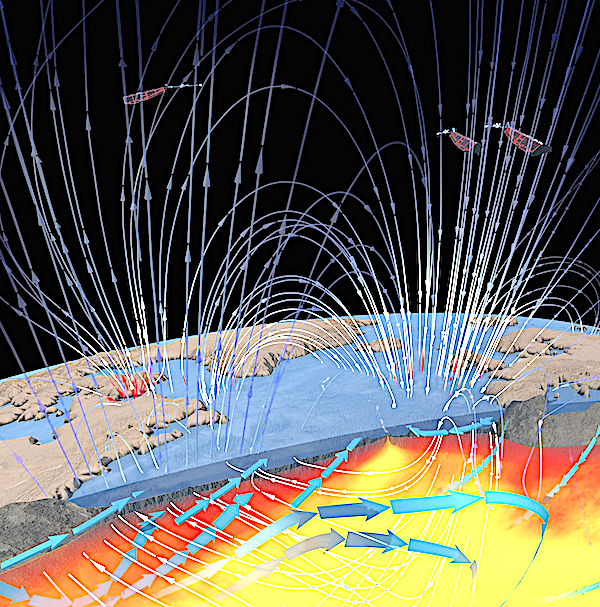
The tidal flows of Earth’s salty seawater across Earth’s magnetic field lines generate electric currents within the ocean. These in turn induce secondary magnetic fields that form part of the planet’s complex magnetic field signal that can be detected from space. ESA’s Swarm satellites can measure these tiny oceanic magnetic fields and distinguish them from other magnetic fields such as those from the core, ionosphere, magnetosphere, and magnetized crust. This data can be used to study the physical properties of suboceanic materials as well as to understand more about the salinity and temperature of our oceans. Credit: Lina Jakaitė

ESA’s Swarm mission, utilizing the faint magnetic signals generated by Earth’s ocean tides, offers groundbreaking insights into undersea magma distribution and potential changes in global ocean temperatures and salinity.

These discoveries, revealed by a long-standing satellite constellation originally launched in 2013, have provided unparalleled data that could transform our understanding of the Earth’s underwater dynamics and its geomagnetic field influences.

Magnetic Oceanography

A recent study using data from ESA’s Swarm mission reveals that faint magnetic signals generated by Earth’s tides could provide valuable insights into the distribution of magma beneath the ocean floor. These signals may also help scientists better understand long-term changes in global ocean temperatures and salinity.

The Swarm mission consists of three satellites dedicated to studying Earth’s geomagnetic field. This protective field, which extends from deep within the planet out into space, is primarily generated by the movement of liquid iron in Earth’s outer core. Additional sources of magnetism come from magnetized rocks within the Earth’s crust.

While oceans are not typically considered sources of magnetism, the salty seawater acts as a moderate electrical conductor. As ocean tides move through Earth’s magnetic field, they generate weak electric currents. These currents, in turn, produce faint magnetic signals — subtle but detectable from space by Swarm’s highly sensitive instruments.
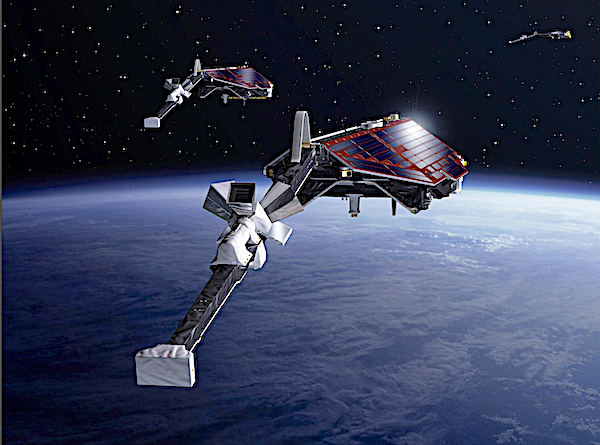
Swarm constellation. Swarm is ESA’s first Earth observation constellation of satellites. Its mission is to unravel one of the most mysterious aspects of our planet: the magnetic field. Credit: ESA–P. Carril, 2013

Advancements in Magnetic Signal Detection

With its satellites flying at an altitude between 462 km and 511 km, Swarm measures Earth’s magnetic field more accurately than ever before. It can detect faint tidal signatures and distinguish them from other stronger magnetic field sources from Earth’s interior.

“This study shows that Swarm can provide data on properties of the entire water column of our oceans,” says Anja Strømme, ESA’s Swarm Mission Manager.

Swarm’s data can also provide insights into the distribution of magma, which could in the future support a better understanding of events such as the Hunga-Tonga volcanic eruption of 2022.

The study of these signatures made the front cover of the world’s oldest scientific journal, Philosophical Transactions of the Royal Society A, and was conducted by a team from the University of Cologne and the Technical University of Denmark.

Extended Mission Benefits and Challenges

The mission, launched in 2013, was only meant to fly for four years but is now in its 12th year. Anja adds: “This is one of the benefits of flying missions for longer than originally planned. So, by flying as long as the scientific output is of excellent quality and resources allow, you can tackle scientific questions that weren’t originally envisaged.”

Swarm is, however, slowly nearing the natural end of its lifespan as drag gradually brings the satellites physically closer to Earth. This has enabled the mission’s instruments — the satellites carry state-of-the-art sensors including magnetometers that measure the strength, magnitude and direction of the magnetic field — to capture faint signals that would be more difficult to detect from the higher orbits at the start of the mission.

Impact of Solar Activity on Magnetic Detection

Swarm’s ability to detect faint ocean signals was also helped by the Sun’s less active period around 2017. “These are among the smallest signals detected by the Swarm mission so far,” says lead author Alexander Grayver, of the University of Cologne.

“The data are particularly good because they were gathered during a period of solar minimum, when there was less noise due to space weather.”

The ‘minimum’ period of the Sun’s 11-year solar cycle is when the Sun’s surface is least active. During this ‘quiet’ period, it emits less solar matter – including electromagnetic radiation and charged particles – so ‘space weather’ phenomena such as the Northern Lights are less frequent. And with less electromagnetic radiation from the Sun, the geomagnetic signals from Earth are more easily detectable by Swarm’s magnetometers and other instruments.

The hope is that, when the next solar minimum comes around after 2030, Swarm might still be flying – albeit at a lower altitude – and will be able to continue detecting the faint signals that can help us understand more about the temperatures and salinity deep within our oceans.

By European Space Agency (ESA)

Filed Under: International Space Agreements

Primary Sidebar

Coverage

  • Missions & Constellations
  • Business & Finance
  • Military & Defense
  • Launch
  • Software Automation & Ground Systems
  • Government & Regulation
  • Services & Applications

Most Read Stories

  • Rheinmetall Withdraws From Mynaric Bidding Process; Rocket Lab Acquisition Clears Major Competitive Hurdle
  • L3Harris Unveils XL-300P: The First P25 Handheld with 5G and Satellite Direct-to-Device Connectivity
  • Rheinmetall Walked Away. Germany Should Take the Hint.
  • Guardians in the Kill Chain: How the Space Force Led the Opening Salvo of Operation Epic Fury
  • Rocket Lab Emerging as Potential Bus Provider for 2,800-Satellite Equatys Constellation

Secondary Sidebar

Footer


Satnews is a leading provider of satellite news, events, publications, research and other satellite industry information in both commercial and military enterprises worldwide.

Stories By Category

  • Business & Finance
  • Government & Regulation
  • Launch
  • Military & Defense
  • Missions & Constellations
  • Services & Applications
  • Software Automation & Ground Systems
  • Spectrum & Licensing
  • Startups & NewSpace Business

About Us

  • Leadership & Editorial Team
  • SatNews History
  • Free Satnews Subscription
  • SatNews Events
  • Magazines

Navigation

  • Latest Stories
  • Magazines
  • Events
  • Contact
  • Cookie & Privacy Policy for Satnews

We use cookies to ensure that we give you the best experience on our website. If you continue to use this site we will assume that you are happy with it.
x
Sign up Now (For Free)
Access daily or weekly satellite news updates covering all aspects of the commercial and military satellite industry.
Invalid email address
Notify Me Regarding ( At least one ):
We value your privacy and will not sell or share your email or other information with any other company. You may also unsubscribe at anytime.

Click Here to see our full privacy policy.
Thanks for subscribing!