

Los Alamos National Laboratory
Updated June 11, 2024,* to reflect new information about the satellite in question and recent UN Security Council Resolutions
What is Russia reported to be working on?
Russia is reported to be working on some sort of anti-satellite (ASAT) system that would use a nuclear explosion to create weapons effects, most likely an electromagnetic pulse (EMP), that would in turn disable or destroy satellites. According to reports, this new capability has not been deployed nor tested, and it does not pose a threat to terrestrial facilities.
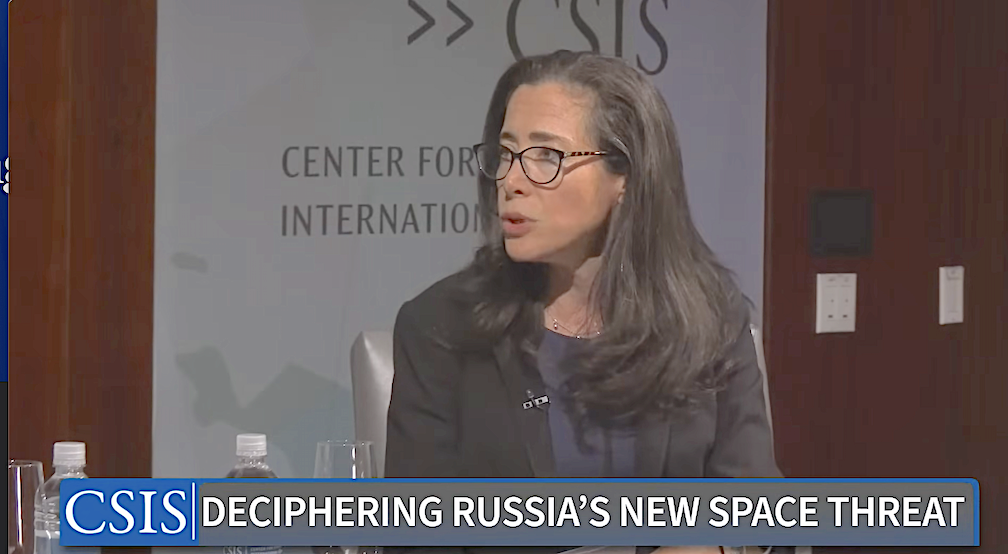
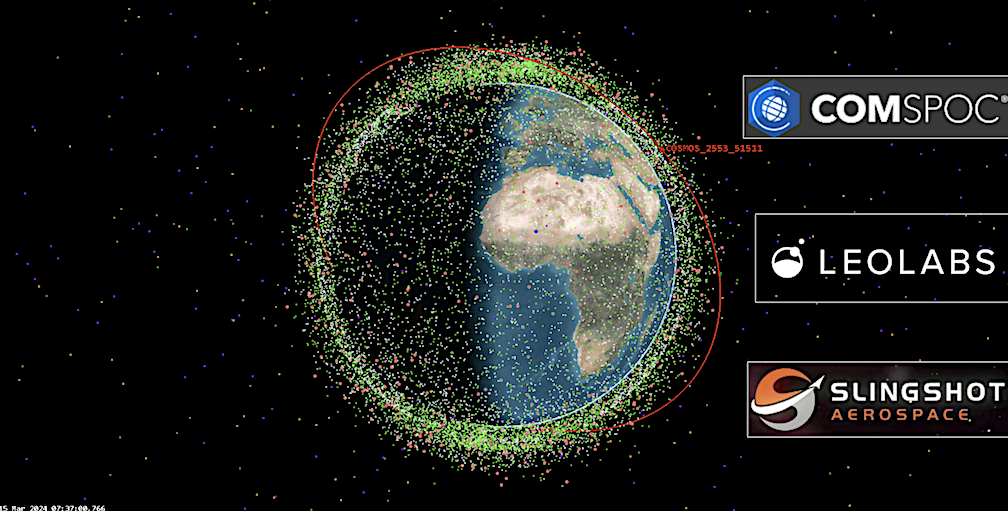
Mallory Stewart of the State Department said in a May 2024 fireside chat at CSIS that the Russian satellite of concern was at a high low Earth orbit; specifically, she noted that the satellite “is in a region not used by any other spacecraft — that in itself was somewhat unusual. And the orbit is in a region of higher radiation than normal lower Earth orbits, but not high enough of a radiation environment to allow accelerated testing of electronics as Russia has described the purpose to be.” With that information, internet sleuths quickly figured out that the satellite in question was COSMOS-2553, launched in February 2022 and currently at an altitude of 2100 kilometers (although some outside experts felt that COSMOS-2553’s primary mission might be as a remote sensing satellite).
Wasn’t there a UN Security Council resolution on this?
Two, actually. The first was sponsored by the United States and Japan (with 65 co-sponsors) in April 2024 and included language that affirmed obligations of the Outer Space Treaty, which prohibits placing nuclear weapons or other weapons of mass destruction in orbit; it additionally called on nations “not to develop nuclear weapons or any other kinds of weapons of mass destruction specifically designed to be placed in orbit around the Earth, or to be installed on celestial bodies, or to be stationed in outer space in any other manner.” It failed to pass when Russia vetoed it; China abstained, and the remaining 13 countries in the UN Security Council voted for it.
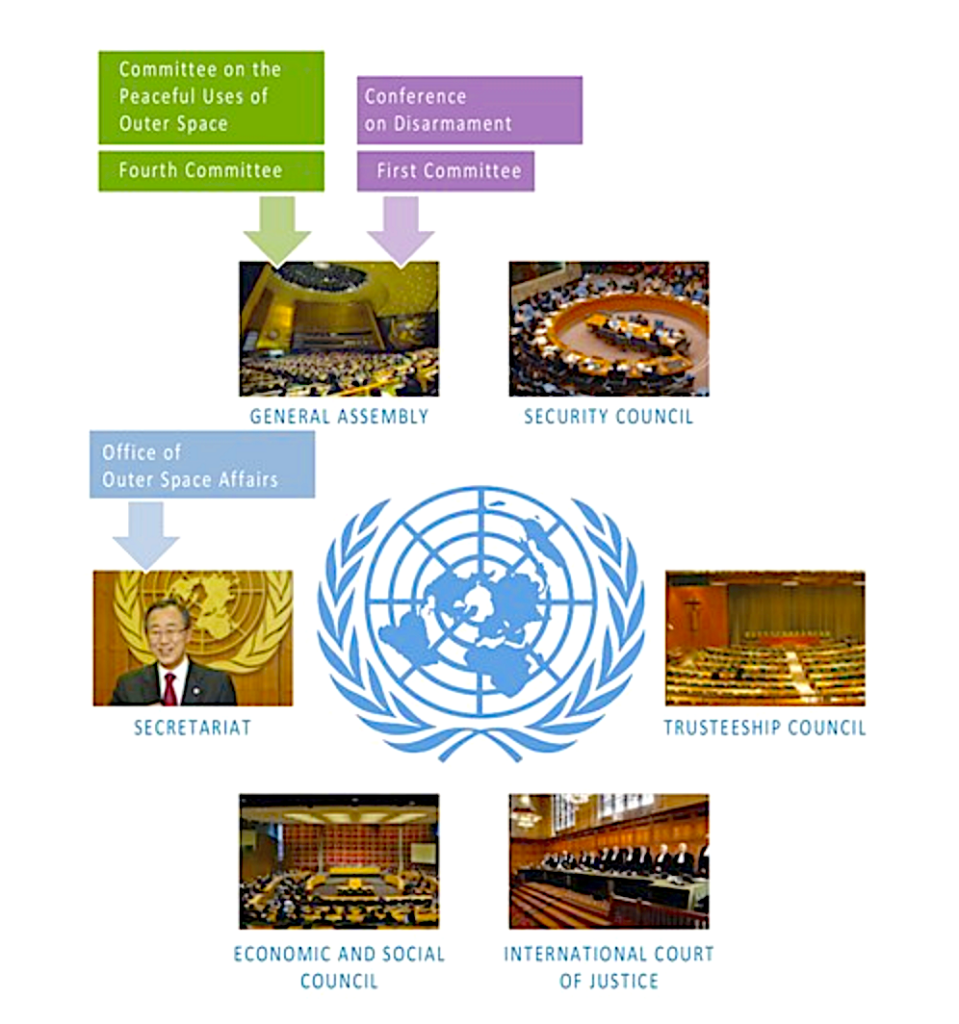
The second UN Security Council resolution was sponsored by Russia in May 2024 (with co-sponsors Belarus, China, Nicaragua, North Korea, and Syria) and called upon states not to place any weapons in space; it used the language in the April 2024 resolution as its starting point (which Russia had vetoed) and added the amendment Russia had proposed at the time (which also failed to pass in the April vote). This resolution also did not pass, with a vote of 7 in favor, 7 against (including vetoes by France, the United Kingdom, and the United States), and one abstention. The United States representative, when discussing this resolution with the other members of the Council, asserted that on “May 16, Russia launched a satellite into low Earth orbit that the United States assesses is likely a counterspace weapon presumably capable of attacking other satellites in low Earth orbit. Russia deployed this new counterspace weapon into the same orbit as a U.S. government satellite.” This is a different satellite — COSMOS 2576 — from the satellite that has been thought to be related to Russia’s developing a nuclear warhead to be placed in space.
Does this violate any treaties?
If Russia were to put a nuclear weapon in orbit, it would very clearly violate the 1967 Outer Space Treaty (OST). Article IV of the OST explicitly prohibits the placement of objects carrying nuclear weapons or any other kinds of weapons of mass destruction in orbit around the Earth. Russia, along with nearly every other spacefaring nation, is a party to the OST.
The Partial Test Ban Treaty (PTBT) also prohibits the testing of nuclear weapons in outer space. Russia has been a signatory of the PTBT since 1963. The PTBT was officially superseded by the 1996 Comprehensive Nuclear Test Ban Treaty (CTBT), the latter of which Russia signed and ratified (and then withdrew its ratification, citing the United States’ own failure to ratify the treaty). States that have not signed the CTBT or have withdrawn from it are still subject to the PTBT.
Ironically, Russia has — with China — been pushing for another treaty called the Prevention of the Placement of Weapons in Outer Space Treaty (PPWT) since 2008 that would prevent placing weapons in outer space or using threats or force against outer space objects. This treaty is still in draft form and is not considered international law, but has been a major part of Russia’s diplomatic efforts within the United Nations over the last fifteen years. Russia has also been pushing for a voluntary No First Placement of Weapons in Outer Space (NFP) pledge since 2004.
What would happen to satellites if a nuclear weapon were to detonate while on orbit?
A lot depends on the size of the warhead and the altitude at which the warhead is set off. When a nuclear weapon is detonated, it produces an electro-magnetic pulse (EMP), “an instantaneous, intense energy field that can overload or disrupt at a distance numerous electrical systems and high technology microcircuits.” When conducted at high altitude, which is roughly anything beyond 30 km above the Earth’s surface, it is denoted as a High-Altitude EMP (HEMP).
There are instantaneous and enduring effects of a HEMP. The instant effect is exposure to X-ray, gamma, and ultraviolet photons from the detonation. These effects occur at the moment of detonation and cause damage to satellites with direct line of sight to the detonations. The protective coatings of affected solar cells will be damaged or destroyed, meaning affected satellites can experience partial or total loss of power generation. The semiconductors in circuits onboard spacecraft will also be damaged, which can cause short circuiting, known as latch-up, where the impacted components burn out and lose functionality. These combined effects could severely damage or completely disable any satellite within line-of-sight. Satellites further away from the blast have a decreased chance for photons to degrade or destroy their components.
The enduring effect from a HEMP is radiation exposure from trapped ionized particles. A HEMP blast releases large amounts of charged particles into space, which can be trapped by the Earth’s magnetic field and significantly amplify the normal Van Allen radiation belts for an extended period of time. Eventually the trapped particles will diffuse, taking roughly 30 days for geosynchronous Earth orbit (GEO, roughly 36,000 km altitude) and nearly 300 days for low Earth orbits (LEO, roughly 100-2000 km in altitude). The greatest risk in LEO is in the first 10-20 days and the first 2-3 days for GEO.

Satellites affected by this extended radiation effect will likely experience a circuitry failure, have degraded power supplies, or both. Circuitry failures could have non-crippling outcomes, such as only losing the functionality of the satellites’ payload. This would be mission-ending for that particular satellite, but the satellite would still be able to safely maneuver or de-orbit. Failure of power generating solar cells could drastically reduce remaining functional time on orbit. This would impact both the duration of the satellite’s mission and could affect maneuverability. In the worst case scenario, stationkeeping or downlink communications circuits may fail, resulting in a lost satellite.
HEMP effects depend on many variables: latitude and altitude of detonation, yield of the atomic explosion, affected layers of the Earth’s magnetic field, and more. Instantaneous and enduring HEMP effects achieve the same outcome: irreversibly compromising or completely disabling mass numbers of satellites on orbit.
Most commercial satellites in LEO and GEO have not been hardened against the radiation that would be released in a nuclear attack. Thus, if there was a nuclear explosion in those orbits, affected satellites in those regions would probably end up being eventually useless. If a nuclear weapon was detonated at the altitude that GPS is at (roughly 20,000 km, or medium Earth orbit), it is hard to say what the consequences would be, as GPS started off life as strictly a military system and to this day carries nuclear detonation detection sensors, so it is plausible it might have been hardened against nuclear attacks.
Exquisite U.S. military intelligence and nuclear command and control satellites are supposed to be hardened against nuclear attack and so they probably would survive the detonation of a nuclear weapon but there is little to no discussion of this in the public literature.
Does Russia have any Cold War history of planning to use nuclear weapons as ASATs?
Perhaps. During the Cold War, the Soviet Union deployed the 51T6 missile defense interceptor, which was part of the A-135 missile defense system. The 51T6 had a nuclear warhead and was designed to destroy incoming warheads outside the atmosphere. It was likely to also have some utility as an ASAT weapon, although it was never tested in that role.
Does the United States have any Cold War history of planning to use nuclear weapons as ASATs?
Yes. In 1962, the United States began development of Program 505, also known as Nike Zeus, which consisted of a modified Nike rocket tipped with a one-megaton nuclear warhead. This was followed by Program 437, which replaced the Nike with a Thor ballistic missile. Program 437 was operational on Johnston Atoll in the South Pacific until the early 1970s.
Have we ever seen the effects of a nuclear explosion on satellites in orbit?
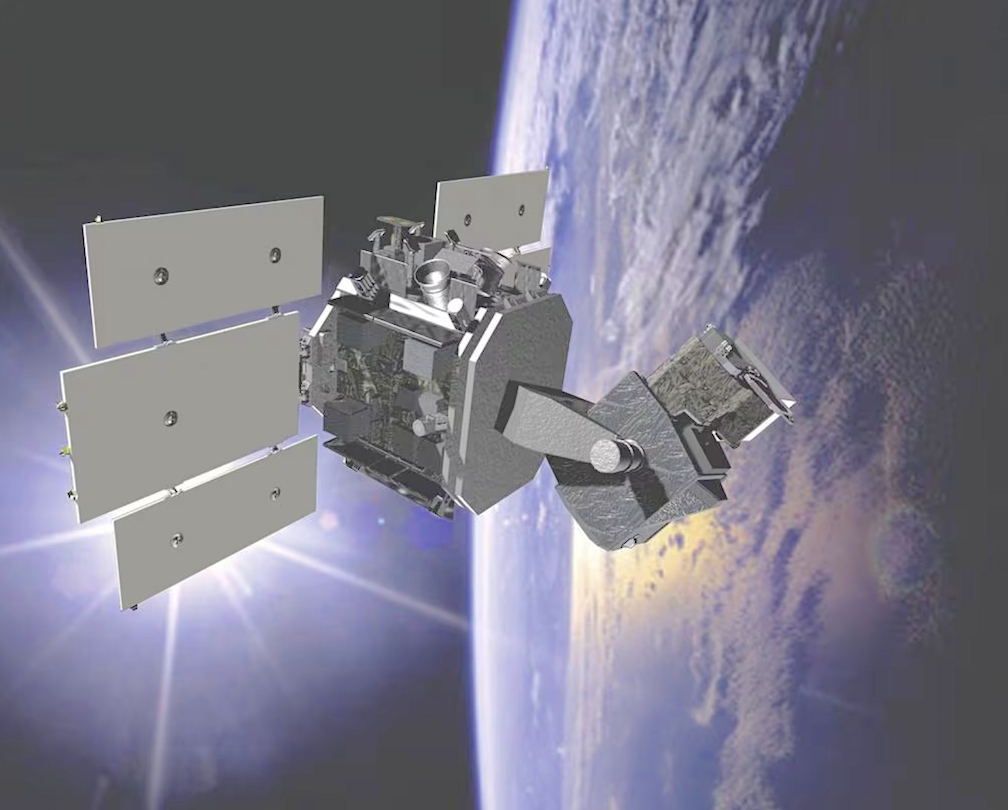
Space Force’s Space-Based Space Surveillance satellites (Boeing)
From 1958-1962, the United States and the USSR both conducted high altitude nuclear explosions (HANE), which varied from 22 km to 540 km in altitude. Together, they conducted around 18 tests (11 by the United States, 7 by the USSR).
The most well-known was a July 1962 test called Starfish Prime, where a 1.4 MT warhead was detonated at an altitude of 400 km above the Johnston Atoll in the Pacific Ocean; the radiation released by it ended up damaging and eventually disabling at least six satellites, which were a significant portion of the active satellites at that time. The EMP it released was bigger than the weapons designers had anticipated; it darkened streetlights over 1,400 km away in Hawaii and created artificial auroras.
Why is this a really bad idea?

Nuclear explosions on orbit are highly escalatory; even during the height of the Cold War, arms control treaties made sure to spell out that national technical means would not be interfered with.

They are indiscriminate: this is not a capability that can be focused on one satellite. Many other satellites would also be harmed by this, including Russian satellites. If the explosion happened in low Earth orbit, people on the International Space Station and the Chinese space station would be in danger as well. Additionally, ground-based telemetry, tracking and command infrastructure could also be held at risk, depending on where above the Earth the HANE is detonated.
* This is an updated version of the original FAQ on this topic, which was published April 14, 2024.
By Victoria Samson, SWF Chief Director, Space Security and Stability, and Seth Walton, SWF Program Assistant
