

• Skip to primary navigation
  • Skip to main content
  • Skip to primary sidebar
  • Skip to secondary sidebar
  • Skip to footer
  • NEWS:
  • SatNews
  • SatMagazine
  • MilSatMagazine
  • SmallSat News
  • |     EVENTS:
  • SmallSat Symposium
  • Satellite Innovation
  • MilSat Symposium
  • SmallSat Europe

SatNews

Satellite Industry Intelligence Since 1983

Subscribe
  • LATEST
  • SatNews Events
  • Magazines
  • Calendar
  • Subscribe
  • Missions & Constellations
    • Exploration & Science Missions
    • In-Orbit Servicing & Orbital Operations
    • LEO Constellations
    • Mission Autonomy & Onboard Systems
    • Mission Deployments & Manifests
    • Navigation & PNT
    • SmallSat
    • Spacecraft & Payload Technology
    View All in Missions & Constellations →
    Iridium Unveils Core Role in Artemis II and Next-Gen PNT at Space Symposium 2026Iridium Unveils Core Role in Artemis II and Next-Gen PNT at Space Symposium 2026
    Boeing and Millennium Unveil Resolute Mid-Class Satellite PlatformBoeing and Millennium Unveil Resolute Mid-Class Satellite Platform
    NASA Shifts Focus to Permanent Lunar Base and Nuclear PropulsionNASA Shifts Focus to Permanent Lunar Base and Nuclear Propulsion
    Kepler and Astrolight Secure ESA Contract for HydRON Optical NetworkKepler and Astrolight Secure ESA Contract for HydRON Optical Network
  • Business
    • Contracts & Commercial Deals
    • Earnings & Financial Reporting
    • Events & Conferences
    • Funding & Venture Capital
    • Market Forecasts
    • Mergers & Acquisitions
    • Personnel Moves & Appointments
    View All in Business & Finance →
    Geographic Hotspots: Where Demand Is AcceleratingGeographic Hotspots: Where Demand Is Accelerating
    SmallSat Europe Speaker Focus: Martin Langer, OroraTechSmallSat Europe Speaker Focus: Martin Langer, OroraTech
    SmallSat Europe Speaker Focus: Jaume Sanpera, SateliotSmallSat Europe Speaker Focus: Jaume Sanpera, Sateliot
    Ericsson Initiates SEK 15 Billion Share Buyback ProgramEricsson Initiates SEK 15 Billion Share Buyback Program
  • Defense
    • Counterspace & ASAT
    • Defense Budgets & Procurement
    • ISR & Reconnaissance
    • MILSATCOM
    • Missile Warning & Defense
    • National Security Programs
    • Space Domain Awareness
    View All in Military & Defense →
    Saltzman Unveils 2040 Blueprint to Scale Space Force for Great Power CompetitionSaltzman Unveils 2040 Blueprint to Scale Space Force for Great Power Competition
    The Rise of Grey Zone Satellites: Ambiguity as a Tactical AdvantageThe Rise of Grey Zone Satellites: Ambiguity as a Tactical Advantage
    SmallSat Europe Speaker Focus: Col. Marcin Mazur, Polish Space AgencySmallSat Europe Speaker Focus: Col. Marcin Mazur, Polish Space Agency
    US Space Force Awards $68.6M Modification to Lockheed Martin for Next-Gen OPIRUS Space Force Awards $68.6M Modification to Lockheed Martin for Next-Gen OPIR
  • Gov
    • Export Controls & Compliance
    • International Space Agreements
    • National Space Policy
    • Space Law & Treaties
    • Space Sustainability & Debris Policy
    • Space Traffic Management / Debris Removal
    View All in Government & Regulation →
    SmallSat Europe Speaker Focus: Chris Quilty, Quilty SpaceSmallSat Europe Speaker Focus: Chris Quilty, Quilty Space
    NRL to Showcase Sovereign Space Capabilities at 41st Space SymposiumNRL to Showcase Sovereign Space Capabilities at 41st Space Symposium
    FCC Modernizes Satellite Spectrum Rules to Unleash Next-Generation BroadbandFCC Modernizes Satellite Spectrum Rules to Unleash Next-Generation Broadband
    SmallSat Europe Speaker Focus: Daniel Bock, Morpheus SpaceSmallSat Europe Speaker Focus: Daniel Bock, Morpheus Space
  • Launch
    • Launch Providers
    • Launch Schedule & Calendars
    • Launch Sites & Infrastructure
    • Rocket Technology & Vehicles
    View All in Launch →
    Ensign-Bickford Hardware Supports Successful Artemis II Lunar MissionEnsign-Bickford Hardware Supports Successful Artemis II Lunar Mission
    China Accelerates Orbital Internet Deployment with Successful Smart Dragon-3 Sea LaunchChina Accelerates Orbital Internet Deployment with Successful Smart Dragon-3 Sea Launch
    What the SpaceX IPO Changes for Every Satellite OperatorWhat the SpaceX IPO Changes for Every Satellite Operator
    €30 million Financing for PLD Space’s Small Satellite Launcher€30 million Financing for PLD Space’s Small Satellite Launcher
  • Software
    • Autonomous Ground Operations
    • Data Processing & AI/ML
    • Digital Twins & Modeling
    • Ground Segment & Teleports
    • Mission Planning & Simulation
    • Space Systems Software Engineering
    • Spectrum & Licensing
    View All in Software Automation & Ground Systems →
    Blue Origin Unveils Project Quartz Global Ground Station NetworkBlue Origin Unveils Project Quartz Global Ground Station Network
    Cloudcomputing Targets 1.5M Identities in Spain and Finalizes Innovate IT AcquisitionCloudcomputing Targets 1.5M Identities in Spain and Finalizes Innovate IT Acquisition
    Archangel Lightworks Secures £10M Series A to Scale Optical Ground InfrastructureArchangel Lightworks Secures £10M Series A to Scale Optical Ground Infrastructure
    Keysight and Sateliot Win ESA and GSMA Foundry Challenge for 6G InnovationKeysight and Sateliot Win ESA and GSMA Foundry Challenge for 6G Innovation
  • Services & Apps
    • Climate & Environmental Monitoring
    • Disaster Response & Security Mapping
    • Earth Observation & Imaging
    • Maritime & Aviation Satcom
    • Satellite Communications
    View All in Services & Applications →
    NASA Targets Commercial Relays to Replace Aging TDRSS InfrastructureNASA Targets Commercial Relays to Replace Aging TDRSS Infrastructure
    OQ Technology Awarded ESA Contract to Adapt 5G Beamforming for SpaceOQ Technology Awarded ESA Contract to Adapt 5G Beamforming for Space
    Kraken Robotics Integrates KATFISH Sonar on SEFINE RD-22 USV Following Multi-Naval DemonstrationsKraken Robotics Integrates KATFISH Sonar on SEFINE RD-22 USV Following Multi-Naval Demonstrations
    Astroscale Plans World-First Multi-Orbit Satellite Inspection MissionAstroscale Plans World-First Multi-Orbit Satellite Inspection Mission

Airbus-built TEXUS sounding rockets launched to conduct experiments in microgravity

March 26, 2024

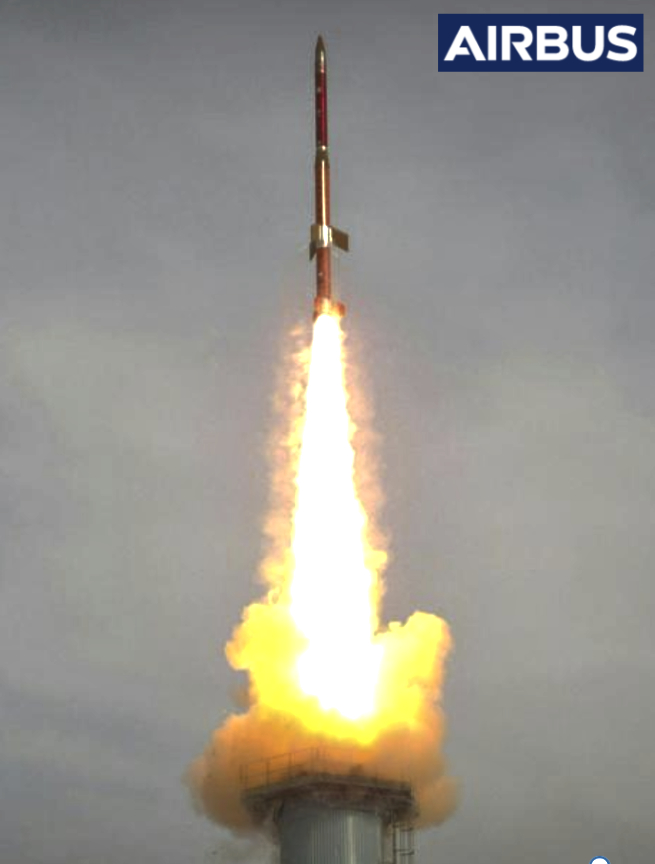
The TEXUS 60 rocket was successfully launched by Airbus on Sunday, March 24, at 10:45 CET, from Esrange Space Centre in Kiruna, Sweden — the rocket reached an apogee of 251 km and provided 362 seconds of microgravity time.
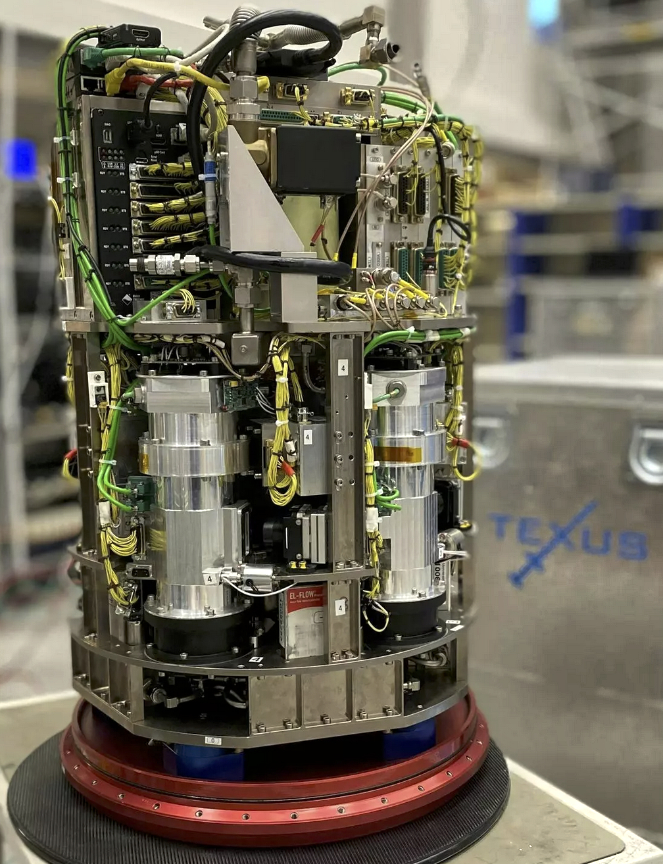
TEXUS 60 sounding rocket engine. Photo is courtesy of Airbus.

The payloads on board included two DLR experiments for the German Aerospace Center (DLR), called Simona and GECO, as well as a joint experiment of DLR and the Japanese Space Agency (JAXA), called Phoenix 2.
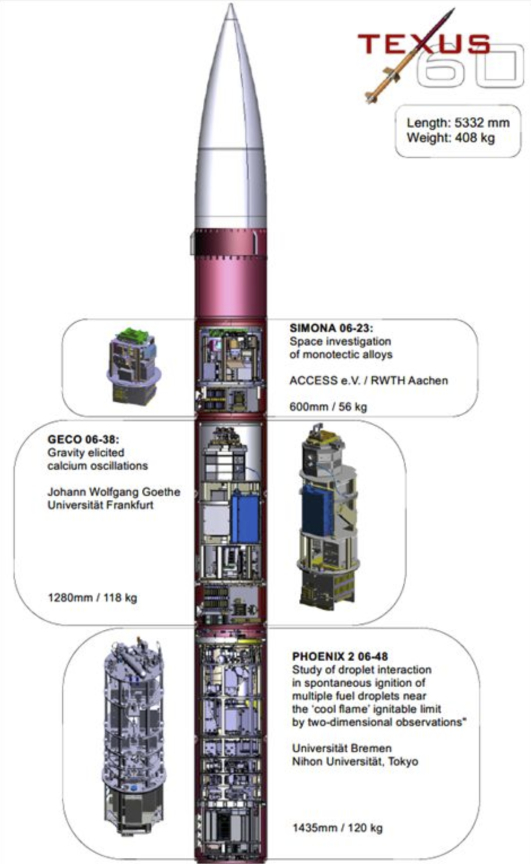
During a microgravity time period of six minutes, Simona performed an experiment to study specific reactions of liquid alloys in microgravity to enhance advanced materials for car engine bearings, while GECO recorded calcium interaction with microgravity in plants to expand our knowledge about plant cultivation to ensure, for instance, a food source in space.

Finally, Phoenix 2 got deeper into droplet interaction in spontaneous ignition of multiple fuel droplets that will lead to a better understanding of liquid spray combustion which is employed in industrial furnaces, boilers, gas turbines, diesels, spark-ignition, and rocket engines.

Previously, the TEXUS 59 rocket was successfully launched from Esrange on February 15th carrying two ESA experiments, Safari and T-REX , and one DLR experiment, Topoflame, on board. 

Safari, for example, aimed to  study the growth of crystals that can lead to improvements in drug development to better understand the function of molecules that are important in health and disease, and agricultural solutions that better protect crops and enhance plant growth on Earth. T-REX, studying different behavior of immune system cells under microgravity. Its findings could help to understand the biological process that allows a cell or an organism to respond to a variety of signals since this is one of the leading causes in various human diseases. More than fifty percent of cancers arise due to frequent mutations in genes.

The last experiment aboard TEXUS 59 was Topoflame, aimed to understand the insights of fire safety in astronautical spaceflight, studying flame propagation along solid fuels. Planned space exploration missions raise concerns about fire safety and propagation under conditions of reduced gravity. 

These launches represent a double success generating an enormous amount of data to support scientists.

Airbus is in charge of the development of the TEXUS rockets, from the mission concept and engine procurement to the data recovery. The average weight of a TEXUS payload is around 350 kg.

Airbus engineers from different disciplines develop, integrate and test the experimental equipment. In collaboration with customers and scientific teams, they establish experimental concepts. Breadboard tests are conducted to support design decisions. Depending on the results, further tests may be required to determine or verify critical parameters of the experiment before launch. Design reviews with customers ensure that their requirements are fully met.

Finally, the experimental equipment is integrated, tested at various stages and verified. All this goes hand-in-hand with the development of the ground support systems needed to control the experiments during the test phase in Bremen and during the flight from Esrange.

Before transferring all flight hardware and ground systems to Esrange, a flight system acceptance review is organized with customers, which also covers the contributions of subcontractors: the service system (communication between the experiments and the ground station), the recovery system (parachutes), the rocket engines (solid propellant) and the readiness of the facilities at Esrange.

Sounding rockets – also known as research rockets – launch scientific and technological experiments to the edge of space before falling back to Earth. Put simply, TEXUS helps scientists conduct biological, material science and physical experiments under microgravity conditions. The program also plays an important role in preparing experiments for the International Space Station (ISS). 

In ballistic flight, a TEXUS rocket reaches a peak altitude of about 260 kilometers. The flight, from lift-off to landing, takes about 15 minutes. As it falls freely, the experiments inside experience weightlessness for a duration of six minutes, which is only about one ten thousandth of the Earth’s normal gravity. During these six minutes of valuable research time, the scientists can directly control and monitor their experiments from the ground using telecommand and video transmission. The data is collected during the flight by telemetry and after recovery of the payload. The rocket’s payload lands by parachute and is recovered by helicopter with the support of Airbus and the Swedish Space Corporation, Esrange’s operator.
In gravitational biology, for instance, the role of gravity for cellular growth, development, reproduction, movement, orientation and other physiological processes, as well as the mechanisms of adaptation and compensation, are investigated. In bioprocessing, cell fusion and cell cultivation techniques are investigated. Also, growth of high-quality monocrystals of biological macromolecules for crystal structure analysis; or rapid technological processes such as electrophoresis and electrofusion can be performed. These are only some of the research areas studied that ultimately translate into tangible benefits for society.

As they never enter orbit, sounding rockets do not require extreme propulsion or telemetry and tracking coverage. The costs of the rocket are shared between 2, 3 or 4 research centers that provide their experiments. In addition, they serve as a test bed for future innovations that will go on board satellites or even the Space Station.

The payload can be developed in a short time frame of 6 to 18 months. Moreover, with such a short development time, the latest technology can be incorporated into its experiments. It also offers a very fast response capability, e.g. to arrive in time to study cosmological phenomena, such as the effects of an extreme solar flare on the auroras’ behavior. 

Investigators are directly involved in developing the hardware, and in the preparation and execution of the experiment. Remote operation of the experiment can be done directly by the scientist during flight via telecommand and the support of adequate laboratory facilities at the launch site. Sounding rockets offer the possibility of conducting a series of periodical investigations for rapid verification of data used to prepare experiments that will later be implemented on the ISS.

TEXUS (Technological Experiments in Zero Gravity) is the world’s most successful and longest lasting sounding rocket program – the first TEXUS rocket was launched in December of 1977. Customers include the European Space Agency and the German Aerospace Center (DLR) working together with various research institutes and universities around the world.

Filed Under: International Space Agreements, Launch

Primary Sidebar

Coverage

  • Missions & Constellations
  • Business & Finance
  • Military & Defense
  • Launch
  • Software Automation & Ground Systems
  • Government & Regulation
  • Services & Applications

Most Read Stories

  • SpaceX Loses Contact With Starlink Satellite
  • Rocket Lab Emerging as Potential Bus Provider for 2,800-Satellite Equatys Constellation
  • SpaceX Accelerates Record-Breaking IPO Following Trillion-Dollar xAI Merger
  • Planet Labs Imposes Indefinite Blackout on Iran Satellite Imagery at U.S. Request
  • Amazon in Reported Talks to Acquire Globalstar in $9 Billion Move to Challenge Starlink

Secondary Sidebar

Footer


Satnews is a leading provider of satellite news, events, publications, research and other satellite industry information in both commercial and military enterprises worldwide.

Stories By Category

  • Business & Finance
  • Government & Regulation
  • Launch
  • Military & Defense
  • Missions & Constellations
  • Services & Applications
  • Software Automation & Ground Systems
  • Spectrum & Licensing
  • Startups & NewSpace Business

About Us

  • Leadership & Editorial Team
  • SatNews History
  • Free Satnews Subscription
  • SatNews Events
  • Magazines

Navigation

  • Latest Stories
  • Magazines
  • Events
  • Contact
  • Cookie & Privacy Policy for Satnews

We use cookies to ensure that we give you the best experience on our website. If you continue to use this site we will assume that you are happy with it.
x
Sign up Now (For Free)
Access daily or weekly satellite news updates covering all aspects of the commercial and military satellite industry.
Invalid email address
Notify Me Regarding ( At least one ):
We value your privacy and will not sell or share your email or other information with any other company. You may also unsubscribe at anytime.

Click Here to see our full privacy policy.
Thanks for subscribing!