

• Skip to primary navigation
  • Skip to main content
  • Skip to primary sidebar
  • Skip to secondary sidebar
  • Skip to footer
  • NEWS:
  • SatNews
  • SatMagazine
  • MilSatMagazine
  • SmallSat News
  • |     EVENTS:
  • SmallSat Symposium
  • Satellite Innovation
  • MilSat Symposium
  • SmallSat Europe

SatNews

Satellite Industry Intelligence Since 1983

Subscribe
  • LATEST
  • Missions & Constellations
    • Exploration & Science Missions
    • In-Orbit Servicing & Orbital Operations
    • LEO Constellations
    • Mission Autonomy & Onboard Systems
    • Mission Deployments & Manifests
    • Navigation & PNT
    • SmallSat
    • Spacecraft & Payload Technology
    View All in Missions & Constellations →
    General Galactic to Demonstrate Water-Powered “Genesis” Propulsion on 2026 Trinity MissionGeneral Galactic to Demonstrate Water-Powered “Genesis” Propulsion on 2026 Trinity Mission
    The Barcelona two-step reveals tough competitionThe Barcelona two-step reveals tough competition
    SES Activates Latest O3b mPOWER Satellites; Constellation Reaches 10-Unit Operational MilestoneSES Activates Latest O3b mPOWER Satellites; Constellation Reaches 10-Unit Operational Milestone
    Mynaric Secures ESA HydRON Element 3 Contract for High-Throughput Optical User SegmentMynaric Secures ESA HydRON Element 3 Contract for High-Throughput Optical User Segment
  • Business
    • Contracts & Commercial Deals
    • Earnings & Financial Reporting
    • Events & Conferences
    • Funding & Venture Capital
    • Market Forecasts
    • Mergers & Acquisitions
    • Personnel Moves & Appointments
    View All in Business & Finance →
    Vast Secures $500M in Series A and Debt Financing to Accelerate Commercial Space Station ProductionVast Secures $500M in Series A and Debt Financing to Accelerate Commercial Space Station Production
    Terran Orbital Names Kwon Park Senior Director of Manufacturing Operations to Lead Production ScalingTerran Orbital Names Kwon Park Senior Director of Manufacturing Operations to Lead Production Scaling
    The Barcelona two-step reveals tough competitionThe Barcelona two-step reveals tough competition
    SatNews Launches New Website: 52,000 Stories, Zero Left BehindSatNews Launches New Website: 52,000 Stories, Zero Left Behind
  • Defense
    • Counterspace & ASAT
    • Defense Budgets & Procurement
    • ISR & Reconnaissance
    • MILSATCOM
    • Missile Warning & Defense
    • National Security Programs
    • Space Domain Awareness
    View All in Military & Defense →
    Guardians in the Kill Chain: How the Space Force Led the Opening Salvo of Operation Epic FuryGuardians in the Kill Chain: How the Space Force Led the Opening Salvo of Operation Epic Fury
    BlackSky Awarded $99M Air Force Contract for Advanced Optical Testbed; Lockheed Martin Expands Missile ProductionBlackSky Awarded $99M Air Force Contract for Advanced Optical Testbed; Lockheed Martin Expands Missile Production
    Space Development Agency Faces “Growing Pains” as PWSA Scaling Hits ChokepointsSpace Development Agency Faces “Growing Pains” as PWSA Scaling Hits Chokepoints
    Sierra Space Secures $550 Million Series C to Scale Defense-Tech and Dream Chaser OperationsSierra Space Secures $550 Million Series C to Scale Defense-Tech and Dream Chaser Operations
  • Gov
    • Export Controls & Compliance
    • International Space Agreements
    • National Space Policy
    • Space Law & Treaties
    • Space Sustainability & Debris Policy
    • Space Traffic Management / Debris Removal
    View All in Government & Regulation →
    The Iran Precedent: Operation Epic Fury and the Law of Armed Conflict in SpaceThe Iran Precedent: Operation Epic Fury and the Law of Armed Conflict in Space
    Geopolitical Scrutiny: The Strategic Implications of APT Satellite’s Chinese State OwnershipGeopolitical Scrutiny: The Strategic Implications of APT Satellite’s Chinese State Ownership
    Sovereign Checkpoints and Debt CliffsSovereign Checkpoints and Debt Cliffs
    Securing the Future of the Orbital EnvironmentSecuring the Future of the Orbital Environment
  • Launch
    • Launch Providers
    • Launch Schedule & Calendars
    • Launch Sites & Infrastructure
    • Rocket Technology & Vehicles
    View All in Launch →
    Times Microwave Systems Launches Levitate™ Ultra-Lightweight Cables for UAV and Defense AvionicsTimes Microwave Systems Launches Levitate™ Ultra-Lightweight Cables for UAV and Defense Avionics
    Blue Origin Accelerates New Glenn 9×4 Production and TeraWave Constellation DevelopmentBlue Origin Accelerates New Glenn 9×4 Production and TeraWave Constellation Development
    PLD Space Secures €180 Million Series C Led by Mitsubishi Electric to Scale MIURA 5 ProductionPLD Space Secures €180 Million Series C Led by Mitsubishi Electric to Scale MIURA 5 Production
    SpaceX Lunar Manufacturing Proposal Triggers Surge in APT Satellite SharesSpaceX Lunar Manufacturing Proposal Triggers Surge in APT Satellite Shares
  • Software
    • Autonomous Ground Operations
    • Data Processing & AI/ML
    • Digital Twins & Modeling
    • Ground Segment & Teleports
    • Mission Planning & Simulation
    • Space Systems Software Engineering
    • Spectrum & Licensing
    View All in Software Automation & Ground Systems →
    Danish Army Selects BAE Systems OneArc for 7-Year Simulation Modernization ProgramDanish Army Selects BAE Systems OneArc for 7-Year Simulation Modernization Program
    a.i. solutions Partners with USGS to Integrate AI into Landsat Flight Operationsa.i. solutions Partners with USGS to Integrate AI into Landsat Flight Operations
    Orbital Edge AI: Axelera AI and ESA Partner to Standardize Space-Based InferenceOrbital Edge AI: Axelera AI and ESA Partner to Standardize Space-Based Inference
    Rohde & Schwarz and Qualcomm Validate Advanced 5×5 MIMO for Wi-Fi 8 NetworkingRohde & Schwarz and Qualcomm Validate Advanced 5×5 MIMO for Wi-Fi 8 Networking
  • Services & Apps
    • Climate & Environmental Monitoring
    • Disaster Response & Security Mapping
    • Earth Observation & Imaging
    • Maritime & Aviation Satcom
    • Satellite Communications
    View All in Services & Applications →
    a.i. solutions Partners with USGS to Integrate AI into Landsat Flight Operationsa.i. solutions Partners with USGS to Integrate AI into Landsat Flight Operations
    Axian Telecom and AST SpaceMobile to Launch Africa’s First Direct-to-Device Mobile NetworkAxian Telecom and AST SpaceMobile to Launch Africa’s First Direct-to-Device Mobile Network
    The Iran Precedent: Operation Epic Fury and the Law of Armed Conflict in SpaceThe Iran Precedent: Operation Epic Fury and the Law of Armed Conflict in Space
    Planet Labs Imagery Verifies Smoke over Central Tehran Following Leadership StrikesPlanet Labs Imagery Verifies Smoke over Central Tehran Following Leadership Strikes
  • SatNews Events
  • Magazines
  • Calendar
  • Jobs

DART Team Confirms Orbit of Targeted Asteroid

August 29, 2022

Using some of the world’s most powerful telescopes, the DART investigation team last month completed a six-night observation campaign to confirm earlier calculations of the orbit of Dimorphos—DART’s asteroid target—around its larger parent asteroid, Didymos, confirming where the asteroid is expected to be located at the time of impact. DART, which is the world’s first attempt to change the speed and path of an asteroid’s motion in space, tests a method of asteroid deflection that could prove useful if such a need arises in the future for planetary defense. 
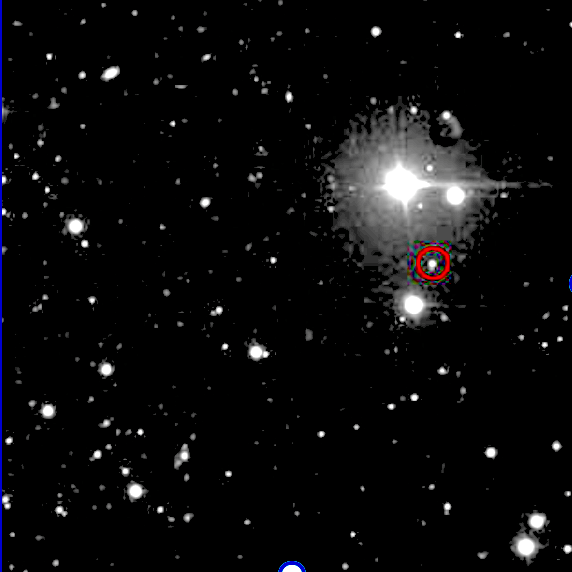
On the night of July 7, 2022, the Lowell Discovery Telescope near Flagstaff, Arizona captured this sequence in which the asteroid Didymos, located near the center of the screen, moves across the night sky. The sequence is sped up by about 900 times. Scientists used this and other observations from the July campaign to confirm Dimorphos’ orbit and anticipated location at the time of DART’s impact.
Credits: Lowell Observatory/N. Moskovitz

On the night of July 7, 2022, the Lowell Discovery Telescope near Flagstaff, Arizona captured this sequence in which the asteroid Didymos, located near the center of the screen, moves across the night sky. The sequence is sped up by about 900 times. Scientists used this and other observations from the July campaign to confirm Dimorphos’ orbit and anticipated location at the time of DART’s impact. Credits: Lowell Observatory/N. Moskovitz

“The measurements the team made in early 2021 were critical for making sure that DART arrived at the right place and the right time for its kinetic impact into Dimorphos,” said Andy Rivkin, the DART investigation team co-lead at the Johns Hopkins University Applied Physics Laboratory (APL) in Laurel, Maryland. “Confirming those measurements with new observations shows us that we don’t need any course changes and we’re already right on target.”
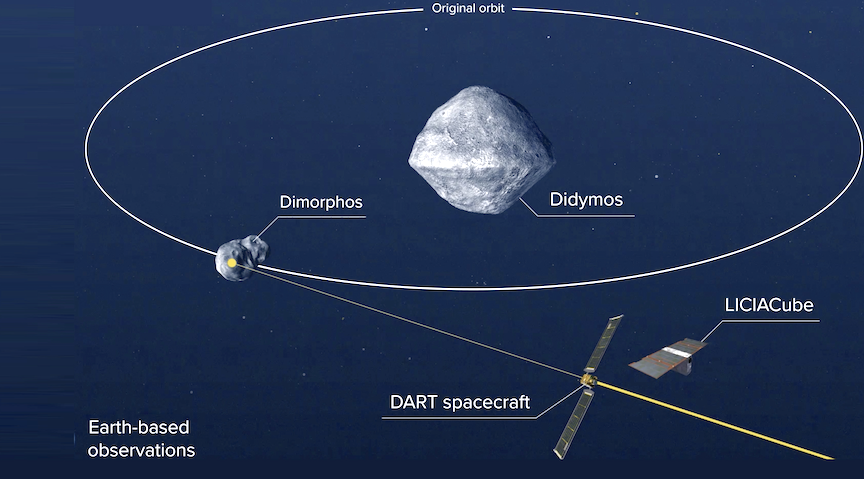
DART’s Mission Objectives:
Demonstrate a kinetic impact with Dimorphos.
Change the binary orbital period of Dimorphos.
Use ground-based telescope observations to measure Dimorphos’ period change before and after impact.
Measure the effects of the impact and resulting ejecta on Dimorphos.

However, understanding the dynamics of Dimorphos’ orbit is important for reasons beyond ensuring DART’s impact. If DART succeeds in altering Dimorphos’ path, the moonlet will move closer toward Didymos, shortening the time it takes to orbit it. Measuring that change is straightforward, but scientists need to confirm that nothing other than the impact is affecting the orbit. This includes subtle forces such as radiation recoil from the asteroid’s Sun-warmed surface, which can gently push on the asteroid and cause its orbit to change. 

“The before-and-after nature of this experiment requires exquisite knowledge of the asteroid system before we do anything to it,” said Nick Moskovitz, an astronomer with Lowell Observatory in Flagstaff, Arizona, and co-lead of the July observation campaign. “We don’t want to, at the last minute, say, ‘Oh, here’s something we hadn’t thought about or phenomena we hadn’t considered.’ We want to be sure that any change we see is entirely due to what DART did.”

In late September to early October, around the time of DART’s impact, Didymos and Dimorphos will make their closest approach to Earth in recent years at approximately 6.7 million miles (10.8 million kilometers) away. Since March 2021 the Didymos system had been out of range of most ground-based telescopes because of its distance from Earth, but early this July the DART Investigation Team employed powerful telescopes in Arizona and Chile — the Lowell Discovery Telescope at Lowell Observatory, the Magellan Telescope at Las Campanas Observatory and the Southern Astrophysical Research (SOAR) Telescope — to observe the asteroid system and look for changes in its brightness. These changes, called “mutual events,” occur when one of the asteroids passes in front of the other because of Dimorphos’ orbit, blocking some of the light they emit.   

“It was a tricky time of year to get these observations,” said Moskovitz. In the Northern Hemisphere, the nights are short, and it is monsoon season in Arizona. In the Southern Hemisphere, the threat of winter storms loomed. In fact, just after the observation campaign, a snowstorm hit Chile, prompting evacuations from the mountain where SOAR is located. The telescope was then shut down for close to ten days. “We asked for six half-nights of observation with some expectation that about half of those would be lost to weather, but we only lost one night. We got really lucky.”

In all, the team was able to extract from the data the timing of 11 new mutual events. Studying those changes in brightness enabled scientists to determine precisely how long it takes Dimorphos to orbit the larger asteroid and thereby predict where Dimorphos will be located at specific moments in time, including when DART makes impact. The results were consistent with previous calculations.

“We really have high confidence now that the asteroid system is well understood and we are set up to understand what happens after impact,” Moskovitz said.  

Not only did this observation campaign enable the team to confirm Dimorphos’ orbital period and expected location at time of impact, but it also allowed team members to refine the process they will use to determine whether DART successfully changed Dimorphos’s orbit post-impact, and by how much. 

n October, the team will again use ground-based telescopes around the world to look for mutual events and calculate Dimorphos’ new orbit, expecting that the time it takes the smaller asteroid to orbit Didymos will have shifted by several minutes. These observations will also help constrain theories that scientists around the world have put forward about Dimorphos’ orbit dynamics and the rotation of both asteroids.

Johns Hopkins APL manages the DART mission for NASA’s Planetary Defense Coordination Office as a project of the agency’s Planetary Missions Program Office. DART is the world’s first planetary defense test mission, intentionally executing a kinetic impact into Dimorphos to slightly change its motion in space. While neither asteroid poses a threat to Earth, the DART mission will demonstrate that a spacecraft can autonomously navigate to a kinetic impact on a relatively small target asteroid and that this is a viable technique to deflect an asteroid on a collision course with Earth if one is ever discovered. DART will reach its target on Sept. 26, 2022.

From NASA’s DART mission

Filed Under: Exploration & Science Missions, Government & Regulation

Primary Sidebar

Coverage

  • Missions & Constellations
  • Business & Finance
  • Military & Defense
  • Launch
  • Software Automation & Ground Systems
  • Government & Regulation
  • Services & Applications

Most Read Stories

  • Global Shift Toward Sovereign Launch Gains Momentum Amid Geopolitical Tensions
  • SES Executive Confirms End of the 15-Year Satellite Era
  • SpaceX Unveils ‘Stargaze’ System to Revolutionize Space Traffic Management
  • The Space Data Layer is Coming, Just Not as Fast or as Small as You Think
  • AST SpaceMobile Encapsulates BlueBird 7 Satellite for Inaugural New Glenn Mission

Secondary Sidebar

Footer


Satnews is a leading provider of satellite news, events, publications, research and other satellite industry information in both commercial and military enterprises worldwide.

Stories By Category

  • Business & Finance
  • Government & Regulation
  • Launch
  • Military & Defense
  • Missions & Constellations
  • Services & Applications
  • Software Automation & Ground Systems
  • Spectrum & Licensing
  • Startups & NewSpace Business

About Us

  • Leadership & Editorial Team
  • SatNews History
  • Free Satnews Subscription
  • SatNews Events
  • Magazines

Navigation

  • Latest Stories
  • Magazines
  • Events
  • Contact
  • Cookie & Privacy Policy for Satnews

We use cookies to ensure that we give you the best experience on our website. If you continue to use this site we will assume that you are happy with it.
x
Sign up Now (For Free)
Access daily or weekly satellite news updates covering all aspects of the commercial and military satellite industry.
Invalid email address
Notify Me Regarding ( At least one ):
We value your privacy and will not sell or share your email or other information with any other company. You may also unsubscribe at anytime.

Click Here to see our full privacy policy.
Thanks for subscribing!