

• Skip to primary navigation
  • Skip to main content
  • Skip to primary sidebar
  • Skip to secondary sidebar
  • Skip to footer
  • NEWS:
  • SatNews
  • SatMagazine
  • MilSatMagazine
  • SmallSat News
  • |     EVENTS:
  • SmallSat Symposium
  • Satellite Innovation
  • MilSat Symposium
  • SmallSat Europe

SatNews

Satellite Industry Intelligence Since 1983

Subscribe
  • LATEST
  • SatNews Events
  • Magazines
  • Calendar
  • Subscribe
  • Missions & Constellations
    • Exploration & Science Missions
    • In-Orbit Servicing & Orbital Operations
    • LEO Constellations
    • Mission Autonomy & Onboard Systems
    • Mission Deployments & Manifests
    • Navigation & PNT
    • SmallSat
    • Spacecraft & Payload Technology
    View All in Missions & Constellations →
    NASA Shuts Off Instrument on Voyager 1 to Extend Interstellar MissionNASA Shuts Off Instrument on Voyager 1 to Extend Interstellar Mission
    Starlink Outages Disrupt Navy Drone Tests as Pentagon Dependency GrowsStarlink Outages Disrupt Navy Drone Tests as Pentagon Dependency Grows
    Iridium Unveils Core Role in Artemis II and Next-Gen PNT at Space Symposium 2026Iridium Unveils Core Role in Artemis II and Next-Gen PNT at Space Symposium 2026
    Boeing and Millennium Unveil Resolute Mid-Class Satellite PlatformBoeing and Millennium Unveil Resolute Mid-Class Satellite Platform
  • Business
    • Contracts & Commercial Deals
    • Earnings & Financial Reporting
    • Events & Conferences
    • Funding & Venture Capital
    • Market Forecasts
    • Mergers & Acquisitions
    • Personnel Moves & Appointments
    View All in Business & Finance →
    Geographic Hotspots: Where Demand Is AcceleratingGeographic Hotspots: Where Demand Is Accelerating
    Amazon+Globalstar. Turbocharging the industryAmazon+Globalstar. Turbocharging the industry
    SmallSat Europe Speaker Focus: Martin Langer, OroraTechSmallSat Europe Speaker Focus: Martin Langer, OroraTech
    SmallSat Europe Speaker Focus: Jaume Sanpera, SateliotSmallSat Europe Speaker Focus: Jaume Sanpera, Sateliot
  • Defense
    • Counterspace & ASAT
    • Defense Budgets & Procurement
    • ISR & Reconnaissance
    • MILSATCOM
    • Missile Warning & Defense
    • National Security Programs
    • Space Domain Awareness
    View All in Military & Defense →
    Saltzman Unveils 2040 Blueprint to Scale Space Force for Great Power CompetitionSaltzman Unveils 2040 Blueprint to Scale Space Force for Great Power Competition
    The Rise of Grey Zone Satellites: Ambiguity as a Tactical AdvantageThe Rise of Grey Zone Satellites: Ambiguity as a Tactical Advantage
    SmallSat Europe Speaker Focus: Col. Marcin Mazur, Polish Space AgencySmallSat Europe Speaker Focus: Col. Marcin Mazur, Polish Space Agency
    US Space Force Awards $68.6M Modification to Lockheed Martin for Next-Gen OPIRUS Space Force Awards $68.6M Modification to Lockheed Martin for Next-Gen OPIR
  • Gov
    • Export Controls & Compliance
    • International Space Agreements
    • National Space Policy
    • Space Law & Treaties
    • Space Sustainability & Debris Policy
    • Space Traffic Management / Debris Removal
    View All in Government & Regulation →
    SmallSat Europe Speaker Focus: Chris Quilty, Quilty SpaceSmallSat Europe Speaker Focus: Chris Quilty, Quilty Space
    NRL to Showcase Sovereign Space Capabilities at 41st Space SymposiumNRL to Showcase Sovereign Space Capabilities at 41st Space Symposium
    FCC Modernizes Satellite Spectrum Rules to Unleash Next-Generation BroadbandFCC Modernizes Satellite Spectrum Rules to Unleash Next-Generation Broadband
    SmallSat Europe Speaker Focus: Daniel Bock, Morpheus SpaceSmallSat Europe Speaker Focus: Daniel Bock, Morpheus Space
  • Launch
    • Launch Providers
    • Launch Schedule & Calendars
    • Launch Sites & Infrastructure
    • Rocket Technology & Vehicles
    View All in Launch →
    Blue Origin Achieves First Booster Reuse but Satellite Enters Off-Nominal OrbitBlue Origin Achieves First Booster Reuse but Satellite Enters Off-Nominal Orbit
    Ensign-Bickford Hardware Supports Successful Artemis II Lunar MissionEnsign-Bickford Hardware Supports Successful Artemis II Lunar Mission
    China Accelerates Orbital Internet Deployment with Successful Smart Dragon-3 Sea LaunchChina Accelerates Orbital Internet Deployment with Successful Smart Dragon-3 Sea Launch
    What the SpaceX IPO Changes for Every Satellite OperatorWhat the SpaceX IPO Changes for Every Satellite Operator
  • Software
    • Autonomous Ground Operations
    • Data Processing & AI/ML
    • Digital Twins & Modeling
    • Ground Segment & Teleports
    • Mission Planning & Simulation
    • Space Systems Software Engineering
    • Spectrum & Licensing
    View All in Software Automation & Ground Systems →
    Blue Origin Unveils Project Quartz Global Ground Station NetworkBlue Origin Unveils Project Quartz Global Ground Station Network
    Cloudcomputing Targets 1.5M Identities in Spain and Finalizes Innovate IT AcquisitionCloudcomputing Targets 1.5M Identities in Spain and Finalizes Innovate IT Acquisition
    Archangel Lightworks Secures £10M Series A to Scale Optical Ground InfrastructureArchangel Lightworks Secures £10M Series A to Scale Optical Ground Infrastructure
    Keysight and Sateliot Win ESA and GSMA Foundry Challenge for 6G InnovationKeysight and Sateliot Win ESA and GSMA Foundry Challenge for 6G Innovation
  • Services & Apps
    • Climate & Environmental Monitoring
    • Disaster Response & Security Mapping
    • Earth Observation & Imaging
    • Maritime & Aviation Satcom
    • Satellite Communications
    View All in Services & Applications →
    NASA Targets Commercial Relays to Replace Aging TDRSS InfrastructureNASA Targets Commercial Relays to Replace Aging TDRSS Infrastructure
    OQ Technology Awarded ESA Contract to Adapt 5G Beamforming for SpaceOQ Technology Awarded ESA Contract to Adapt 5G Beamforming for Space
    Kraken Robotics Integrates KATFISH Sonar on SEFINE RD-22 USV Following Multi-Naval DemonstrationsKraken Robotics Integrates KATFISH Sonar on SEFINE RD-22 USV Following Multi-Naval Demonstrations
    Astroscale Plans World-First Multi-Orbit Satellite Inspection MissionAstroscale Plans World-First Multi-Orbit Satellite Inspection Mission

U.S. Space Force Releases Decades Of Bolide Data To NASA For Planetary Defense Studies

April 10, 2022

An agreement between NASA and the U.S. Space Force recently authorized the public release of decades of data collected by U.S. government sensors on fireball events (large bright meteors also known as bolides*) for the benefit of the scientific and planetary defense communities.
This action results from collaboration between NASA’s Planetary Defense Coordination Office (PDCO) and the U.S. Space Force to continue furthering our nation’s efforts in planetary defense, which include finding, tracking, characterizing, and cataloguing near-Earth objects (NEOs). The newly released data is comprised of information on the changing brightness of bolides as they pass through Earth’s atmosphere, called light curves, that could enhance the planetary defense community’s current ability to model the effects of impacts by larger asteroids that could one day pose a threat to Earth.

Bolides, very bright meteors that can even be seen in daylight, are a regular occurrence — on the order of several dozen times per year — that result when Earth is impacted by asteroids too small to reach the ground but large enough to explode upon impact with Earth’s atmosphere. U.S. government sensors detect these atmospheric impact events, and the bolide data is reported to the NASA Jet Propulsion Laboratory’s Center for Near Earth Object Studies (CNEOS) fireballs database, which contains data going back to 1988 for nearly 1,000 bolide events.

Now, planetary defense experts will have access to even more detailed data — specifically, light curve information that captures the optical intensity variation during the several seconds of an object’s breakup in the atmosphere. The data will be available to scientists as soon as it is properly archived, with the reported events and made easily accessible.
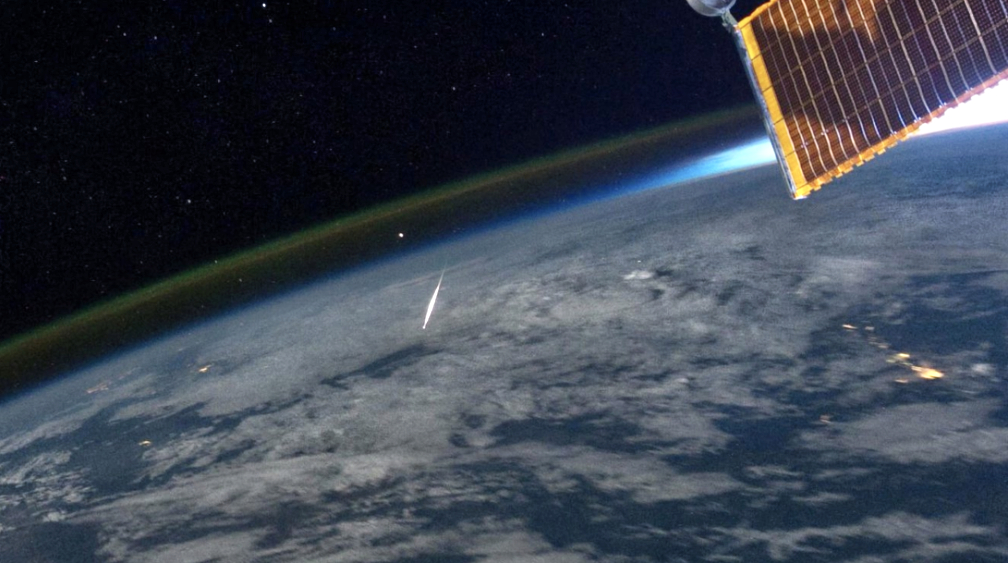
This photograph taken by an International Space Station astronaut shows a bright meteor from the Perseid meteor shower in Earth’s atmosphere. The brightest meteors are known as fireballs, or bolides.
Credit: NASA

This uniquely rich data set has been greatly sought after by the scientific community as an object’s breakup in Earth’s atmosphere provides scientific insight into the object’s strength and composition based on what altitudes at which it breaks up and disintegrates. The approximate total radiated energy and pre-entry velocity vector (i.e., direction) can also be better derived from bolide light curve data.

“The growing archive of bolide reports, as posted on the NASA CNEOS Fireballs website, has significantly increased scientific knowledge and contributes to the White House approved National Near-Earth Object Preparedness Strategy and Action Plan,” said Lindley Johnson, planetary defense officer at NASA Headquarters. “The release of these new bolide data demonstrates another key area of collaboration between NASA and the U.S. Space Force and helps further the pursuit of improved capabilities for understanding these objects and our preparedness to respond to the impact hazard NEOs pose to Earth.”

Recently a small asteroid approximately 2 meters in size, so small it posed no hazard to Earth, was detected in space as it approached Earth and impacted the atmosphere southwest of Jan Mayen, a Norwegian island nearly 300 miles (470 kilometers) off the east coast of Greenland and northeast of Iceland. While this asteroid, designated 2022 EB5, was much smaller than objects NASA is tasked to detect and warn about, CNEOS continued to update NASA’s PDCO with impact location predictions as observations were collected leading up to 2022 EB5’s impact, offering the planetary defense community a real-word scenario to test NEO tracking capabilities and give confidence that the impact prediction process and models are adequate for timely and accurate notification of the potential impact of a larger object, should one be discovered on a trajectory toward Earth. Similar to other bolide events, 2022 EB5’s impact was detected by U.S. Government sensors and reported by the U.S. Space Force units, confirming the time and location predicted by CNEOS, and added to NASA’s archive of these events at JPL CNEOS.
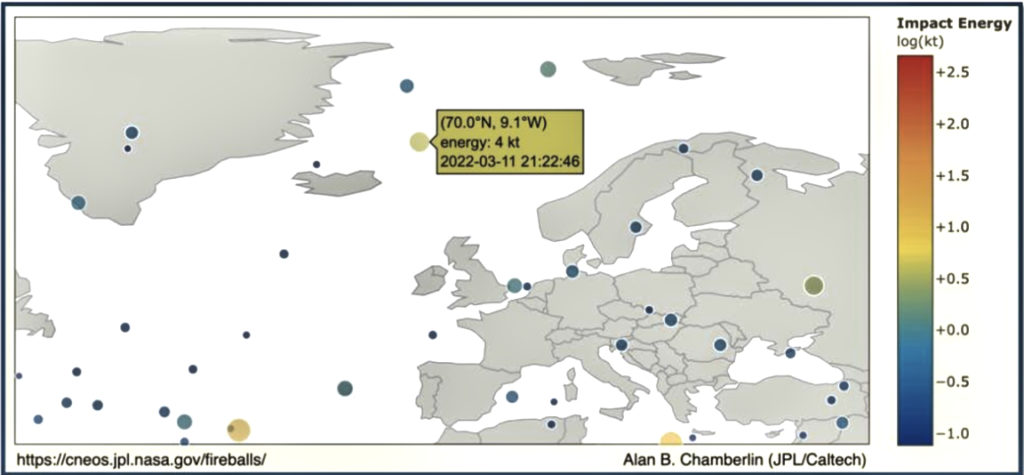
Screen capture from NASA JPL CNEOS’ Fireball webpage depicting data collected by U.S. government sensors of impact in atmosphere by small 2 meter asteroid 2022 EB5 on March 11, 2022.
Credits: NASA JPL CNEOS and U.S. Space Force’s Space Operation’s Center.

Another notable bolide event in this released data set is of a meteor that was detected on January 8, 2014. This object gained the interest of the scientific community as it has been posited it could have interstellar origin due to the detected event’s high velocity within the atmosphere. Further analysis carried out under U.S. Space Command’s purview confirmed the object’s high velocity impact, but the short duration of collected data, less than five seconds, makes it difficult to definitively determine if the object’s origin was indeed interstellar.

NASA established the PDCO in 2016 to manage the agency’s ongoing efforts in planetary defense. NASA has been directed to discover 90% of NEOs larger than 140 meters (459 feet) in size. The agency is diligently working to achieve this directive and has currently found approximately 40% of near-Earth asteroids larger than that size.

Filed Under: Data Processing & AI/ML, Exploration & Science Missions

Primary Sidebar

Coverage

  • Missions & Constellations
  • Business & Finance
  • Military & Defense
  • Launch
  • Software Automation & Ground Systems
  • Government & Regulation
  • Services & Applications

Most Read Stories

  • SpaceX Loses Contact With Starlink Satellite
  • Rocket Lab Emerging as Potential Bus Provider for 2,800-Satellite Equatys Constellation
  • SpaceX Accelerates Record-Breaking IPO Following Trillion-Dollar xAI Merger
  • Planet Labs Imposes Indefinite Blackout on Iran Satellite Imagery at U.S. Request
  • Amazon in Reported Talks to Acquire Globalstar in $9 Billion Move to Challenge Starlink

Secondary Sidebar

Footer


Satnews is a leading provider of satellite news, events, publications, research and other satellite industry information in both commercial and military enterprises worldwide.

Stories By Category

  • Business & Finance
  • Government & Regulation
  • Launch
  • Military & Defense
  • Missions & Constellations
  • Services & Applications
  • Software Automation & Ground Systems
  • Spectrum & Licensing
  • Startups & NewSpace Business

About Us

  • Leadership & Editorial Team
  • SatNews History
  • Free Satnews Subscription
  • SatNews Events
  • Magazines

Navigation

  • Latest Stories
  • Magazines
  • Events
  • Contact
  • Cookie & Privacy Policy for Satnews

We use cookies to ensure that we give you the best experience on our website. If you continue to use this site we will assume that you are happy with it.
x
Sign up Now (For Free)
Access daily or weekly satellite news updates covering all aspects of the commercial and military satellite industry.
Invalid email address
Notify Me Regarding ( At least one ):
We value your privacy and will not sell or share your email or other information with any other company. You may also unsubscribe at anytime.

Click Here to see our full privacy policy.
Thanks for subscribing!