

• Skip to primary navigation
  • Skip to main content
  • Skip to primary sidebar
  • Skip to secondary sidebar
  • Skip to footer
  • NEWS:
  • SatNews
  • SatMagazine
  • MilSatMagazine
  • SmallSat News
  • |     EVENTS:
  • SmallSat Symposium
  • Satellite Innovation
  • MilSat Symposium
  • SmallSat Europe

SatNews

Satellite Industry Intelligence Since 1983

Subscribe
  • LATEST
  • SatNews Events
  • Magazines
  • Calendar
  • Subscribe
  • Missions & Constellations
    • Exploration & Science Missions
    • In-Orbit Servicing & Orbital Operations
    • LEO Constellations
    • Mission Autonomy & Onboard Systems
    • Mission Deployments & Manifests
    • Navigation & PNT
    • SmallSat
    • Spacecraft & Payload Technology
    View All in Missions & Constellations →
    NASA Shuts Off Instrument on Voyager 1 to Extend Interstellar MissionNASA Shuts Off Instrument on Voyager 1 to Extend Interstellar Mission
    Starlink Outages Disrupt Navy Drone Tests as Pentagon Dependency GrowsStarlink Outages Disrupt Navy Drone Tests as Pentagon Dependency Grows
    Iridium Unveils Core Role in Artemis II and Next-Gen PNT at Space Symposium 2026Iridium Unveils Core Role in Artemis II and Next-Gen PNT at Space Symposium 2026
    Boeing and Millennium Unveil Resolute Mid-Class Satellite PlatformBoeing and Millennium Unveil Resolute Mid-Class Satellite Platform
  • Business
    • Contracts & Commercial Deals
    • Earnings & Financial Reporting
    • Events & Conferences
    • Funding & Venture Capital
    • Market Forecasts
    • Mergers & Acquisitions
    • Personnel Moves & Appointments
    View All in Business & Finance →
    Geographic Hotspots: Where Demand Is AcceleratingGeographic Hotspots: Where Demand Is Accelerating
    Amazon+Globalstar. Turbocharging the industryAmazon+Globalstar. Turbocharging the industry
    SmallSat Europe Speaker Focus: Martin Langer, OroraTechSmallSat Europe Speaker Focus: Martin Langer, OroraTech
    SmallSat Europe Speaker Focus: Jaume Sanpera, SateliotSmallSat Europe Speaker Focus: Jaume Sanpera, Sateliot
  • Defense
    • Counterspace & ASAT
    • Defense Budgets & Procurement
    • ISR & Reconnaissance
    • MILSATCOM
    • Missile Warning & Defense
    • National Security Programs
    • Space Domain Awareness
    View All in Military & Defense →
    Saltzman Unveils 2040 Blueprint to Scale Space Force for Great Power CompetitionSaltzman Unveils 2040 Blueprint to Scale Space Force for Great Power Competition
    The Rise of Grey Zone Satellites: Ambiguity as a Tactical AdvantageThe Rise of Grey Zone Satellites: Ambiguity as a Tactical Advantage
    SmallSat Europe Speaker Focus: Col. Marcin Mazur, Polish Space AgencySmallSat Europe Speaker Focus: Col. Marcin Mazur, Polish Space Agency
    US Space Force Awards $68.6M Modification to Lockheed Martin for Next-Gen OPIRUS Space Force Awards $68.6M Modification to Lockheed Martin for Next-Gen OPIR
  • Gov
    • Export Controls & Compliance
    • International Space Agreements
    • National Space Policy
    • Space Law & Treaties
    • Space Sustainability & Debris Policy
    • Space Traffic Management / Debris Removal
    View All in Government & Regulation →
    SmallSat Europe Speaker Focus: Chris Quilty, Quilty SpaceSmallSat Europe Speaker Focus: Chris Quilty, Quilty Space
    NRL to Showcase Sovereign Space Capabilities at 41st Space SymposiumNRL to Showcase Sovereign Space Capabilities at 41st Space Symposium
    FCC Modernizes Satellite Spectrum Rules to Unleash Next-Generation BroadbandFCC Modernizes Satellite Spectrum Rules to Unleash Next-Generation Broadband
    SmallSat Europe Speaker Focus: Daniel Bock, Morpheus SpaceSmallSat Europe Speaker Focus: Daniel Bock, Morpheus Space
  • Launch
    • Launch Providers
    • Launch Schedule & Calendars
    • Launch Sites & Infrastructure
    • Rocket Technology & Vehicles
    View All in Launch →
    Blue Origin Achieves First Booster Reuse but Satellite Enters Off-Nominal OrbitBlue Origin Achieves First Booster Reuse but Satellite Enters Off-Nominal Orbit
    Ensign-Bickford Hardware Supports Successful Artemis II Lunar MissionEnsign-Bickford Hardware Supports Successful Artemis II Lunar Mission
    China Accelerates Orbital Internet Deployment with Successful Smart Dragon-3 Sea LaunchChina Accelerates Orbital Internet Deployment with Successful Smart Dragon-3 Sea Launch
    What the SpaceX IPO Changes for Every Satellite OperatorWhat the SpaceX IPO Changes for Every Satellite Operator
  • Software
    • Autonomous Ground Operations
    • Data Processing & AI/ML
    • Digital Twins & Modeling
    • Ground Segment & Teleports
    • Mission Planning & Simulation
    • Space Systems Software Engineering
    • Spectrum & Licensing
    View All in Software Automation & Ground Systems →
    Blue Origin Unveils Project Quartz Global Ground Station NetworkBlue Origin Unveils Project Quartz Global Ground Station Network
    Cloudcomputing Targets 1.5M Identities in Spain and Finalizes Innovate IT AcquisitionCloudcomputing Targets 1.5M Identities in Spain and Finalizes Innovate IT Acquisition
    Archangel Lightworks Secures £10M Series A to Scale Optical Ground InfrastructureArchangel Lightworks Secures £10M Series A to Scale Optical Ground Infrastructure
    Keysight and Sateliot Win ESA and GSMA Foundry Challenge for 6G InnovationKeysight and Sateliot Win ESA and GSMA Foundry Challenge for 6G Innovation
  • Services & Apps
    • Climate & Environmental Monitoring
    • Disaster Response & Security Mapping
    • Earth Observation & Imaging
    • Maritime & Aviation Satcom
    • Satellite Communications
    View All in Services & Applications →
    NASA Targets Commercial Relays to Replace Aging TDRSS InfrastructureNASA Targets Commercial Relays to Replace Aging TDRSS Infrastructure
    OQ Technology Awarded ESA Contract to Adapt 5G Beamforming for SpaceOQ Technology Awarded ESA Contract to Adapt 5G Beamforming for Space
    Kraken Robotics Integrates KATFISH Sonar on SEFINE RD-22 USV Following Multi-Naval DemonstrationsKraken Robotics Integrates KATFISH Sonar on SEFINE RD-22 USV Following Multi-Naval Demonstrations
    Astroscale Plans World-First Multi-Orbit Satellite Inspection MissionAstroscale Plans World-First Multi-Orbit Satellite Inspection Mission

Dragon’s Delivery Of European Science Readies For Space

January 3, 2022

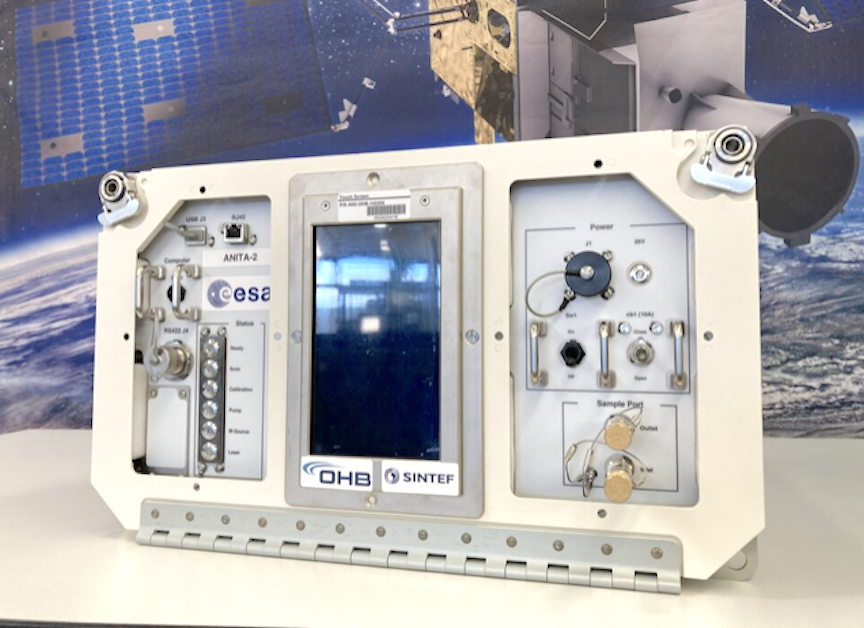
ANITA-2

The Dragon spacecraft is scheduled to launch from NASA’s Kennedy Space Center in Florida, USA, at 11:06 CET (10:06 GMT) Tuesday, December 21. Some of the European cargo it carries is shown below.

Safe air — Astronauts living on the International Space Station never get a breath of fresh outdoor air.

In their closed atmosphere, irritating, poisonous and carcinogenic gas compounds emanate from materials, equipment and the crew itself. However, there is no window to open to freshen the room, so the astronauts must rely on the air revitalization system.

Air quality is monitored continuously to assure the crew’s health and well-being. A rapid response by the astronauts to any accidental release of harmful gaseous contaminants, or malfunction of the air system is essential, and air monitoring is even more important as missions last longer and samples cannot be taken to Earth for analysis.

ANITA-2 (Analysing Interferometer for Ambient Air) is an instrument that will constantly monitor air quality. Considerably smaller than its predecessor that flew in Space Shuttle Endeavour to the International Space Station in 2007, and with improved software, the spectroscopy-based facility will run automatically in the background while astronauts get on with their work. The system is useful for all confined spaces such as in submarines.

First step to printable skin — Another item among the Dragon’s cargo is a handheld bioprinter. Researchers behind the technology demonstration from German Space Agency DLR say it could see astronauts use their own skin cells to print plasters and heal wounds during future missions to the Moon and Mars. But first it must be tested under space conditions.
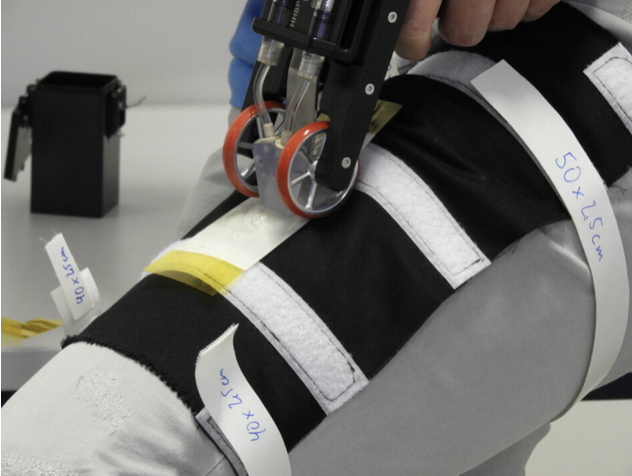
Bioprint First Aid handheld bioprinter

The Bioprint First Aid  bioprinter is hand-operated, consisting only of a handle, dispensing device, print head, guide wheels and two bio-ink cartridges. The technology demonstration will not use real human cells but fluorescent microparticles. When combined with two fast-curing gels, these microparticles create a plaster-like wound covering, which will be printed onto an astronaut’s foil-covered arm or leg and sent back to Earth for further testing.
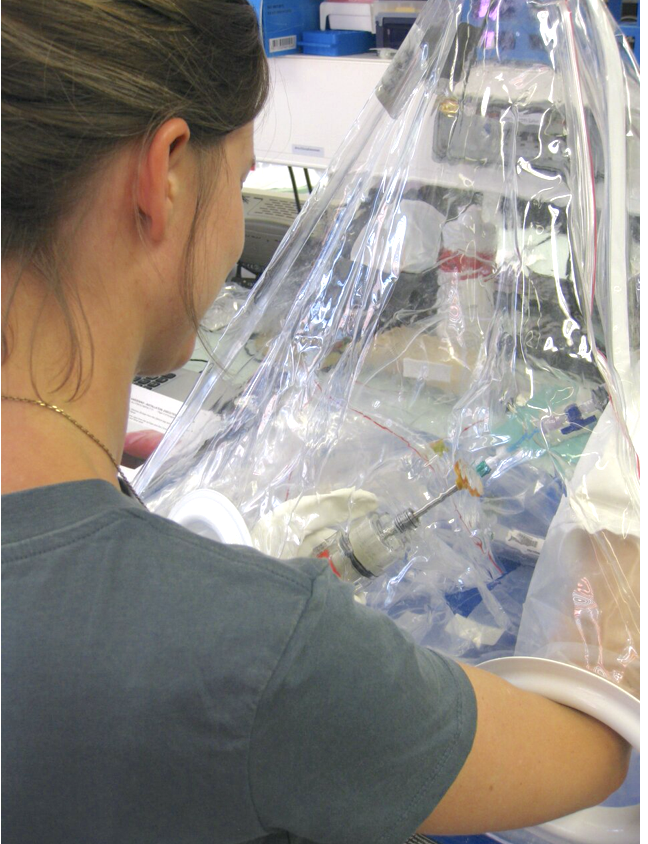
Concrete Hardening experiment

The hard stuff — Next on the list is another ESA-sponsored DLR experiment: Concrete Hardening, an investigation into how gravity affects the hardening process and properties of concrete.

Previous research showed differences in porosity and microstructure of concrete samples in microgravity. However, this was limited to the solidification of pure cement. In this study, the crew will mix cement, sand, or Moon dust simulant, plus additives with water and leave these to harden in weightlessness. Back on Earth scientists will examine the microstructure and mechanical strength of the samples mixed and hardened in orbit.

The results of this research will facilitate the development of new, improved concrete mixes that could be used as building material for astronaut habitats during Moon and Mars missions, as well as for sustainable construction on Earth.

Spotlight on cellular function — The Cytoskeleton experiment investigates the internal machinery of human cells in microgravity to expand our knowledge of cellular function. It does so with a focus on Rho family GTPases.

These molecules control many important cellular pathways including cell proliferation, apoptosis (a form of programmed cell death), gene expression and intercellular organization. It is believed that weightlessness can disturb the way Rho family GTPases function and the signalling they control.

Cytokeleton tests two cell types: the fibroblast cell line WI-26, and the osteoblast cell line MG63. These two cell types are important for the body’s structure, with fibroblasts producing proteins, such as collagen – the main component of connective tissue – and osteoblasts responsible for bone formation.

Results of this study could help maintain optimal crew health and performance during spaceflight, and feed into clinical medical research on the ground by enabling scientists to examine cells in a way that is not possible on Earth.

Astro Pi — The Astro Pi mark II payload is a like for like upgrade and replacement for the original Astro Pi hardware that flew to the ISS in 2015 for ESA astronaut Tim Peake’s Principia mission.

They are two COTS Raspberry Pi 4B computers enclosed in aerospace grade aluminum cases with a range of integrated environmental sensors and a 12-megapixel camera for Earth Observation. ESA astronaut Samantha Cristoforetti explores the upgraded Astro Pis in this hardware reveal video. 

One Astro Pi will be deployed in the Columbus module while the other will be looking through a hatch window towards the Earth. Students in European schools who are participating in the European Astro Pi Challenge can control these computers using the python programming language. By submitting their python programs their experiments are run on board the Station with the generated results and science data returned to ground for them to analyse.
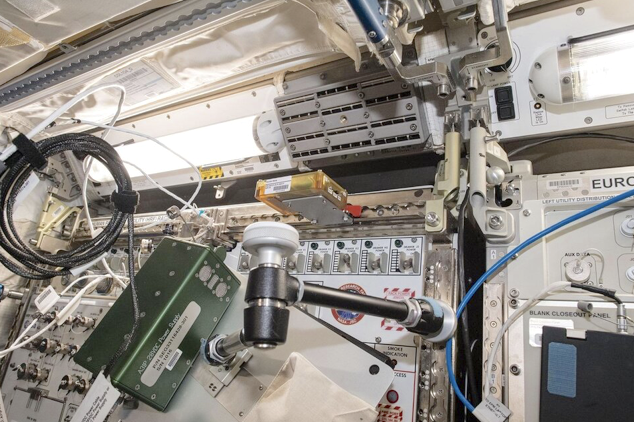
Wireless Compose module installed on the Space Station

Compose components — Wireless Compose-2 is a technology demonstrator that aims to provide a flexible and adaptable wireless network infrastructure to conduct and execute low-power, low-weight, and wireless experiments on the International Space Station (ISS). Building on technology used for DLR’s first Wireless Compose technology demonstrator in 2018, it shows the capabilities of Wireless Networks for scientific, localization, and medical experiments in the Columbus module.

Hardware for Wireless Compose-2 consists of five modules that together weigh just one kilogram. Each individual module is roughly the size of a small smartphone. The network will be a platform for other experiments including the Ballistocardiography for Extraterrestrial Applications and long-Term missions (BEAT) experiment that uses a t-shirt equipped with sensors to measure an astronaut’s ballistocardiographic data, including pulse and blood pressure.

Space age — Funded by the UK Space Agency, Microage will see synthetic muscle cells the size of a grain of rice sent for examination in orbit. A proportion of these cells will be electrically stimulated to induce contractions under microgravity conditions, while others are exposed to artificial gravity via centrifugation. Samples will be frozen and returned to Earth to help identify the mechanisms by which muscle mass is lost and possible modes of prevention.

Filed Under: Exploration & Science Missions, Launch Providers

Primary Sidebar

Coverage

  • Missions & Constellations
  • Business & Finance
  • Military & Defense
  • Launch
  • Software Automation & Ground Systems
  • Government & Regulation
  • Services & Applications

Most Read Stories

  • SpaceX Loses Contact With Starlink Satellite
  • Rocket Lab Emerging as Potential Bus Provider for 2,800-Satellite Equatys Constellation
  • SpaceX Accelerates Record-Breaking IPO Following Trillion-Dollar xAI Merger
  • Planet Labs Imposes Indefinite Blackout on Iran Satellite Imagery at U.S. Request
  • Amazon in Reported Talks to Acquire Globalstar in $9 Billion Move to Challenge Starlink

Secondary Sidebar

Footer


Satnews is a leading provider of satellite news, events, publications, research and other satellite industry information in both commercial and military enterprises worldwide.

Stories By Category

  • Business & Finance
  • Government & Regulation
  • Launch
  • Military & Defense
  • Missions & Constellations
  • Services & Applications
  • Software Automation & Ground Systems
  • Spectrum & Licensing
  • Startups & NewSpace Business

About Us

  • Leadership & Editorial Team
  • SatNews History
  • Free Satnews Subscription
  • SatNews Events
  • Magazines

Navigation

  • Latest Stories
  • Magazines
  • Events
  • Contact
  • Cookie & Privacy Policy for Satnews

We use cookies to ensure that we give you the best experience on our website. If you continue to use this site we will assume that you are happy with it.
x
Sign up Now (For Free)
Access daily or weekly satellite news updates covering all aspects of the commercial and military satellite industry.
Invalid email address
Notify Me Regarding ( At least one ):
We value your privacy and will not sell or share your email or other information with any other company. You may also unsubscribe at anytime.

Click Here to see our full privacy policy.
Thanks for subscribing!