


The global satellite communication industry is transitioning to meet new market trends and match projected threats from perceived disruptors. It is typical to expect mergers and acquisitions (M&A) within any maturing industry, especially technology-driven sectors, where inventors regularly threaten incumbents. In the case of SATCOM, the industry is entering a new consolidation cycle, where vertical integration is becoming as inevitable as horizontal solidification.
Between 2012-2017, the industry witnessed a wave of M&As across operator-distributor, equipment-service provider and multiple cross-value-chain consolidations. While the recent wave of consolidation builds on the industry’s past M&A trajectory, it, most importantly, points to a new direction for SATCOM’s future. With equipment providers expanding into service business lines, vertical mergers are becoming more common within the operator-SP-Equipment provider triad.
What is Driving this New Consolidation Cycle?
1. Pricing Pressure and Commoditization of Capacity
It is well known that with the growth of capacity supply from High Throughput Satellite (HTS) fleets, the industry sees an increasing demand for cheaper HTS capacity vs. traditional FSS GEO capacity. GEO operators are making larger bets on new HTS capacity, with Hughes’ Jupiter-3 planned for launch in H2 2021 and ViaSat’s ViaSat-3 rescheduled for early 2022. Eutelsat’s Konnect VHTS is due to become operational in 2022, while SES plans to launch SES 17 later this year. This trend puts pressure on overall capacity pricing in the market as FSS supply undercuts price to remain competitive, while HTS fleets pursue volume to increase fill rates.
The impact is that capacity supply is increasingly becoming a commodity business as operators rely on rising sales volume to compensate for price erosion. With large HTS payloads coming online from 2021, attrition from FSS to HTS will continue, resulting in declining fill rates, even as media demand continues to shrink. Highly efficient HTS fleets will be launched in the next 2-3 years, with different application focus and fixed/steerable beams to suit mobility and Gov/Mil applications.
Smaller operators and service providers will be cut up in the murky middle as capacity pricing pressure persists and more capacity is available in the market post-2021. For example, Eutelsat CEO Rodolphe Belmer recently told analysts that Eutelsat plans to “take back” some of its capacity leased by Nilesat on the 7|8 degrees West hotspot over the Middle East, to “distribute it ourselves”. With the contract renewal due by July 2021, Eutelsat expects to re-negotiate the lease deal or take back the capacity and redistribute it via its Middle East-focus distribution subsidiary Noorsat. A race for market share will erode value, while higher integrating offerings will increase revenue per bit leased.
Operators are moving closer to customers down the value chain through vertical integration to cushion against changing wholesale market dynamics. Operators are rolling out distribution strategies or acquiring service providers to capture market share and optimize fill rates by launching more differentiated services and products down the value chain. This trend is expected to remain as integrated operators such as ViaSat and Hughes continue to outperform their peers across various operational and solvency metrics.
2. Stunted Growth in Video
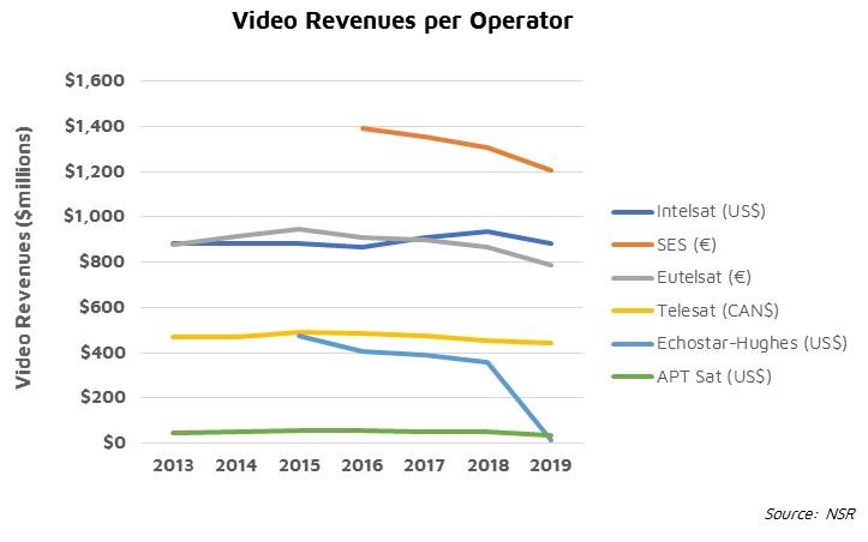
According to NSR’s Satellite Industry Financial Analysis, 10th Edition report, video revenues continue to decline year-on-year, contracting by 15.1% cumulatively in 2019 across the top six operators analyzed and further in 2020. Video contributes most of the wholesale capacity revenue pie, making it challenging for operators to retain the pure-play high EBITDA wholesale business as video revenue shrinks. Non-integrated operators face severe organic growth challenges as there is a balancing act between video and non-video business.
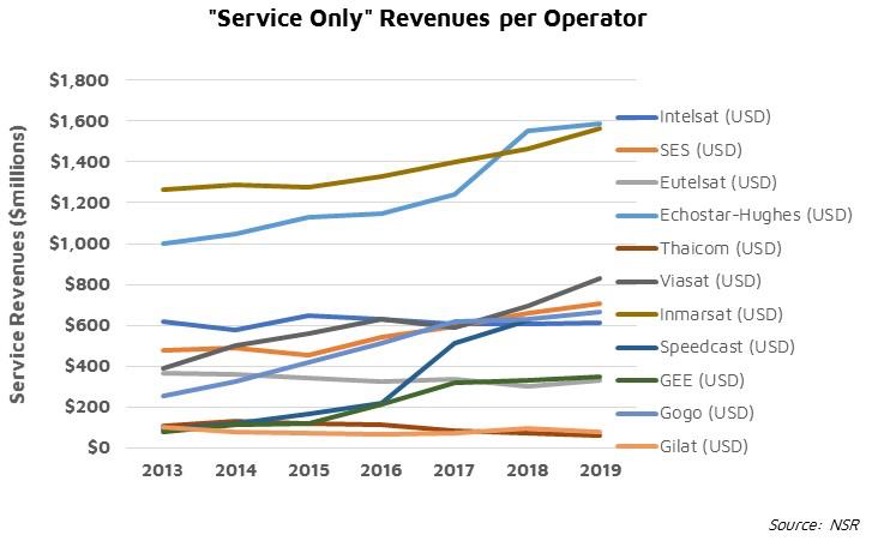
Non-video revenues will continue to increase, with the service business retaining the lead over lease revenue in the long term as operators guard against a top-line erosion with video on the decline. The industry appears to have factored in this trend a long time ago, and operators are now actively consolidating towards various service strategies across different non-video verticals. Initial growth in managed services for Gov/Mil, the pre-COVID gains in mobility and steady performance of fixed broadband services appear to be major drivers accelerating consolidation in the non-video business.
The highest performers include ViaSat (on the back of Gov/Mil, Broadband and Aero), Hughes (Broadband), Inmarsat (Mobility) and expected to have risen further post PE acquisition, and finally SES (with O3B service revenues in Trunking, Cruise and Energy). Eutelsat’s acquisition of Bigblu’s broadband business in Europe, the roll-out of Konnect in Africa, and Intelsat’s acquisition of Gogo’s Commercial Aviation business are recent examples of the growing investment into the service business.
3. Perceived Threat from Non-GEO Constellations
Perhaps, the most significant driver of this ongoing cycle of satcom industry consolidation is the perceived disruption of the market landscape by non-GEO constellation operators such as SpaceX Starlink, Amazon Kuiper, OneWeb, and Telesat Lightspeed, among others. Following the success of the March 14 launch, SpaceX now has more than 1,200 Starlink satellites in orbit.
In October, SpaceX began rolling out a public beta service to customers in the U.S., Canada and the U.K., and have reportedly entered parts of European markets, with regulatory processes in the works across various countries globally. In January, FCC filings revealed that SpaceX has more than 10,000 beta users on Starlink. Recently, SpaceX applied for regulatory approval to begin connecting large vehicles – from trucks to jets to ships – via Starlink, indicating the LEO operator is ready to battle for market share not only in the direct-to-premises consumer broadband market but also in the mobility market.
While the full impact of these NGEOs plays remains to be seen, its long term threats on market access and capacity supply show enough worry for incumbents to consolidate in order to stay competitive. With some of these new entrants making incredible technological advances and matching the financial base to fuel commercialization, the big questions now border around their go-to-market strategies and their impact on the competitive landscape. The NGEO effect is driving a transition across the industry, with operators looking to bridge the gap with end customers and exercise more control over its distribution. As capacity supply abounds from non-GEO and GEO HTS fleets, distribution is expected to become the core success factor.
The Consolidation Landscape
The industry is already significantly moving towards vertical integration. NSR’s Satcom Business in Models in a 3.0 Era outlined seven major components of the changing consolidation landscape within the context of small, medium and large satellite operators’ exposure to risk. Intelsat’s acquisition of Gogo’s IFC business, Eutelsat’s downstream play with Noorsat in the Middle East for video and broadband play in Africa and Europe, and SES’ vertically integrated network offerings for the cruise, telecom and Gov/Mil sectors, among other recent M&As, show the changing landscape is focused on protecting market access across key verticals. NSR expects consolidation to deepen further from gaining market access across various verticals to expanding market share through horizontal solidification.
The Bottom Line
The new state of affairs in SATCOM will likely play out via a number of trends and strategic moves:
- Integrated GEO businesses and high-volume wholesale capacity models will remain viable, while small stand-alone operators or service providers will find it challenging to survive post-2024.
- Cash-rich companies such as SES and Hughes could make large bets to compete against large NGEOs.
- Smaller operators struggling with cash and service providers unable to generate enough cash will need to merge or declare bankruptcy or write off legacy assets soon to remain competitive against the more efficient capacity of the 2020s.
- Regional and domestic operators in the Middle East, Africa and Southeast Asia will likely see horizontal mergers and vertical integration with SPs as smaller operators are unable to compete against low pricing from large GEOs or LEOs. Large GEO and LEO operators will seek to acquire critical spectrum rights and landing permits in these regions by making outright acquisition bids or form JVs with operators and SPs in these markets.
- With a European constellation announcement on the anvil and with media business in Europe struggling, an SES and Eutelsat merger could help both companies consolidate positions in Video, Mobility and Gov/Mil, and expand on broadband services.

Author: Joseph Ibeh, NSR Analyst, Nigeria
