
• Skip to primary navigation
  • Skip to main content
  • Skip to primary sidebar
  • Skip to secondary sidebar
  • Skip to footer
  • NEWS:
  • SatNews
  • SatMagazine
  • MilSatMagazine
  • SmallSat News
  • |     EVENTS:
  • SmallSat Symposium
  • Satellite Innovation
  • MilSat Symposium
  • SmallSat Europe

SatNews

Satellite Industry Intelligence Since 1983

Subscribe
  • LATEST
  • SatNews Events
  • Magazines
  • Calendar
  • Subscribe
  • Missions & Constellations
    • Exploration & Science Missions
    • In-Orbit Servicing & Orbital Operations
    • LEO Constellations
    • Mission Autonomy & Onboard Systems
    • Mission Deployments & Manifests
    • Navigation & PNT
    • SmallSat
    • Spacecraft & Payload Technology
    View All in Missions & Constellations →
    ESA Awards OHB €102 Million Prime Contract for ClearSpace-1 Debris Removal MissionESA Awards OHB €102 Million Prime Contract for ClearSpace-1 Debris Removal Mission
    Google Selects Blue Origin’s New Glenn Rocket for 2029 AI Satellite LaunchGoogle Selects Blue Origin’s New Glenn Rocket for 2029 AI Satellite Launch
    RBC Signals Secures $10 Million Strategic Growth Investment Led by Washington Harbour PartnersRBC Signals Secures $10 Million Strategic Growth Investment Led by Washington Harbour Partners
    GomSpace Secures €8 Million Phase 2 Contract for North American Dual-Satellite Lunar Prospecting MissionGomSpace Secures €8 Million Phase 2 Contract for North American Dual-Satellite Lunar Prospecting Mission
  • Business
    • Contracts & Commercial Deals
    • Earnings & Financial Reporting
    • Events & Conferences
    • Funding & Venture Capital
    • Market Forecasts
    • Mergers & Acquisitions
    • Personnel Moves & Appointments
    View All in Business & Finance →
    Telesat Secures Six-Week Debt Standstill From GEO Lenders Through Jan. 18, 2027Telesat Secures Six-Week Debt Standstill From GEO Lenders Through Jan. 18, 2027
    SES Targets Middle Corridor and Central Asia Amid €623 Million EU Infrastructure PushSES Targets Middle Corridor and Central Asia Amid €623 Million EU Infrastructure Push
    PLD Space Signs First Commercial MIURA 5 Launch Contract With Mitsubishi ElectricPLD Space Signs First Commercial MIURA 5 Launch Contract With Mitsubishi Electric
    Iceye Makes All-Cash €2 Billion ($2.2B) Takeover Offer for Italian Rocket Builder AvioIceye Makes All-Cash €2 Billion ($2.2B) Takeover Offer for Italian Rocket Builder Avio
  • Defense
    • Counterspace & ASAT
    • Defense Budgets & Procurement
    • ISR & Reconnaissance
    • MILSATCOM
    • Missile Warning & Defense
    • National Security Programs
    • Space Domain Awareness
    View All in Military & Defense →
    Senate Appropriators Move to Bar Sole-Source Awards Over $100 Million for Space Data Network and SB-AMTISenate Appropriators Move to Bar Sole-Source Awards Over $100 Million for Space Data Network and SB-AMTI
    Space Force Awards $10 Million in SEWOL Prototype Contracts to Three FirmsSpace Force Awards $10 Million in SEWOL Prototype Contracts to Three Firms
    York Space Systems Posts $807.4M Q3 Loss After $749.7M Pentagon Contract ChargeYork Space Systems Posts $807.4M Q3 Loss After $749.7M Pentagon Contract Charge
    Ukraine Reports Renewed Starshield Velocity Restrictions on Military DronesUkraine Reports Renewed Starshield Velocity Restrictions on Military Drones
  • Gov
    • Export Controls & Compliance
    • International Space Agreements
    • National Space Policy
    • Space Law & Treaties
    • Space Sustainability & Debris Policy
    • Space Traffic Management / Debris Removal
    View All in Government & Regulation →
    FCC Upper C-Band Auction 115 Creates Indirect Spectrum and Market Shifts for SmallSat and LEO OperatorsFCC Upper C-Band Auction 115 Creates Indirect Spectrum and Market Shifts for SmallSat and LEO Operators
    FCC Sets April 27, 2027 Start Date for Upper C-Band Auction, Pressuring BroadcastersFCC Sets April 27, 2027 Start Date for Upper C-Band Auction, Pressuring Broadcasters
    Starlink Satellites Pass Over South Africa, But Licensing Approval Remains StalledStarlink Satellites Pass Over South Africa, But Licensing Approval Remains Stalled
    Satellogic Reports Record Revenue and Largest-Ever $37 Million Sovereign Satellite OrderSatellogic Reports Record Revenue and Largest-Ever $37 Million Sovereign Satellite Order
  • Launch
    • Launch Providers
    • Launch Schedule & Calendars
    • Launch Sites & Infrastructure
    • Rocket Technology & Vehicles
    View All in Launch →
    ULA Clears Blue Origin BE-4 Engines, Focuses Vulcan Failure Probe on Core Stage Fuel SupplyULA Clears Blue Origin BE-4 Engines, Focuses Vulcan Failure Probe on Core Stage Fuel Supply
    NASA’s Voyager 1 Reaches One Light-Day From Earth at 16.1 Billion MilesNASA’s Voyager 1 Reaches One Light-Day From Earth at 16.1 Billion Miles
    Southern Launch Recovers Second Varda Space Capsule in 12 Days at Koonibba Test RangeSouthern Launch Recovers Second Varda Space Capsule in 12 Days at Koonibba Test Range
    Nammo UK Completes Prototype Hot-Fire Tests for ESA Argonaut Lunar Lander EngineNammo UK Completes Prototype Hot-Fire Tests for ESA Argonaut Lunar Lander Engine
  • Software
    • Autonomous Ground Operations
    • Data Processing & AI/ML
    • Digital Twins & Modeling
    • Ground Segment & Teleports
    • Mission Planning & Simulation
    • Space Systems Software Engineering
    • Spectrum & Licensing
    View All in Software Automation & Ground Systems →
    Ramon.Space Raises $124 Million Series B to Scale Orbital Computing InfrastructureRamon.Space Raises $124 Million Series B to Scale Orbital Computing Infrastructure
    Gilat Cuts 2026 Growth Forecast to 3% Amid Launch and IFC DelaysGilat Cuts 2026 Growth Forecast to 3% Amid Launch and IFC Delays
    U.S. Navy Expands ALL.SPACE Terminal Fleet to 108 with Follow-On Hydra MAX 2 OrderU.S. Navy Expands ALL.SPACE Terminal Fleet to 108 with Follow-On Hydra MAX 2 Order
    SpaceX Selects Qualcomm to Supply Terrestrial Base Stations for Starlink Mobile NetworkSpaceX Selects Qualcomm to Supply Terrestrial Base Stations for Starlink Mobile Network
  • Services & Apps
    • Climate & Environmental Monitoring
    • Disaster Response & Security Mapping
    • Earth Observation & Imaging
    • Maritime & Aviation Satcom
    • Satellite Communications
    View All in Services & Applications →
    Thales Alenia Space Awarded DGA Contract for French IRIS Military Optical ConstellationThales Alenia Space Awarded DGA Contract for French IRIS Military Optical Constellation
    Ubotica Demonstrates Autonomous Onboard Satellite Scheduling for Maritime SurveillanceUbotica Demonstrates Autonomous Onboard Satellite Scheduling for Maritime Surveillance
    UniSQ Demonstrates Tomographic Spectrometer During KREPE-3 Re-Entry CampaignUniSQ Demonstrates Tomographic Spectrometer During KREPE-3 Re-Entry Campaign
    MDA Space Secures C$100M+ Thales Alenia Space Award for First 66 IRIS² SatellitesMDA Space Secures C$100M+ Thales Alenia Space Award for First 66 IRIS² Satellites

UPDATE 1: Perseverance Pays Off — ULA Lands NASA’s Rover Successfully Landing On Mars

February 18, 2021

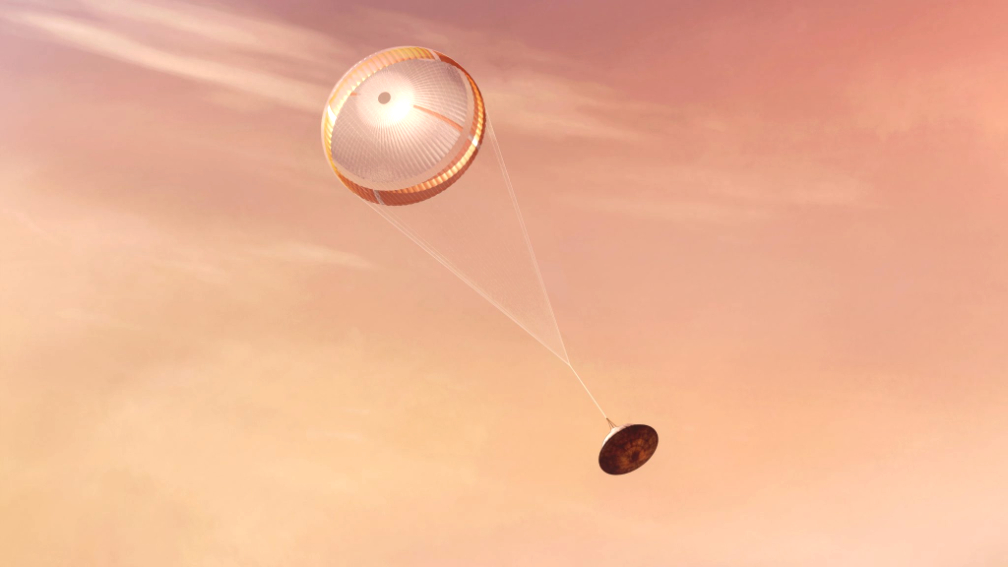
Artistic rendition of NASA’s Perseverance rover deploys a supersonic parachute from its aeroshell as it slows down before landing on Mars. Hundreds of critical events had to be executed perfectly and exactly on time and the rover to landed safely on February 18, 2021. Image: NASA/JPL-Caltech

Cheers erupted in mission control at NASA’s Jet Propulsion Laboratory as controllers confirmed that NASA’s Perseverance rover, with the Ingenuity Mars Helicopter attached to its belly, has touched down safely on Mars. Engineers are analyzing the data from the spacecraft.

Cheers erupted in mission control at NASA’s Jet Propulsion Laboratory as controllers confirmed that NASA’s Perseverance rover, with the Ingenuity Mars Helicopter attached to its belly, has touched down safely on Mars. Engineers are analyzing the data flowing back from the spacecraft. Image: NASA/JPL-Caltech

A post landing briefing is expected at 5:30 p.m. EST (2:30 p.m. PST) on NASA TV and YouTube.

The largest, most advanced rover NASA has sent to another world touched down on Mars after a 203-day journey traversing 293 million miles (472 million kilometers). Confirmation of the successful touchdown was announced in mission control at NASA’s Jet Propulsion Laboratory in Southern California at 3:55 p.m. EST (12:55 p.m. PST).

Packed with groundbreaking technology, the Mars 2020 mission launched on July 30, 2020, from Cape Canaveral Space Force Station in Florida. The Perseverance rover mission marks an ambitious first step in the effort to collect Mars samples and return them to Earth.
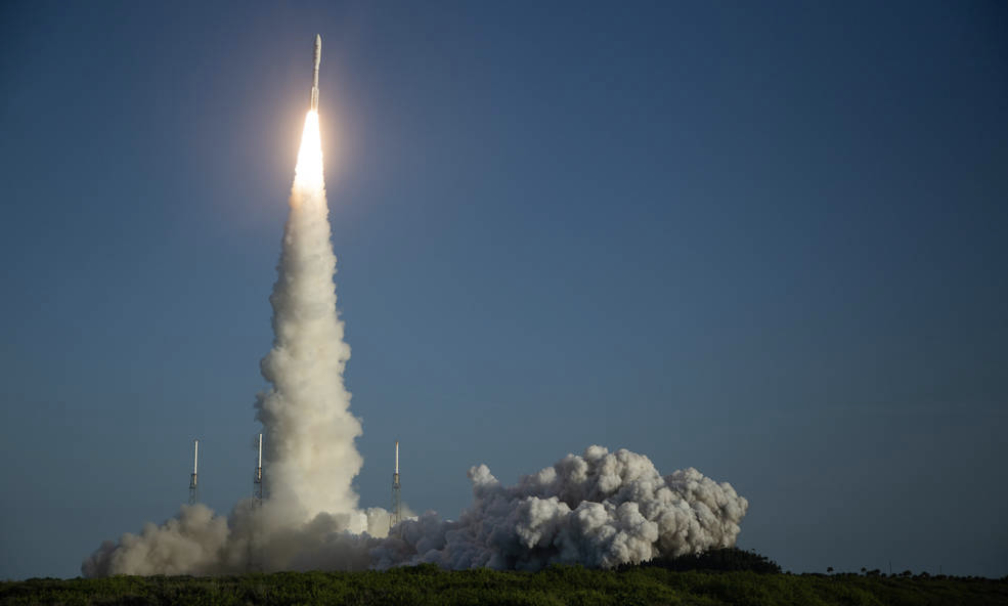
The ULA launch of the NASA Mars mission.

“This landing is one of those pivotal moments for NASA, the United States, and space exploration globally – when we know we are on the cusp of discovery and sharpening our pencils, so to speak, to rewrite the textbooks,” said acting NASA Administrator Steve Jurczyk. “The Mars 2020 Perseverance mission embodies our nation’s spirit of persevering even in the most challenging of situations, inspiring, and advancing science and exploration. The mission itself personifies the human ideal of persevering toward the future and will help us prepare for human exploration of the Red Planet in the 2030s.”

About the size of a car, the 2,263-pound (1,026-kilogram) robotic geologist and astrobiologist will undergo several weeks of testing before it begins its two-year science investigation of Mars’ Jezero Crater.
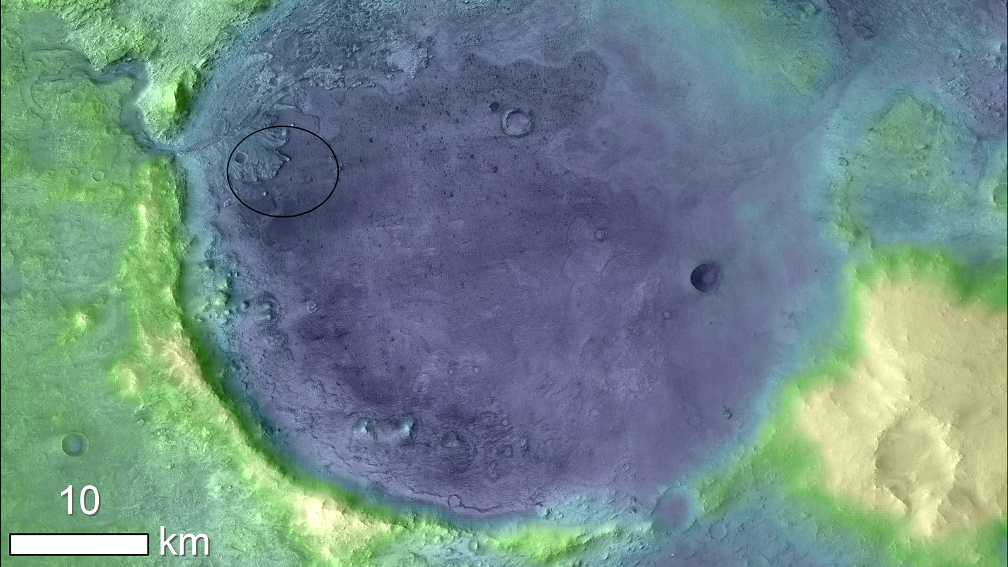
Jezero Crater’s Ancient Lakeshore: Lighter colors represent higher elevation in this image of Jezero Crater on Mars, the landing site for NASA’s Mars 2020 mission. The oval indicates the landing ellipse, where the rover will be touching down on Mars. Image credit: NASA/JPL-Caltech/MSSS/JHU-APL/ESA

While the rover will investigate the rock and sediment of Jezero’s ancient lakebed and river delta to characterize the region’s geology and past climate, a fundamental part of its mission is astrobiology, including the search for signs of ancient microbial life. To that end, the Mars Sample Return campaign, being planned by NASA and ESA (European Space Agency), will allow scientists on Earth to study samples collected by Perseverance to search for definitive signs of past life using instruments too large and complex to send to the Red Planet.

“Because of today’s exciting events, the first pristine samples from carefully documented locations on another planet are another step closer to being returned to Earth,” said Thomas Zurbuchen, associate administrator for science at NASA. “Perseverance is the first step in bringing back rock and regolith from Mars. We don’t know what these pristine samples from Mars will tell us. But what they could tell us is monumental – including that life might have once existed beyond Earth.”

Some 28 miles (45 kilometers) wide, Jezero Crater sits on the western edge of Isidis Planitia, a giant impact basin just north of the Martian equator. Scientists have determined that 3.5 billion years ago the crater had its own river delta and was filled with water.

Labeled pull-apart view showing the major components of the MMRTG, or Multi-Mission Radioisotope Thermoelectric Generator. Image credit: NASA

The power system that provides electricity and heat for Perseverance through its exploration of Jezero Crater is a Multi-Mission Radioisotope Thermoelectric Generator, or MMRTG. The U.S. Department of Energy (DOE) provided it to NASA through an ongoing partnership to develop power systems for civil space applications.

Equipped with seven primary science instruments, the most cameras ever sent to Mars, and its exquisitely complex sample caching system – the first of its kind sent into space – Perseverance will scour the Jezero region for fossilized remains of ancient microscopic Martian life, taking samples along the way.  
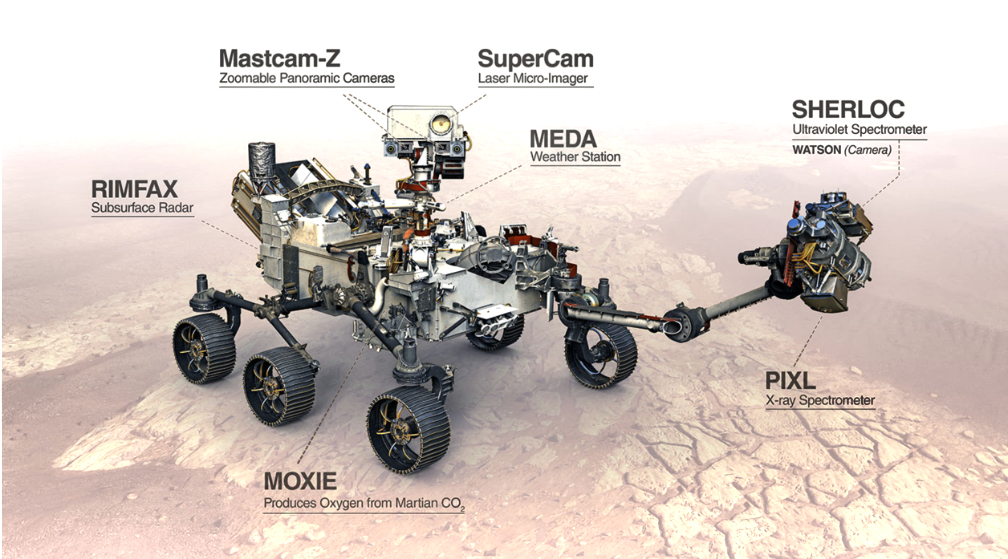
The rover’s onboard instruments, image is courtesy of NASA.

“Perseverance is the most sophisticated robotic geologist ever made, but verifying that microscopic life once existed carries an enormous burden of proof,” said Lori Glaze, Director of NASA’s Planetary Science Division. “While we’ll learn a lot with the great instruments we have aboard the rover, it may very well require the far more capable laboratories and instruments back here on Earth to tell us whether our samples carry evidence that Mars once harbored life.”

Paving the Way for Human Missions

“Landing on Mars is always an incredibly difficult task and we are proud to continue building on our past success,” said JPL Director Michael Watkins. “But, while Perseverance advances that success, this rover is also blazing its own path and daring new challenges in the surface mission. We built the rover not just to land but to find and collect the best scientific samples for return to Earth, and its incredibly complex sampling system and autonomy not only enable that mission, they set the stage for future robotic and crewed missions.”
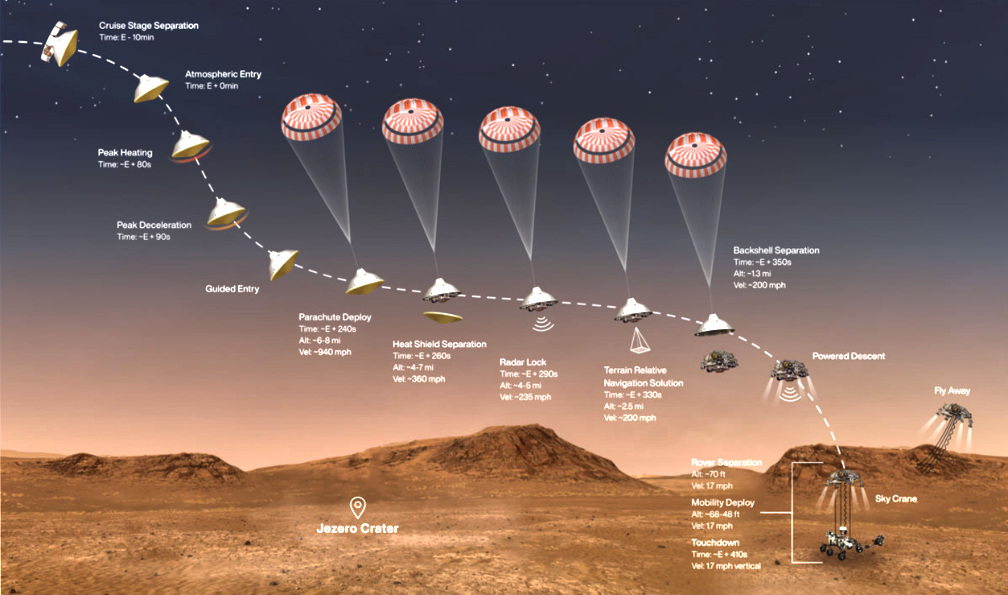
Perseverance Rover’s Entry, Descent and Landing Profile: This illustration shows the events that occur in the final minutes of the nearly seven-month journey that NASA’s Perseverance rover takes to Mars. Credit: NASA/JPL-Caltech.

The Mars Entry, Descent, and Landing Instrumentation 2 (MEDLI2) sensor suite collected data about Mars’ atmosphere during entry, and the Terrain-Relative Navigation system autonomously guided the spacecraft during final descent. The data from both are expected to help future human missions land on other worlds more safely and with larger payloads.

This artist’s concept depicts astronauts and human habitats on Mars. NASA’s Mars 2020 rover will carry a number of technologies that could make Mars safer and easier to explore for humans. JPL is building and will manage operations of the Mars 2020 rover for the NASA Science Mission Directorate at the agency’s headquarters in Washington.

On the surface of Mars, Perseverance’s science instruments will have an opportunity to scientifically shine. Mastcam-Z is a pair of zoomable science cameras on Perseverance’s remote sensing mast, or head, that creates high-resolution, color 3D panoramas of the Martian landscape. Also located on the mast, the SuperCam uses a pulsed laser to study the chemistry of rocks and sediment and has its own microphone to help scientists better understand the property of the rocks, including their hardness.

This image, taken in the Spacecraft Assembly Facility’s High Bay 1 at the Jet Propulsion Laboratory in Pasadena, California, on July 23, 2019, shows a close-up of the head of Mars 2020’s remote sensing mast. The mast head contains the SuperCam instrument (its lens is in the large circular opening). In the gray boxes beneath mast head are the two Mastcam-Z imagers. On the exterior sides of those imagers are the rover’s two navigation cameras.

Located on a turret at the end of the rover’s robotic arm, the Planetary Instrument for X-ray Lithochemistry (PIXL) and the Scanning Habitable Environments with Raman & Luminescence for Organics & Chemicals (SHERLOC) instruments will work together to collect data on Mars’ geology close-up. PIXL will use an X-ray beam and suite of sensors to delve into a rock’s elemental chemistry. SHERLOC’s ultraviolet laser and spectrometer, along with its Wide Angle Topographic Sensor for Operations and eNgineering (WATSON) imager, will study rock surfaces, mapping out the presence of certain minerals and organic molecules, which are the carbon-based building blocks of life on Earth.

The rover chassis is home to three science instruments, as well. The Radar Imager for Mars’ Subsurface Experiment (RIMFAX) is the first ground-penetrating radar on the surface of Mars and will be used to determine how different layers of the Martian surface formed over time. The data could help pave the way for future sensors that hunt for subsurface water ice deposits.

Also with an eye on future Red Planet explorations, the Mars Oxygen In-Situ Resource Utilization Experiment (MOXIE) technology demonstration will attempt to manufacture oxygen out of thin air – the Red Planet’s tenuous and mostly carbon dioxide atmosphere. The rover’s Mars Environmental Dynamics Analyzer (MEDA) instrument, which has sensors on the mast and chassis, will provide key information about present-day Mars weather, climate, and dust.

Currently attached to the belly of Perseverance, the diminutive Ingenuity Mars Helicopter is a technology demonstration that will attempt the first powered, controlled flight on another planet.
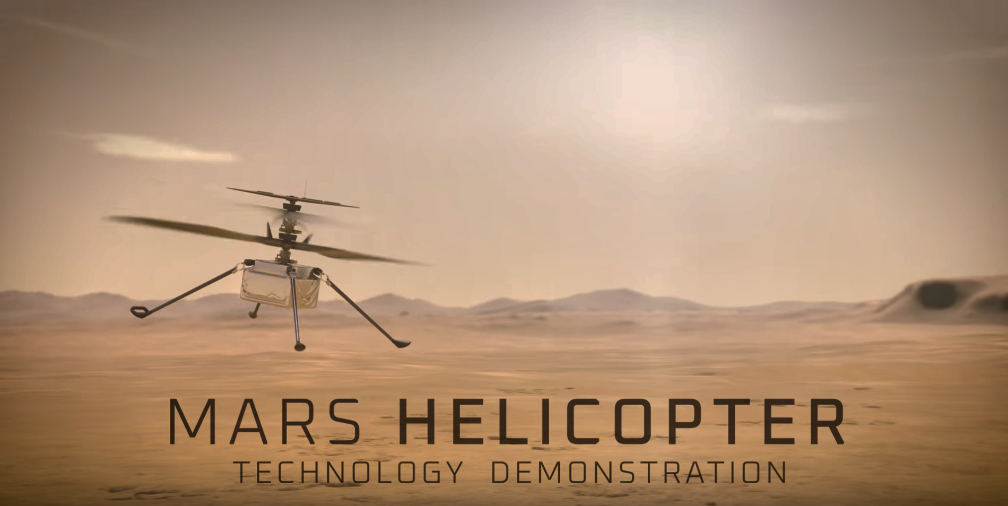
Project engineers and scientists will now put Perseverance through its paces, testing every instrument, subsystem, and subroutine over the next month or two. Only then will they deploy the helicopter to the surface for the flight test phase. If successful, Ingenuity could add an aerial dimension to exploration of the Red Planet in which such helicopters serve as a scouts or make deliveries for future astronauts away from their base.

Once Ingenuity’s test flights are complete, the rover’s search for evidence of ancient microbial life will begin in earnest.

“Perseverance is more than a rover, and more than this amazing collection of men and women that built it and got us here,” said John McNamee, Project manager of the Mars 2020 Perseverance rover mission at JPL. “It is even more than the 10.9 million people who signed up to be part of our mission. This mission is about what humans can achieve when they persevere. We made it this far. Now, watch us go.”

Original posting…

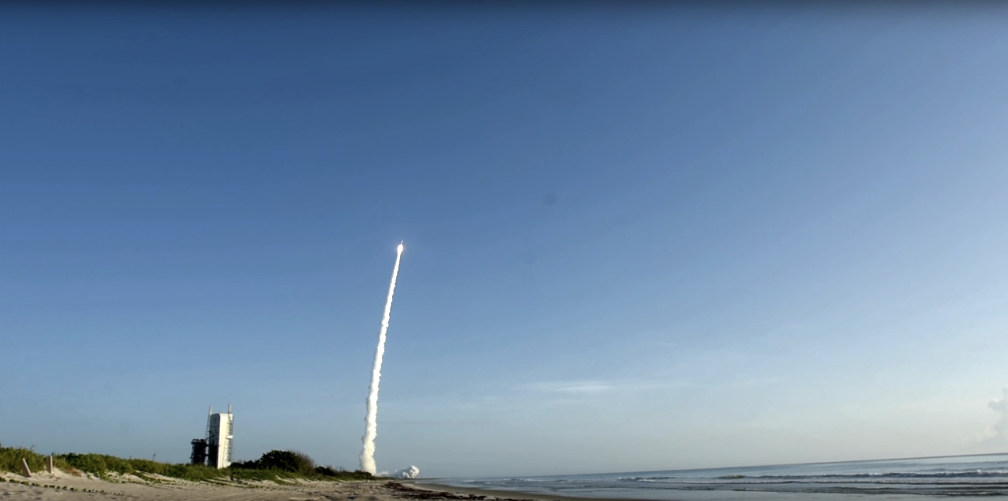
A United Launched Alliance (ULA) Atlas V rocket launched NASA’s Mars 2020 mission with the Perseverance rover and Ingenuity helicopter on July 30, 2020. After a seven-month journey, the rover is planning to land on Mars on Thursday, February 18. This event caps a 293-millon-mile journey at began atop a United Launch Alliance’s Atlas V rocket.
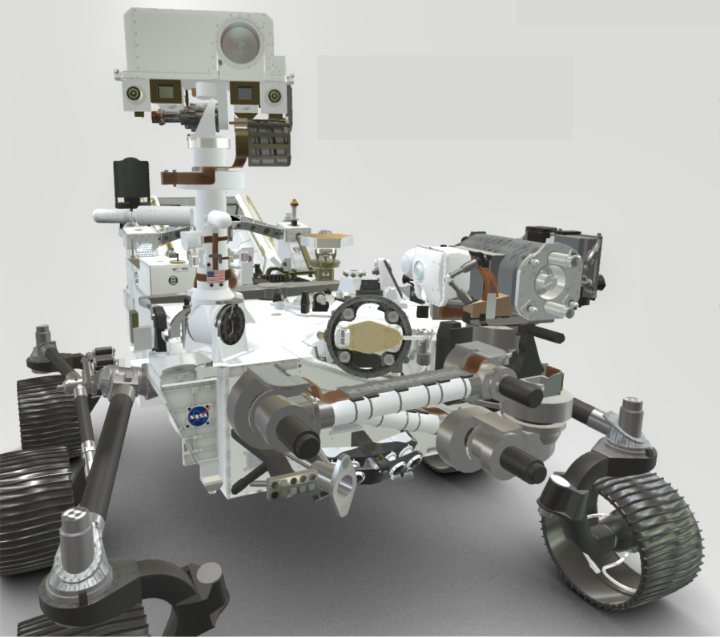
NASA’s Mars Rover, Perseverance.

ULA and the company’s heritage vehicles have launched every U.S. mission to the red planet — the launch of Mars 2020 marked ULA’s 20th trip. Perseverance launched aboard an Atlas V rocket in the 541 configuration, with a 5-meter payload fairing and four solid rocket boosters. The Atlas V rocket delivered Perseverance on an ultra-precise interplanetary trajectory to intercept Mars.
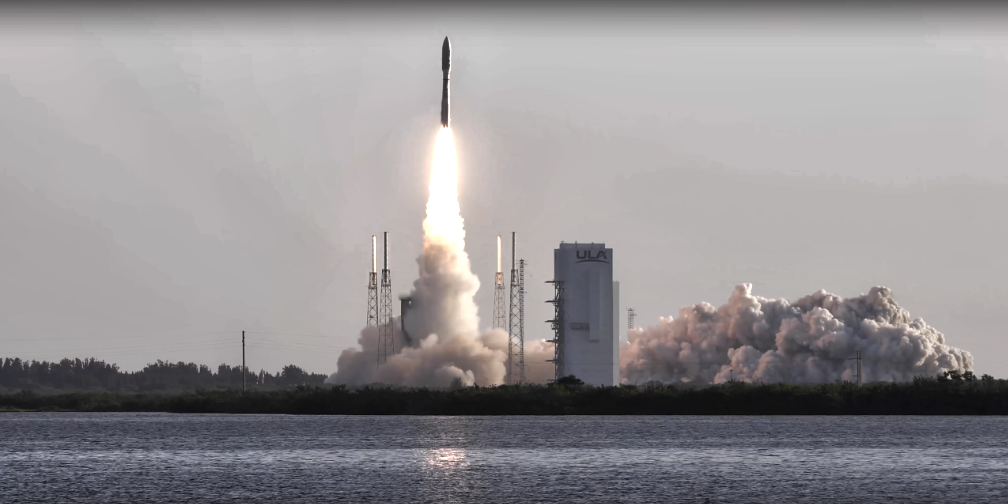
ULA’s Delta V rocket liftoff with Perseverance.

The Perseverance rover will explore an ancient river delta in Jezero Crater to study what the planet was like in its ancient history, seek signs of past microbial life, collect and store samples of selected rock and soil for future return to Earth, and prepare for future human missions. The rover will also deploy the Ingenuity helicopter, a technology demonstration to prove that powered flight can be achieved on Mars.
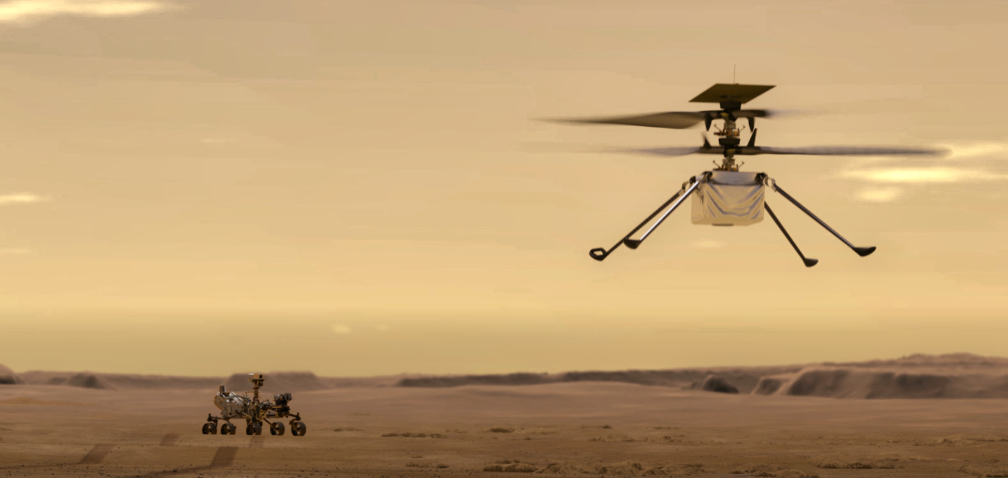
Artistic rendition of the Perseverance rover and Ingenuity helicopter operating on Mars.

The primary goal of the mission is determining whether life ever existed on Mars. Scientists believe evidence of microbial life may be preserved in Jezero, which holds rocks and minerals that could only form in water, and Perseverance is the first rover mission designed to discover signs of past life.

The Perseverance landing will be especially difficult as the rover will face the most challenging terrain ever targeted by a robotic spacecraft. Jezero Crater is a 28-mile-wide impact basin with steep cliffs, sand dunes, boulder fields, and smaller impact craters.

To date, ULA has launched 142 times with 100 percent mission success. ULA is proud to have been part of such a significant science mission continuing the Mars legacy to provide crucial knowledge and understanding of the red planet.

The Perseverance rover is scheduled to touch down on Mars on Thursday, February 18, at approximately 3:55 p.m. EST.

View the launch at this direct ULA streaming link…
Filed Under: Exploration & Science Missions, Market Forecasts Tagged With: Featured

Primary Sidebar

Coverage

  • Missions & Constellations
  • Business & Finance
  • Military & Defense
  • Launch
  • Software Automation & Ground Systems
  • Government & Regulation
  • Services & Applications

Most Read Stories

  • Space Force Reassigns Six National Security Launches to SpaceX Amid Vulcan Grounding
  • Blue Origin Reconstructs Launch Complex 36 Tower, Targets November Return to Flight for New Glenn
  • Xona Space Systems Secures $250M Series D at $2.45B Valuation to Scale Pulsar PNT Fleet
  • Amazon Navigates Launch Delays with Under 400 Satellites in Orbit Ahead of Nov. 13 Vulcan Return
  • Starlink Surges to 13.6 Million Subscribers as GSMA Assesses TAM Penetration and Telco Defense

Secondary Sidebar

Footer


Satnews is a leading provider of satellite news, events, publications, research and other satellite industry information in both commercial and military enterprises worldwide.

Stories By Category

  • Business & Finance
  • Government & Regulation
  • Launch
  • Military & Defense
  • Missions & Constellations
  • Services & Applications
  • Software Automation & Ground Systems
  • Spectrum & Licensing
  • Startups & NewSpace Business

About Us

  • Leadership & Editorial Team
  • SatNews History
  • Free Satnews Subscription
  • SatNews Events
  • Magazines

Navigation

  • Latest Stories
  • Magazines
  • Events
  • Contact
  • Cookie & Privacy Policy for Satnews

We use cookies to ensure that we give you the best experience on our website. If you continue to use this site we will assume that you are happy with it.
x
Sign up Now (For Free)
Access daily or weekly satellite news updates covering all aspects of the commercial and military satellite industry.
Invalid email address
Notify Me Regarding ( At least one ):
We value your privacy and will not sell or share your email or other information with any other company. You may also unsubscribe at anytime.

Click Here to see our full privacy policy.
Thanks for subscribing!