

• Skip to primary navigation
  • Skip to main content
  • Skip to primary sidebar
  • Skip to secondary sidebar
  • Skip to footer
  • NEWS:
  • SatNews
  • SatMagazine
  • MilSatMagazine
  • SmallSat News
  • |     EVENTS:
  • SmallSat Symposium
  • Satellite Innovation
  • MilSat Symposium
  • SmallSat Europe

SatNews

Satellite Industry Intelligence Since 1983

Subscribe
  • LATEST
  • SatNews Events
  • Magazines
  • Calendar
  • Subscribe
  • Missions & Constellations
    • Exploration & Science Missions
    • In-Orbit Servicing & Orbital Operations
    • LEO Constellations
    • Mission Autonomy & Onboard Systems
    • Mission Deployments & Manifests
    • Navigation & PNT
    • SmallSat
    • Spacecraft & Payload Technology
    View All in Missions & Constellations →
    Rohde & Schwarz Introduces Pulsar Signal Simulation to Advance Next-Gen PNT TestingRohde & Schwarz Introduces Pulsar Signal Simulation to Advance Next-Gen PNT Testing
    China Accelerates Orbital Internet Deployment with Successful Smart Dragon-3 Sea LaunchChina Accelerates Orbital Internet Deployment with Successful Smart Dragon-3 Sea Launch
    Smallsats Dominate 2025 Launch Landscape as Mass Efficiency PeaksSmallsats Dominate 2025 Launch Landscape as Mass Efficiency Peaks
    MIT STAR Lab Expands Scope from Lasercom Innovation to Space Policy ArchitectureMIT STAR Lab Expands Scope from Lasercom Innovation to Space Policy Architecture
  • Business
    • Contracts & Commercial Deals
    • Earnings & Financial Reporting
    • Events & Conferences
    • Funding & Venture Capital
    • Market Forecasts
    • Mergers & Acquisitions
    • Personnel Moves & Appointments
    View All in Business & Finance →
    Global Defense Leaders Convene as Space Symposium 41 Addresses Orbital SecurityGlobal Defense Leaders Convene as Space Symposium 41 Addresses Orbital Security
    SmallSat Europe Speaker Focus: Chris Quilty, Quilty SpaceSmallSat Europe Speaker Focus: Chris Quilty, Quilty Space
    “SpaceX and the biggest IPO in history”“SpaceX and the biggest IPO in history”
    SmallSat Europe Speaker Focus: Chiara Manfletti, NeuraspaceSmallSat Europe Speaker Focus: Chiara Manfletti, Neuraspace
  • Defense
    • Counterspace & ASAT
    • Defense Budgets & Procurement
    • ISR & Reconnaissance
    • MILSATCOM
    • Missile Warning & Defense
    • National Security Programs
    • Space Domain Awareness
    View All in Military & Defense →
    NRL to Showcase Sovereign Space Capabilities at 41st Space SymposiumNRL to Showcase Sovereign Space Capabilities at 41st Space Symposium
    Northrop Grumman Minotaur IV Lofted USSF Tech Demonstration Payloads to OrbitNorthrop Grumman Minotaur IV Lofted USSF Tech Demonstration Payloads to Orbit
    The End of the VSAT Parts BinThe End of the VSAT Parts Bin
    Procurement Lag vs. Conflict Speed: Can Defense Buying Cycles Keep Up with Space Innovation?Procurement Lag vs. Conflict Speed: Can Defense Buying Cycles Keep Up with Space Innovation?
  • Gov
    • Export Controls & Compliance
    • International Space Agreements
    • National Space Policy
    • Space Law & Treaties
    • Space Sustainability & Debris Policy
    • Space Traffic Management / Debris Removal
    View All in Government & Regulation →
    FCC Modernizes Satellite Spectrum Rules to Unleash Next-Generation BroadbandFCC Modernizes Satellite Spectrum Rules to Unleash Next-Generation Broadband
    SmallSat Europe Speaker Focus: Daniel Bock, Morpheus SpaceSmallSat Europe Speaker Focus: Daniel Bock, Morpheus Space
    SmallSat Europe Speaker Focus: Dr. Ane Aanesland, ThrustMeSmallSat Europe Speaker Focus: Dr. Ane Aanesland, ThrustMe
    Isaacman’s Budget Math: How NASA Plans to Reach the Moon With a Quarter Less MoneyIsaacman’s Budget Math: How NASA Plans to Reach the Moon With a Quarter Less Money
  • Launch
    • Launch Providers
    • Launch Schedule & Calendars
    • Launch Sites & Infrastructure
    • Rocket Technology & Vehicles
    View All in Launch →
    What the SpaceX IPO Changes for Every Satellite OperatorWhat the SpaceX IPO Changes for Every Satellite Operator
    €30 million Financing for PLD Space’s Small Satellite Launcher€30 million Financing for PLD Space’s Small Satellite Launcher
    Satellite Deployers to be Used on JAXA Small Satellite Mission by ExolaunchSatellite Deployers to be Used on JAXA Small Satellite Mission by Exolaunch
    CAS Space Successfully Launches Kinetica-2, Aiming for Global Cost LeadershipCAS Space Successfully Launches Kinetica-2, Aiming for Global Cost Leadership
  • Software
    • Autonomous Ground Operations
    • Data Processing & AI/ML
    • Digital Twins & Modeling
    • Ground Segment & Teleports
    • Mission Planning & Simulation
    • Space Systems Software Engineering
    • Spectrum & Licensing
    View All in Software Automation & Ground Systems →
    Cloudcomputing Targets 1.5M Identities in Spain and Finalizes Innovate IT AcquisitionCloudcomputing Targets 1.5M Identities in Spain and Finalizes Innovate IT Acquisition
    Archangel Lightworks Secures £10M Series A to Scale Optical Ground InfrastructureArchangel Lightworks Secures £10M Series A to Scale Optical Ground Infrastructure
    Keysight and Sateliot Win ESA and GSMA Foundry Challenge for 6G InnovationKeysight and Sateliot Win ESA and GSMA Foundry Challenge for 6G Innovation
    Automation and Agility: How SSC Space Go is Designed for the New Age of GroundAutomation and Agility: How SSC Space Go is Designed for the New Age of Ground
  • Services & Apps
    • Climate & Environmental Monitoring
    • Disaster Response & Security Mapping
    • Earth Observation & Imaging
    • Maritime & Aviation Satcom
    • Satellite Communications
    View All in Services & Applications →
    Kraken Robotics Integrates KATFISH Sonar on SEFINE RD-22 USV Following Multi-Naval DemonstrationsKraken Robotics Integrates KATFISH Sonar on SEFINE RD-22 USV Following Multi-Naval Demonstrations
    Astroscale Plans World-First Multi-Orbit Satellite Inspection MissionAstroscale Plans World-First Multi-Orbit Satellite Inspection Mission
    The Downlink Deficit: The Pentagon’s Optical Mesh Network and the Terrestrial BottleneckThe Downlink Deficit: The Pentagon’s Optical Mesh Network and the Terrestrial Bottleneck
    Cinemo Reimagines the Vehicle as a Software-Defined Entertainment HubCinemo Reimagines the Vehicle as a Software-Defined Entertainment Hub

UPDATE: Mission Failure Arianespace’s Vega VV17 — SEOSAT-Ingenio / TARANIS: Lost

November 17, 2020

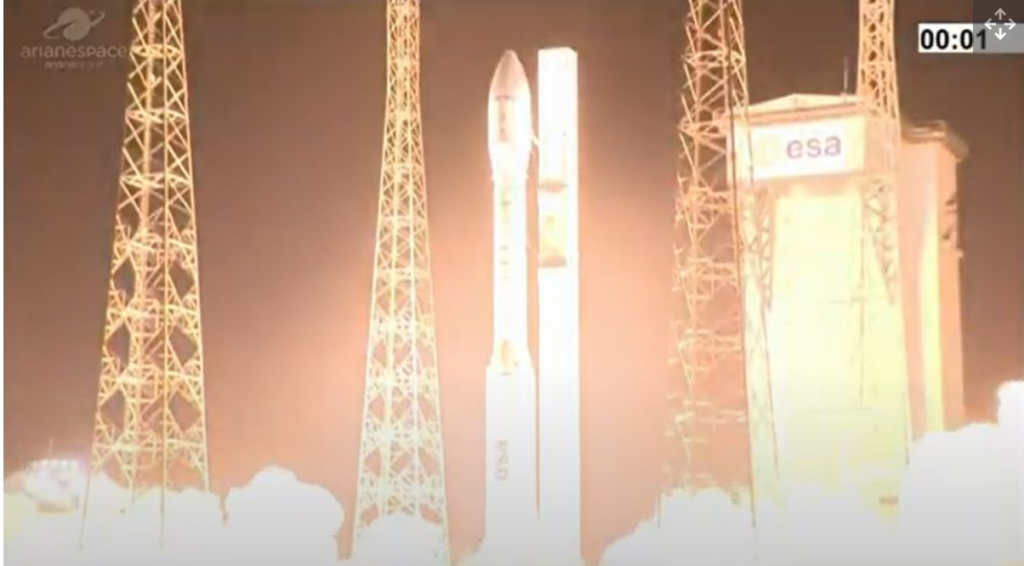
An Arianespace Vega rocket carrying two satellites for Spain and France lifts off from a pad at the Guiana Space Center in Kourou, French Guiana on Nov. 16, 2020. The rocket failed eight minutes into flight, leading to the loss of both satellites. (Image credit: Arianespace)

Thankfully, news of this sort, regarding a mission failure, is a rarity and unfortunate in many ways. Vega launched and appeared to be flying smoothly, but after eight minutes, issues occurred that resulted in the loss of satellites for Spain and France.

The Arianespace Vega VV17 mission launched on Tuesday, November 16, from the Guyana Space Center and was carrying two payloads: SEOSAT-Ingenio, an Earth-science observation satellite for the European Space Agency (ESA) and TARANIS for France’s National Centre for Space Studies (CNES).

The Vega launch vehicle lifted off as scheduled. The first three stages functioned nominally until the ignition of the AVUM upper stage, eight minutes after departure from the launch pad. At that time, a degraded trajectory was detected, followed by a loss of control of the vehicle and the subsequent loss of the mission. The launcher fell in a completely uninhabited area close to the drop zone planned for the Zefiro 9 stage.

There will be research and investigations, and hopefully when the final analysis is provided the industry will be that much the wiser for it. The following is the brief announcement just released by Arianespace.

“Eight minutes after liftoff of Vega mission VV17, following the first ignition of the engine of the Avum upper stage, a deviation of trajectory was identified, entailing the loss of the mission,” stated the company. “Telemetry data analyses are in progress to determine the cause of this failure.“

“We can now confirm that the mission is lost,” Arianespace CEO Stéphane Israël said during the launch webcast.

“Eight minutes after the liftoff, and immediately after the ignition of the engine of the fourth stage of Vega, the Avum stage, we have observed the degradation of the trajectory,” Israël said. “It means that the speed was not nominal anymore.

“I want to present my deepest apologies to my customers for this mission,” Israël said. “Arianespace is presenting its apologies and we have now to analyze and to understand.”

Initial investigations, conducted overnight with the available data, a problem related to the integration of the fourth-stage AVUM nozzle activation system is the most likely cause of the loss of control of the launcher.

In accordance with their standard protocols, Arianespace and the European Space Agency (ESA) will set up an independent Inquiry Commission jointly chaired by Daniel Neuenschwander, Director of Space Transport at ESA, and Stéphane Israël, Arianespace Chief Executive Officer, on November 18.

The Commission will provide detailed evidence to explain why steps were not taken to identify and correct the integration error. The Commission will formulate a road map for the Vega’s return to flight under conditions of complete reliability. Arianespace and ESA will jointly present the findings of this commission.

Arianespace expresses its deepest apologies to the clients and the satellite manufacturers involved in this mission.

This is the second major malfunction of the Vega rocket in two years.

In July 2019, a Vega rocket failed during the launch of a satellite for the United Arab Emirates. A subsequent investigation found that a faulty motor on the booster was to blame.

This Vega flight would have celebrated a first — the two passengers on Arianespace’s upcoming Vega flight would have focused on the Earth and its dynamic atmosphere above thunderstorms .

The mission was to release the two European spacecraft into Sun-Synchronous Orbits (SSO). Both satellites would have operated in similar orbits at an altitude of approximately 700 km.

The satellites’ arrangement placed SEOSAT-Ingenio atop a dispenser system called VESPA (Vega Secondary Payload Adaptor), produced by Airbus in Spain for Vega launcher prime contractor Avio. Positioned inside the VESPA structure is TARANIS. =

The following information was provided before the failure…
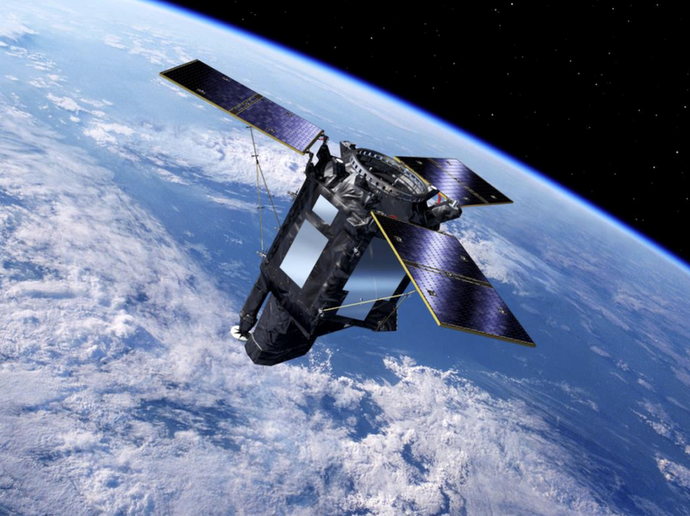
SEOSAT-Ingenio

To be deployed 54 minutes after Vega’s liftoff, SEOSAT-Ingenio is the first Spanish Earth observation satellite – designed to provide information for national applications in cartography, land use, urban management, water management, environmental monitoring, risk management and security.

SEOSAT-Ingenio was built by an industrial consortium of Spanish space-sector companies led by Airbus Defence and Space. It is being launched for the European Space Agency (ESA) at the benefit of Spain’s CDTI (Center for Development of Industrial Technology).

The Spanish Instituto Nacional de Técnica Aeroespacial (INTA), will own and operate the satellite — which has an estimated liftoff mass of 788 kg.

In a shift from typical payload processing practices at the Spaceport, SEOSAT-Ingenio has undergone its preparations with a see-through protective cover made of conductive material, which ensures an extra-high degree of cleanliness.
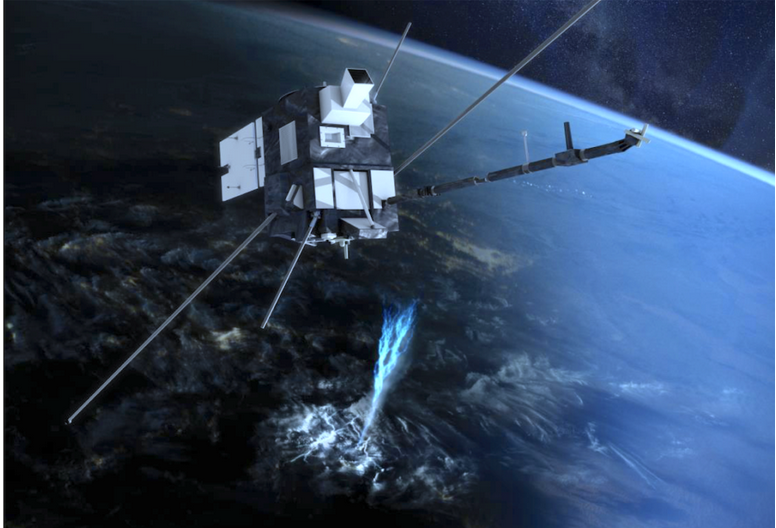
TARANIS (which also stands for “Tool for the Analysis of RAdiation from lightNIng and Sprites”

Launched for the French CNES space agency as its customer and spacecraft prime contractor, TARANIS is the first satellite designed to observe the mysterious red sprites, blue jets, elves and sprite halos that occur at altitudes of 20 to 100 km. above thunderstorms. More formally known as transient luminous events (TLEs), they are categorized as luminous, radiative and electromagnetic phenomena.

During the course of its mission, TARANIS will overfly thousands of transient luminous events – detecting these occurrences and recording their luminous and radiative signatures at high resolution. In addition to its role as a fundamental research satellite, data on Earth’s thermal and climate mechanisms to be gathered by TARANIS could serve more operational applications such climatology and weather forecasting.

Liftoff mass of the spacecraft, which is part of CNES’ family of Myriade small satellites, is estimated at 175 kg. The spacecraft is named TARANIS after the Celtic god of thunder and lightning, and also is the acronym of: Tool for the Analysis of RAdiation from lightNIng and Sprites.

Flight VV17 will be Arianespace’s seventh mission this year using members of its launcher family. It follows three previous flights in 2020 with Ariane 5, two using Soyuz, and Vega’s September success that validated the Small Spacecraft Mission Service (SSMS) shared launch concept.

Filed Under: Earth Observation & Imaging, Market Forecasts

Primary Sidebar

Coverage

  • Missions & Constellations
  • Business & Finance
  • Military & Defense
  • Launch
  • Software Automation & Ground Systems
  • Government & Regulation
  • Services & Applications

Most Read Stories

  • L3Harris Unveils XL-300P: The First P25 Handheld with 5G and Satellite Direct-to-Device Connectivity
  • SpaceX Loses Contact With Starlink Satellite
  • Rheinmetall Walked Away. Germany Should Take the Hint.
  • Rocket Lab Emerging as Potential Bus Provider for 2,800-Satellite Equatys Constellation
  • SpaceX Accelerates Record-Breaking IPO Following Trillion-Dollar xAI Merger

Secondary Sidebar

Footer


Satnews is a leading provider of satellite news, events, publications, research and other satellite industry information in both commercial and military enterprises worldwide.

Stories By Category

  • Business & Finance
  • Government & Regulation
  • Launch
  • Military & Defense
  • Missions & Constellations
  • Services & Applications
  • Software Automation & Ground Systems
  • Spectrum & Licensing
  • Startups & NewSpace Business

About Us

  • Leadership & Editorial Team
  • SatNews History
  • Free Satnews Subscription
  • SatNews Events
  • Magazines

Navigation

  • Latest Stories
  • Magazines
  • Events
  • Contact
  • Cookie & Privacy Policy for Satnews

We use cookies to ensure that we give you the best experience on our website. If you continue to use this site we will assume that you are happy with it.
x
Sign up Now (For Free)
Access daily or weekly satellite news updates covering all aspects of the commercial and military satellite industry.
Invalid email address
Notify Me Regarding ( At least one ):
We value your privacy and will not sell or share your email or other information with any other company. You may also unsubscribe at anytime.

Click Here to see our full privacy policy.
Thanks for subscribing!