

• Skip to primary navigation
  • Skip to main content
  • Skip to primary sidebar
  • Skip to secondary sidebar
  • Skip to footer
  • NEWS:
  • SatNews
  • SatMagazine
  • MilSatMagazine
  • SmallSat News
  • |     EVENTS:
  • SmallSat Symposium
  • Satellite Innovation
  • MilSat Symposium
  • SmallSat Europe

SatNews

Satellite Industry Intelligence Since 1983

Subscribe
  • LATEST
  • SatNews Events
  • Magazines
  • Calendar
  • Subscribe
  • Missions & Constellations
    • Exploration & Science Missions
    • In-Orbit Servicing & Orbital Operations
    • LEO Constellations
    • Mission Autonomy & Onboard Systems
    • Mission Deployments & Manifests
    • Navigation & PNT
    • SmallSat
    • Spacecraft & Payload Technology
    View All in Missions & Constellations →
    Iridium Unveils Core Role in Artemis II and Next-Gen PNT at Space Symposium 2026Iridium Unveils Core Role in Artemis II and Next-Gen PNT at Space Symposium 2026
    Boeing and Millennium Unveil Resolute Mid-Class Satellite PlatformBoeing and Millennium Unveil Resolute Mid-Class Satellite Platform
    NASA Shifts Focus to Permanent Lunar Base and Nuclear PropulsionNASA Shifts Focus to Permanent Lunar Base and Nuclear Propulsion
    Kepler and Astrolight Secure ESA Contract for HydRON Optical NetworkKepler and Astrolight Secure ESA Contract for HydRON Optical Network
  • Business
    • Contracts & Commercial Deals
    • Earnings & Financial Reporting
    • Events & Conferences
    • Funding & Venture Capital
    • Market Forecasts
    • Mergers & Acquisitions
    • Personnel Moves & Appointments
    View All in Business & Finance →
    SmallSat Europe Speaker Focus: Jaume Sanpera, SateliotSmallSat Europe Speaker Focus: Jaume Sanpera, Sateliot
    Ericsson Initiates SEK 15 Billion Share Buyback ProgramEricsson Initiates SEK 15 Billion Share Buyback Program
    Saltzman Unveils 2040 Blueprint to Scale Space Force for Great Power CompetitionSaltzman Unveils 2040 Blueprint to Scale Space Force for Great Power Competition
    SmallSat Europe Speaker Focus: Col. Marcin Mazur, Polish Space AgencySmallSat Europe Speaker Focus: Col. Marcin Mazur, Polish Space Agency
  • Defense
    • Counterspace & ASAT
    • Defense Budgets & Procurement
    • ISR & Reconnaissance
    • MILSATCOM
    • Missile Warning & Defense
    • National Security Programs
    • Space Domain Awareness
    View All in Military & Defense →
    The Rise of Grey Zone Satellites: Ambiguity as a Tactical AdvantageThe Rise of Grey Zone Satellites: Ambiguity as a Tactical Advantage
    US Space Force Awards $68.6M Modification to Lockheed Martin for Next-Gen OPIRUS Space Force Awards $68.6M Modification to Lockheed Martin for Next-Gen OPIR
    General Atomics Completes Pre-Ship Review for Space Force Weather PayloadGeneral Atomics Completes Pre-Ship Review for Space Force Weather Payload
    Global Defense Leaders Convene as Space Symposium 41 Addresses Orbital SecurityGlobal Defense Leaders Convene as Space Symposium 41 Addresses Orbital Security
  • Gov
    • Export Controls & Compliance
    • International Space Agreements
    • National Space Policy
    • Space Law & Treaties
    • Space Sustainability & Debris Policy
    • Space Traffic Management / Debris Removal
    View All in Government & Regulation →
    SmallSat Europe Speaker Focus: Chris Quilty, Quilty SpaceSmallSat Europe Speaker Focus: Chris Quilty, Quilty Space
    NRL to Showcase Sovereign Space Capabilities at 41st Space SymposiumNRL to Showcase Sovereign Space Capabilities at 41st Space Symposium
    FCC Modernizes Satellite Spectrum Rules to Unleash Next-Generation BroadbandFCC Modernizes Satellite Spectrum Rules to Unleash Next-Generation Broadband
    SmallSat Europe Speaker Focus: Daniel Bock, Morpheus SpaceSmallSat Europe Speaker Focus: Daniel Bock, Morpheus Space
  • Launch
    • Launch Providers
    • Launch Schedule & Calendars
    • Launch Sites & Infrastructure
    • Rocket Technology & Vehicles
    View All in Launch →
    Ensign-Bickford Hardware Supports Successful Artemis II Lunar MissionEnsign-Bickford Hardware Supports Successful Artemis II Lunar Mission
    China Accelerates Orbital Internet Deployment with Successful Smart Dragon-3 Sea LaunchChina Accelerates Orbital Internet Deployment with Successful Smart Dragon-3 Sea Launch
    What the SpaceX IPO Changes for Every Satellite OperatorWhat the SpaceX IPO Changes for Every Satellite Operator
    €30 million Financing for PLD Space’s Small Satellite Launcher€30 million Financing for PLD Space’s Small Satellite Launcher
  • Software
    • Autonomous Ground Operations
    • Data Processing & AI/ML
    • Digital Twins & Modeling
    • Ground Segment & Teleports
    • Mission Planning & Simulation
    • Space Systems Software Engineering
    • Spectrum & Licensing
    View All in Software Automation & Ground Systems →
    Cloudcomputing Targets 1.5M Identities in Spain and Finalizes Innovate IT AcquisitionCloudcomputing Targets 1.5M Identities in Spain and Finalizes Innovate IT Acquisition
    Archangel Lightworks Secures £10M Series A to Scale Optical Ground InfrastructureArchangel Lightworks Secures £10M Series A to Scale Optical Ground Infrastructure
    Keysight and Sateliot Win ESA and GSMA Foundry Challenge for 6G InnovationKeysight and Sateliot Win ESA and GSMA Foundry Challenge for 6G Innovation
    Automation and Agility: How SSC Space Go is Designed for the New Age of GroundAutomation and Agility: How SSC Space Go is Designed for the New Age of Ground
  • Services & Apps
    • Climate & Environmental Monitoring
    • Disaster Response & Security Mapping
    • Earth Observation & Imaging
    • Maritime & Aviation Satcom
    • Satellite Communications
    View All in Services & Applications →
    NASA Targets Commercial Relays to Replace Aging TDRSS InfrastructureNASA Targets Commercial Relays to Replace Aging TDRSS Infrastructure
    OQ Technology Awarded ESA Contract to Adapt 5G Beamforming for SpaceOQ Technology Awarded ESA Contract to Adapt 5G Beamforming for Space
    Kraken Robotics Integrates KATFISH Sonar on SEFINE RD-22 USV Following Multi-Naval DemonstrationsKraken Robotics Integrates KATFISH Sonar on SEFINE RD-22 USV Following Multi-Naval Demonstrations
    Astroscale Plans World-First Multi-Orbit Satellite Inspection MissionAstroscale Plans World-First Multi-Orbit Satellite Inspection Mission

Tel Aviv University’s TAU-SAT1 Smallsat Now Undergoing Pre-Flight Testing — Launch Set For Q1 Of 2021

November 5, 2020

The TAU-SAT1 smallsat was devised, developed, assembled, and tested at the new Nanosatellite Center, an interdisciplinary endeavor of the Faculties of Engineering and Exact Sciences and the Porter School of the Environment and Earth Sciences, at Tel Aviv University.
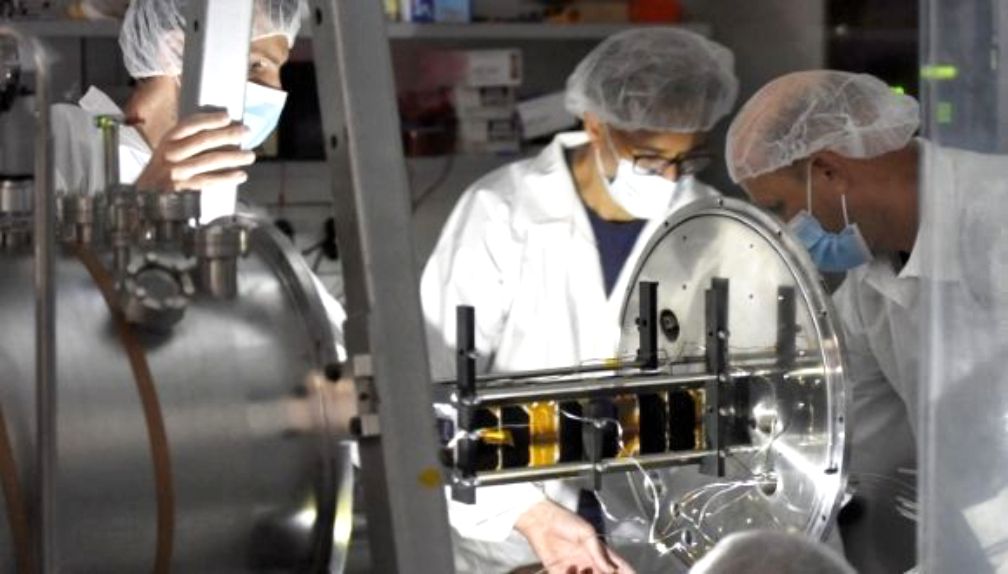
TAU-SAT1 in the cleanroom.

TAU-SAT1 is currently undergoing pre-flight testing at the Japanese space agency, JAXA. From Japan, the satellite will be sent to the United States, where it will “hitch a ride” on a NASA and Northrop Grumman resupply spacecraft destined for the International Space Station in the first quarter of 2021. Once at the station, a robotic arm will release TAU-SAT1 into LEO approximately 400 km above the Earth.

TAU-SAT1 is a research satellite, and will conduct several experiments while on-orbit. Among other things, Tel Aviv University’s satellite will measure cosmic radiation in space.
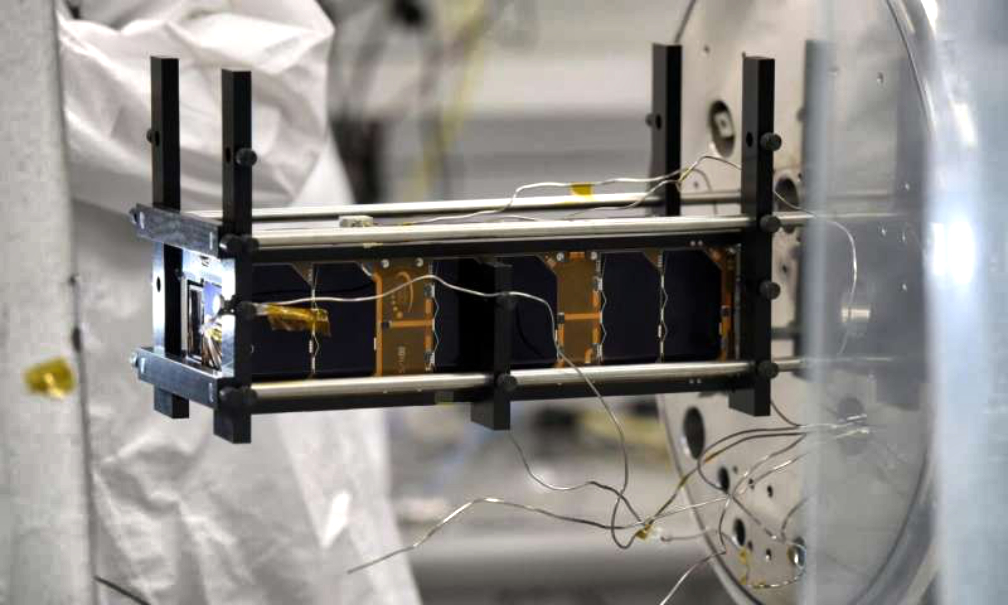
Photo of the TAU-SAT1 smallsat.

A challenge that presented itself was how to extract the data collected by the TAU-SAT1 satellite. At an altitude of 400 km above sea level, the nanosatellite will orbit the earth at 27,600 km per hour, or 7.6 km per second. At this speed, the satellite will complete an orbit around the Earth every 90 minutes.

And this is just the beginning…

But launching the TAU-SAT1 nanosatellite is only Tel Aviv University’s first step on its way to joining the “new space” revolution. The idea behind the new space revolution is to open space up to civilians as well. Our satellite was built and tested with the help of a team of students and researchers. Moreover, we built the infrastructure on our own – from the cleanrooms, to the various testing facilities such as the thermal vacuum chamber, to the receiving and transmission station we placed on the roof.

Now that the infrastructure is ready, the university will begin to develop TAU-SAT2. The idea is that any researcher and any student, from any faculty at Tel Aviv University, or outside of it, will be able to plan and launch experiments into space in the future – even without being an expert in the field.
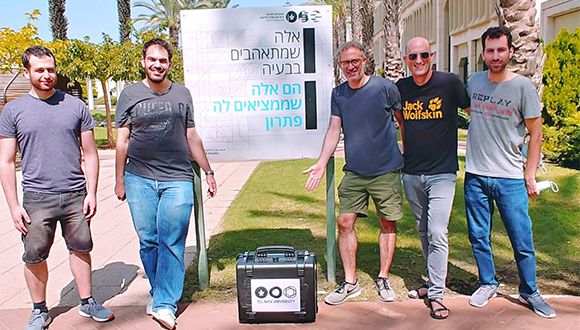
The TAU-SAT1 team here on campus before leaving for the airport.

It will have been only two years from the moment that we began all of the above-mentioned activities until the satellite is launched – this is an achievement that would not have been possible without the involvement of many people: the university administration, who supported the project and the setting up of the infrastructure on campus, Prof. Yossi Rosenwaks, Dean of the Faculty of Engineering, Professors Sivan Toledoand Haim Suchowski from the Faculty of Exact Sciences, and, most importantly, the project team that dealt with R&D around the clock: Elad Sagi, Dolev Bashi, Tomer Nahum, Idan Finkelstein, Dr. Diana Laufer, Eitan Shlisel, Eran Levin, David Greenberg, Sharon Mishal, and Orly Blumberg.

Executive Comments

“This is a nanosatellite, or miniature satellite, of the ‘cubesSat’ variety,” explained Dr. Ofer Amrani, head of Tel Aviv University’s smallsat lab. “The satellite’s dimensions are 10 by 10 by 30 cm, the size of a shoebox and it weighs less than 2.5 kg. TAU-SAT1 is the first nanosatellite designed, built and tested independently in academia in Israel. In order to collect data, we built a satellite station on the roof of the engineering building. Our station, which also serves as an amateur radio station, includes a number of antennas and an automated control system.

“When TAU-SAT1 passes ‘over’ the State of Israel, that is, within a few thousand kilometer radius from the ground station’s receiving range, the antennas will track the satellite’s orbit and a process of data transmission will occur between the satellite and the station. Such transmissions will take place about four times a day, with each one lasting less than 10 minutes. In addition to its scientific mission, the satellite will also serve as a space relay station for amateur radio communities around the world. In total, the satellite is expected to be active for several months. Because it has no engine, its trajectory will fade over time as the result of atmospheric drag – it will burn up in the atmosphere and come back to us as stardust.“

In the last few years, Tel Aviv University has been working on establishing a Nanosatellite Center to build small “shoebox” size satellites for launch into space. “We are seeing a revolution in the field of civilian space,” explained Professor Colin Price, one of the academic heads of the new center. “We call this new space as opposed to the old space where only giant companies with huge budgets and large teams of engineers could build satellites. As a result of miniaturization and modulation of many technologies, today universities are building small satellites that can be developed and launched in less than 2 years, and at a fraction of the budget in the old space. We have just completed the building of Tel Aviv University’s first nano-satellite, and it is ready for launch.”

“We know that that there are high-energy particles moving through space that originate from cosmic radiation,” stated Dr. Meir Ariel, Director of the university’s Nanosatellite Center. “Our scientific task is to monitor this radiation, and to measure the flux of these particles and their products. It should be understood that space is a hostile environment, not only for humans but also for electronic systems. When these particles hit astronauts or electronic equipment in space, they can cause significant damage. The scientific information collected by our satellite will make it possible to design means of protection for astronauts and space systems. To this end, we incorporated a number of experiments into the satellite, which were developed by the Space Environment Department at the Soreq Nuclear Research Center.”

Filed Under: SmallSat

Primary Sidebar

Coverage

  • Missions & Constellations
  • Business & Finance
  • Military & Defense
  • Launch
  • Software Automation & Ground Systems
  • Government & Regulation
  • Services & Applications

Most Read Stories

  • SpaceX Loses Contact With Starlink Satellite
  • Rocket Lab Emerging as Potential Bus Provider for 2,800-Satellite Equatys Constellation
  • SpaceX Accelerates Record-Breaking IPO Following Trillion-Dollar xAI Merger
  • Planet Labs Imposes Indefinite Blackout on Iran Satellite Imagery at U.S. Request
  • Amazon in Reported Talks to Acquire Globalstar in $9 Billion Move to Challenge Starlink

Secondary Sidebar

Footer


Satnews is a leading provider of satellite news, events, publications, research and other satellite industry information in both commercial and military enterprises worldwide.

Stories By Category

  • Business & Finance
  • Government & Regulation
  • Launch
  • Military & Defense
  • Missions & Constellations
  • Services & Applications
  • Software Automation & Ground Systems
  • Spectrum & Licensing
  • Startups & NewSpace Business

About Us

  • Leadership & Editorial Team
  • SatNews History
  • Free Satnews Subscription
  • SatNews Events
  • Magazines

Navigation

  • Latest Stories
  • Magazines
  • Events
  • Contact
  • Cookie & Privacy Policy for Satnews

We use cookies to ensure that we give you the best experience on our website. If you continue to use this site we will assume that you are happy with it.
x
Sign up Now (For Free)
Access daily or weekly satellite news updates covering all aspects of the commercial and military satellite industry.
Invalid email address
Notify Me Regarding ( At least one ):
We value your privacy and will not sell or share your email or other information with any other company. You may also unsubscribe at anytime.

Click Here to see our full privacy policy.
Thanks for subscribing!