

• Skip to primary navigation
  • Skip to main content
  • Skip to primary sidebar
  • Skip to secondary sidebar
  • Skip to footer
  • NEWS:
  • SatNews
  • SatMagazine
  • MilSatMagazine
  • SmallSat News
  • |     EVENTS:
  • SmallSat Symposium
  • Satellite Innovation
  • MilSat Symposium
  • SmallSat Europe

SatNews

Satellite Industry Intelligence Since 1983

Subscribe
  • LATEST
  • SatNews Events
  • Magazines
  • Calendar
  • Subscribe
  • Missions & Constellations
    • Exploration & Science Missions
    • In-Orbit Servicing & Orbital Operations
    • LEO Constellations
    • Mission Autonomy & Onboard Systems
    • Mission Deployments & Manifests
    • Navigation & PNT
    • SmallSat
    • Spacecraft & Payload Technology
    View All in Missions & Constellations →
    The FCC Asked Cowboy Space How Big Its Satellites AreThe FCC Asked Cowboy Space How Big Its Satellites Are
    Loft Orbital and Marlan Space Award $1 Billion Contract for 50 AI-Equipped LEO SatellitesLoft Orbital and Marlan Space Award $1 Billion Contract for 50 AI-Equipped LEO Satellites
    Eutelsat Places €1 Billion Satellite Order to Expand OneWeb LEO ConstellationEutelsat Places €1 Billion Satellite Order to Expand OneWeb LEO Constellation
    Iridium, Deutsche Telekom IoT, and Toyota Demonstrate Satellite Voice Messaging via Iridium NTN DirectIridium, Deutsche Telekom IoT, and Toyota Demonstrate Satellite Voice Messaging via Iridium NTN Direct
  • Business
    • Contracts & Commercial Deals
    • Earnings & Financial Reporting
    • Events & Conferences
    • Funding & Venture Capital
    • Market Forecasts
    • Mergers & Acquisitions
    • Personnel Moves & Appointments
    View All in Business & Finance →
    The Exploration Company Secures $450 Million Series C Financing to Scale Nyx Reusable Spacecraft PlatformThe Exploration Company Secures $450 Million Series C Financing to Scale Nyx Reusable Spacecraft Platform
    Silicon Valley Space Week Speaker Focus: Courtney Sayles, Scout SpaceSilicon Valley Space Week Speaker Focus: Courtney Sayles, Scout Space
    SueWallSt and SBS Law Issue October 30 Lead Plaintiff Deadline Reminder for York Space Systems Securities LitigationSueWallSt and SBS Law Issue October 30 Lead Plaintiff Deadline Reminder for York Space Systems Securities Litigation
    AvL Technologies Awarded $31 Million Contract for WGS-Certified Satellite Terminals to Support Polish Armed ForcesAvL Technologies Awarded $31 Million Contract for WGS-Certified Satellite Terminals to Support Polish Armed Forces
  • Defense
    • Counterspace & ASAT
    • Defense Budgets & Procurement
    • ISR & Reconnaissance
    • MILSATCOM
    • Missile Warning & Defense
    • National Security Programs
    • Space Domain Awareness
    View All in Military & Defense →
    XipLink Secures $1+ Million Defense Contract for Multi-Orbit Networking in AsiaXipLink Secures $1+ Million Defense Contract for Multi-Orbit Networking in Asia
    Eutelsat Names Eclipse as First European OneWeb Government Aviation Distribution Partner for French Defense FleetsEutelsat Names Eclipse as First European OneWeb Government Aviation Distribution Partner for French Defense Fleets
    Kawasaki Heavy Industries and EdgeCortix Partner to Develop AI-Enabled Aerial Defense PlatformsKawasaki Heavy Industries and EdgeCortix Partner to Develop AI-Enabled Aerial Defense Platforms
    Kymeta Secures $20 Million Department of Defense Order for Resilient Flat-Panel SATCOM TerminalsKymeta Secures $20 Million Department of Defense Order for Resilient Flat-Panel SATCOM Terminals
  • Gov
    • Export Controls & Compliance
    • International Space Agreements
    • National Space Policy
    • Space Law & Treaties
    • Space Sustainability & Debris Policy
    • Space Traffic Management / Debris Removal
    View All in Government & Regulation →
    GSMA Intelligence Highlights UK Space Strategy Opportunities Within European Satellite EcosystemGSMA Intelligence Highlights UK Space Strategy Opportunities Within European Satellite Ecosystem
    ISRO Clarifies National Space Mandate, Confirming Agency Will Not Face PrivatizationISRO Clarifies National Space Mandate, Confirming Agency Will Not Face Privatization
    U.S. Commercial Launch and Satellite Operators Withdraw from European Space Summit Following White House InterventionsU.S. Commercial Launch and Satellite Operators Withdraw from European Space Summit Following White House Interventions
    No Robot Has Captured an Uncontrolled Satellite. The Pentagon Is Buying It Anyway.No Robot Has Captured an Uncontrolled Satellite. The Pentagon Is Buying It Anyway.
  • Launch
    • Launch Providers
    • Launch Schedule & Calendars
    • Launch Sites & Infrastructure
    • Rocket Technology & Vehicles
    View All in Launch →
    Arianespace Secures Contract for 10 Ariane 64 Launch Vehicles, Allocating Six Missions to Amazon LeoArianespace Secures Contract for 10 Ariane 64 Launch Vehicles, Allocating Six Missions to Amazon Leo
    ICEYE and Arianespace Execute Agreement to Evaluate Ariane 6 for Sovereign SAR MissionsICEYE and Arianespace Execute Agreement to Evaluate Ariane 6 for Sovereign SAR Missions
    SSC Space and Firefly Aerospace Sign Contract for Two Alpha Launches from Esrange Space CenterSSC Space and Firefly Aerospace Sign Contract for Two Alpha Launches from Esrange Space Center
    Impulse Space Completes Sub-200-Meter Proximity Flyby Between LEO Express SpacecraftImpulse Space Completes Sub-200-Meter Proximity Flyby Between LEO Express Spacecraft
  • Software
    • Autonomous Ground Operations
    • Data Processing & AI/ML
    • Digital Twins & Modeling
    • Ground Segment & Teleports
    • Mission Planning & Simulation
    • Space Systems Software Engineering
    • Spectrum & Licensing
    View All in Software Automation & Ground Systems →
    Cailabs and RBC Signals Partner to Develop Global Optical Ground Station NetworkCailabs and RBC Signals Partner to Develop Global Optical Ground Station Network
    Eutelsat and Skynopy Partner to Launch Global AKAR Software-Defined Ground NetworkEutelsat and Skynopy Partner to Launch Global AKAR Software-Defined Ground Network
    Ground Control Highlights Satellite IoT as Essential Enabler for UK’s 2027 BVLOS Drone MandateGround Control Highlights Satellite IoT as Essential Enabler for UK’s 2027 BVLOS Drone Mandate
    Royal Wagenborg Selects De Boer Marine for Fleetwide Maritime Connectivity and Cybersecurity IntegrationRoyal Wagenborg Selects De Boer Marine for Fleetwide Maritime Connectivity and Cybersecurity Integration
  • Services & Apps
    • Climate & Environmental Monitoring
    • Disaster Response & Security Mapping
    • Earth Observation & Imaging
    • Maritime & Aviation Satcom
    • Satellite Communications
    View All in Services & Applications →
    SES Introduces SES CORE Hybrid Content Delivery and Orchestration PlatformSES Introduces SES CORE Hybrid Content Delivery and Orchestration Platform
    GomSpace and KFUPM Sign Strategic Space Agreement to Cooperate on Small Satellites in Saudi ArabiaGomSpace and KFUPM Sign Strategic Space Agreement to Cooperate on Small Satellites in Saudi Arabia
    Final Three SES O3b mPOWER Satellites Arrive at Cape Canaveral Ahead of Falcon 9 LaunchFinal Three SES O3b mPOWER Satellites Arrive at Cape Canaveral Ahead of Falcon 9 Launch
    SynMax Secures Exclusive Maritime Channel Deal for Satellogic’s Upcoming Merlin Satellite ConstellationSynMax Secures Exclusive Maritime Channel Deal for Satellogic’s Upcoming Merlin Satellite Constellation

NASA/ESA Hubble Sees Planet’s True Colors…Perhaps Something To Sing About?

July 11, 2013

[SatNews] The planet’s atmosphere has a temperature of over 1,000 degrees Celsius (1,832 degrees Farenheit), and it rains glass, sideways, with 7,000 kilometer-per-hour (4,349.59 mph) winds!


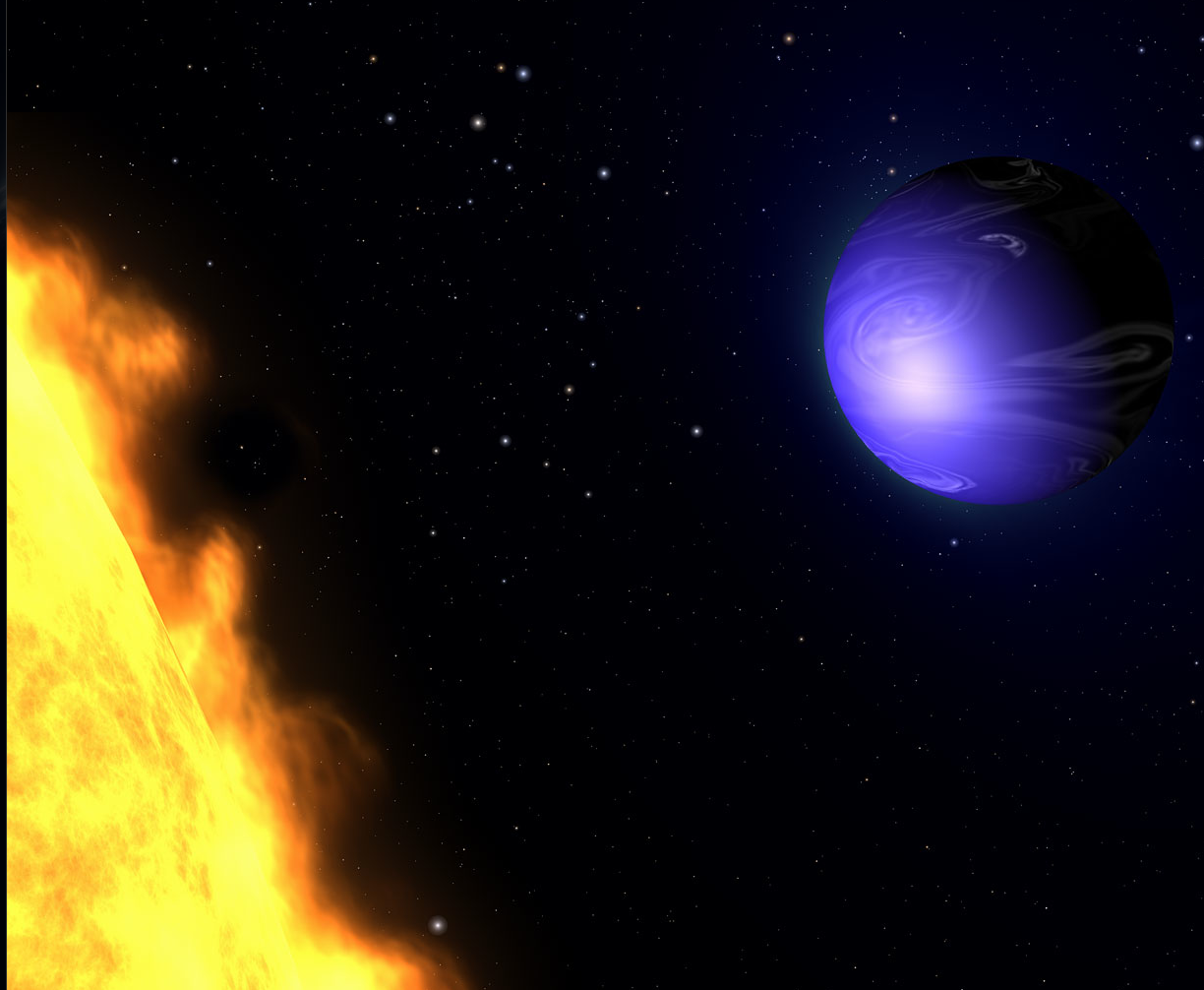
Exotic blue planet HD 189733b (artist’s impression)

Astronomers using the NASA/ESA Hubble Space Telescope have, for the first time, determined the true color of a planet orbiting another star. If seen up close this planet, known as HD 189733b, would be a deep cobalt blue, reminiscent of Earth’s color as seen from space.

But that’s where the similarities end. This “deep blue dot” is a huge gas giant orbiting very close to its host star. The planet’s atmosphere is scorching with a temperature of over 1000 degrees Celsius, and it rains glass, sideways, in howling 7000 kilometre-per-hour winds [1].

At a distance of 63 light-years from us, this turbulent alien world is one of the nearest exoplanets to Earth that can be seen crossing the face of its star. It has been intensively studied by Hubble and other telescopes, and its atmosphere has been found to be dramatically changeable and exotic, with hazes and violent flares (heic0720, heic1209). Now, this planet is the subject of an important first: the first measurement of an exoplanet’s visible color.

“This planet has been studied well in the past, both by ourselves and other teams,” says Frédéric Pont of the University of Exeter, UK, leader of the Hubble observing programme and an author of this new paper. “But measuring its color is a real first—we can actually imagine what this planet would look like if we were able to look at it directly.”

In order to measure what this planet would look like to our eyes, the astronomers measured how much light was reflected off the surface of HD 189733b—a property known as albedo [2].

HD 189733b is faint and close to its star. To isolate the planet’s light from this starlight, the team used Hubble’s Space Telescope Imaging Spectrograph (STIS) to peer at the system before, during, and after the planet passed behind its host star as it orbited. As it slipped behind its star, the light reflected from the planet was temporarily blocked from view, and the amount of light observed from the system dropped. But this technique also shows how the light changes in other ways—for example, its color [3].
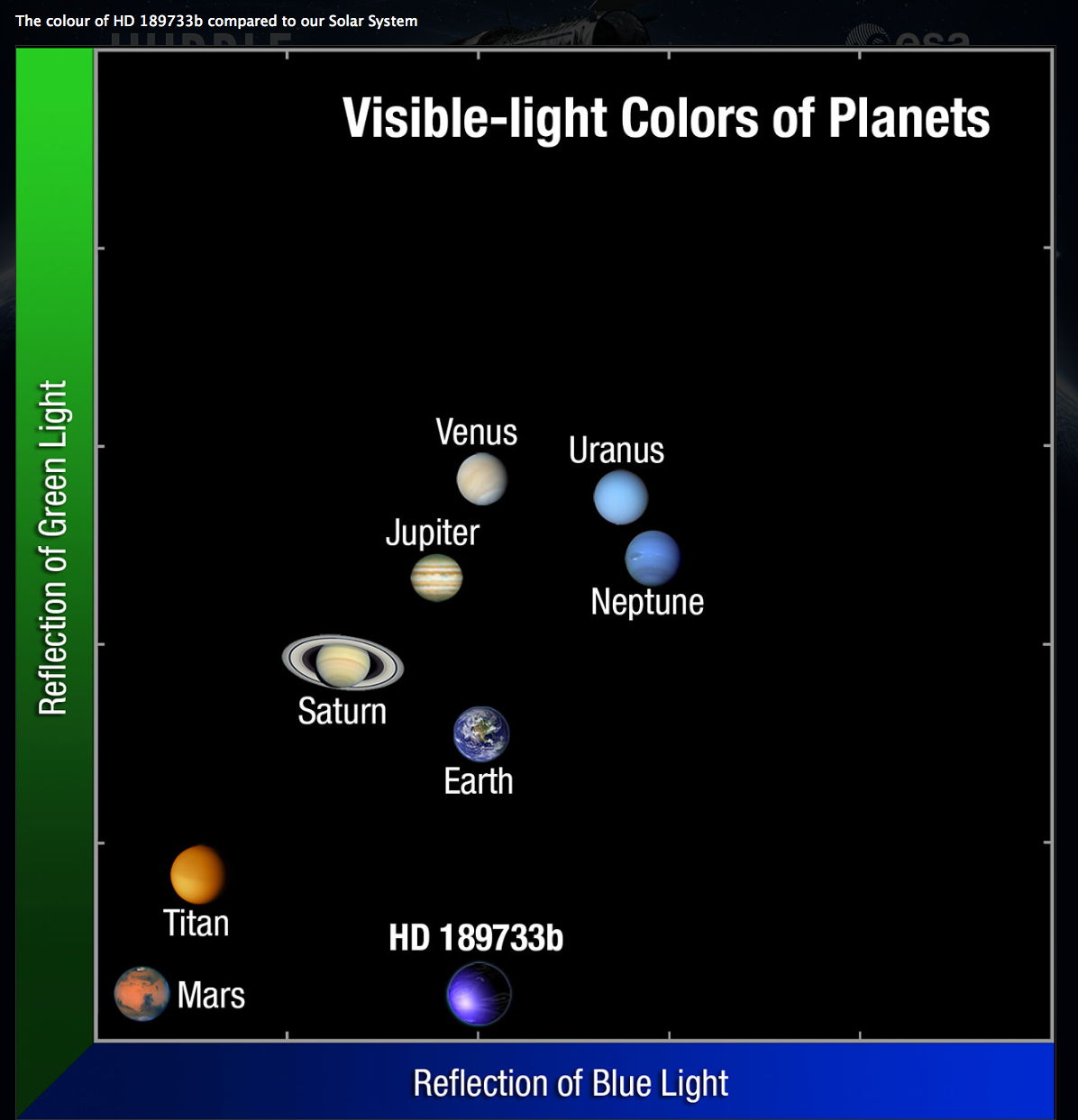
“We saw the brightness of the whole system drop in the blue part of the spectrum when the planet passed behind its star,” explains Tom Evans of the University of Oxford, UK, first author of the paper. “From this, we can gather that the planet is blue, because the signal remained constant at the other colors we measured.”

The planet’s azure blue color does not come from the reflection of a tropical ocean, but is due to a hazy, turbulent atmosphere thought to be laced with silicate particles, which scatter blue light [4]. Earlier observations using different methods have reported evidence for scattering of blue light on the planet, but these most recent Hubble observations give robust confirming evidence, say the researchers.

HD 189733b presented a favorable case for these kinds of measurements as it belongs to a class of planets known as “hot Jupiters”. These massive planets are similar in size to the gas giants in the Solar System, but instead lie very close to their parent star — this size and proximity to their star make them perfect subjects for exoplanet hunting. We know that hot Jupiters are numerous throughout the Universe. As we do not have one close to home in our own Solar System, studies of planets like HD 189733b are important to help us understand these dramatic objects. “It’s difficult to know exactly what causes the color of a planet’s atmosphere, even for planets in the Solar System,” says Pont [5]. “But these new observations add another piece to the puzzle over the nature and atmosphere of HD 189733b. We are slowly painting a more complete picture of this exotic planet.”

Notes

[1] In 2007 NASA’s Spitzer Space Telescope measured the infrared light from the planet, producing one of the first ever temperature maps for an exoplanet. The map shows that day- and night-side temperatures differ by about 260 degrees Celsius, causing fierce winds to roar across the planet. The condensation temperature of the silicates (over 1300 degrees Celsius) mean these particles could form very small grains of glass in the atmosphere.

[2] Albedo is a measure of how much incident radiation is reflected. The greater the albedo, the greater the amount of light reflected. This value ranges from 0 to 1, with 1 being perfect reflectivity and 0 being a completely black surface. The Earth has an albedo of around 0.4.

[3] This technique is possible because the planet’s orbit is tilted edge-on as viewed from Earth, so that it routinely passes in front of and behind the star. When the planet passes behind its host star, the light received from the system drops by about one part in 10,000.

[4] The deep blue color of HD 189733b is consistent with the “red sunset of HD 189733b” result from the transit spectrum (heic0720). If sodium absorbs red light and dust scatters red light, the atmosphere will redden light shining through it, but will appear blue in reflected light.

[5] The colors of Jupiter and Venus are both due to unknown particles within the atmospheres of the planets. Earth looks blue from space because the oceans absorb red and green wavelengths more strongly than blue ones, and reflect the blueish hue of our sky. The shorter blue wavelengths of sunlight are selectively scattered by oxygen and nitrogen molecules in our atmosphere via a process called Rayleigh scattering.

Filed Under: Exploration & Science Missions

Primary Sidebar

Coverage

  • Missions & Constellations
  • Business & Finance
  • Military & Defense
  • Launch
  • Software Automation & Ground Systems
  • Government & Regulation
  • Services & Applications

Most Read Stories

  • Norway's Sovereign Wealth Fund Expands AST SpaceMobile Stake and Discloses $1.22 Billion SpaceX Holding
  • DarkSky International Petitions Full FCC to Overturn Approval of Reflect Orbital's Space-Mirror Satellite
  • SpaceX Establishes 38-Minute Dual-Coast Launch Record as Industry Evaluates High-Cadence Benchmarks
  • Novaspace Projects $3 Billion Cumulative In-Orbit Servicing Market Over the Next Decade
  • SpaceX and Louisiana State Officials Announce Major Aerospace Logistics and Spaceport Infrastructure Deal

Secondary Sidebar

Footer


Satnews is a leading provider of satellite news, events, publications, research and other satellite industry information in both commercial and military enterprises worldwide.

Stories By Category

  • Business & Finance
  • Government & Regulation
  • Launch
  • Military & Defense
  • Missions & Constellations
  • Services & Applications
  • Software Automation & Ground Systems
  • Spectrum & Licensing
  • Startups & NewSpace Business

About Us

  • Leadership & Editorial Team
  • SatNews History
  • Free Satnews Subscription
  • SatNews Events
  • Magazines

Navigation

  • Latest Stories
  • Magazines
  • Events
  • Contact
  • Cookie & Privacy Policy for Satnews

We use cookies to ensure that we give you the best experience on our website. If you continue to use this site we will assume that you are happy with it.
x
Sign up Now (For Free)
Access daily or weekly satellite news updates covering all aspects of the commercial and military satellite industry.
Invalid email address
Notify Me Regarding ( At least one ):
We value your privacy and will not sell or share your email or other information with any other company. You may also unsubscribe at anytime.

Click Here to see our full privacy policy.
Thanks for subscribing!