

• Skip to primary navigation
  • Skip to main content
  • Skip to primary sidebar
  • Skip to secondary sidebar
  • Skip to footer
  • NEWS:
  • SatNews
  • SatMagazine
  • MilSatMagazine
  • SmallSat News
  • |     EVENTS:
  • SmallSat Symposium
  • Satellite Innovation
  • MilSat Symposium
  • SmallSat Europe

SatNews

Satellite Industry Intelligence Since 1983

Subscribe
  • LATEST
  • SatNews Events
  • Magazines
  • Calendar
  • Subscribe
  • Missions & Constellations
    • Exploration & Science Missions
    • In-Orbit Servicing & Orbital Operations
    • LEO Constellations
    • Mission Autonomy & Onboard Systems
    • Mission Deployments & Manifests
    • Navigation & PNT
    • SmallSat
    • Spacecraft & Payload Technology
    View All in Missions & Constellations →
    NATO NCIA Plans EUR 2.7 Billion in Commercial Contracts Through 2028 as Space Share RisesNATO NCIA Plans EUR 2.7 Billion in Commercial Contracts Through 2028 as Space Share Rises
    Radiation-Resistant Lens Designs Adapt to Accelerate Space Payload ProductionRadiation-Resistant Lens Designs Adapt to Accelerate Space Payload Production
    Seibersdorf Laboratories and Tumbleweed Partner on Microgravity R&D Service for Pharma and BiotechSeibersdorf Laboratories and Tumbleweed Partner on Microgravity R&D Service for Pharma and Biotech
    Build, Buy or Merge: Satellite Companies Move to Own Their LaunchBuild, Buy or Merge: Satellite Companies Move to Own Their Launch
  • Business
    • Contracts & Commercial Deals
    • Earnings & Financial Reporting
    • Events & Conferences
    • Funding & Venture Capital
    • Market Forecasts
    • Mergers & Acquisitions
    • Personnel Moves & Appointments
    View All in Business & Finance →
    Early Signals, 2016: SpaceX’s First Backer Opened the First SmallSat SymposiumEarly Signals, 2016: SpaceX’s First Backer Opened the First SmallSat Symposium
    EnSilica Reaches Initial Agreement for $80 Million Resilient GNSS ASIC ProgramEnSilica Reaches Initial Agreement for $80 Million Resilient GNSS ASIC Program
    Thales Alenia Space Signs €240 Million Contract With OHB for Sentinel-3NG Topography AltimetersThales Alenia Space Signs €240 Million Contract With OHB for Sentinel-3NG Topography Altimeters
    A Second LEO Network Has Paying Customers and a Launch ProblemA Second LEO Network Has Paying Customers and a Launch Problem
  • Defense
    • Counterspace & ASAT
    • Defense Budgets & Procurement
    • ISR & Reconnaissance
    • MILSATCOM
    • Missile Warning & Defense
    • National Security Programs
    • Space Domain Awareness
    View All in Military & Defense →
    ARES Shield AI Completes First In-Orbit Object Detection Test Aboard D-Orbit SpacecraftARES Shield AI Completes First In-Orbit Object Detection Test Aboard D-Orbit Spacecraft
    GAO Finds Pentagon Lacks Coordinated View of Military Space Supply Chain RisksGAO Finds Pentagon Lacks Coordinated View of Military Space Supply Chain Risks
    Orbital Proximity Incidents Mask Broader Satellite Jamming ThreatOrbital Proximity Incidents Mask Broader Satellite Jamming Threat
    Lite Coms Secures Over $100 Million in Q3 2026 Defense SATCOM OrdersLite Coms Secures Over $100 Million in Q3 2026 Defense SATCOM Orders
  • Gov
    • Export Controls & Compliance
    • International Space Agreements
    • National Space Policy
    • Space Law & Treaties
    • Space Sustainability & Debris Policy
    • Space Traffic Management / Debris Removal
    View All in Government & Regulation →
    United States Finalizes 20 Agenda Item Positions Ahead of WRC-27 Spectrum NegotiationsUnited States Finalizes 20 Agenda Item Positions Ahead of WRC-27 Spectrum Negotiations
    FCC Upper C-Band Auction 115 Creates Indirect Spectrum and Market Shifts for SmallSat and LEO OperatorsFCC Upper C-Band Auction 115 Creates Indirect Spectrum and Market Shifts for SmallSat and LEO Operators
    FCC Sets April 27, 2027 Start Date for Upper C-Band Auction, Pressuring BroadcastersFCC Sets April 27, 2027 Start Date for Upper C-Band Auction, Pressuring Broadcasters
    Senate Appropriators Move to Bar Sole-Source Awards Over $100 Million for Space Data Network and SB-AMTISenate Appropriators Move to Bar Sole-Source Awards Over $100 Million for Space Data Network and SB-AMTI
  • Launch
    • Launch Providers
    • Launch Schedule & Calendars
    • Launch Sites & Infrastructure
    • Rocket Technology & Vehicles
    View All in Launch →
    NATO Stands Up Starlift Launch Brokerage to Connect Alliance Demand With Allied SpaceportsNATO Stands Up Starlift Launch Brokerage to Connect Alliance Demand With Allied Spaceports
    ULA Clears Blue Origin BE-4 Engines, Focuses Vulcan Failure Probe on Core Stage Fuel SupplyULA Clears Blue Origin BE-4 Engines, Focuses Vulcan Failure Probe on Core Stage Fuel Supply
    Google Selects Blue Origin’s New Glenn Rocket for 2029 AI Satellite LaunchGoogle Selects Blue Origin’s New Glenn Rocket for 2029 AI Satellite Launch
    NASA’s Voyager 1 Reaches One Light-Day From Earth at 16.1 Billion MilesNASA’s Voyager 1 Reaches One Light-Day From Earth at 16.1 Billion Miles
  • Software
    • Autonomous Ground Operations
    • Data Processing & AI/ML
    • Digital Twins & Modeling
    • Ground Segment & Teleports
    • Mission Planning & Simulation
    • Space Systems Software Engineering
    • Spectrum & Licensing
    View All in Software Automation & Ground Systems →
    RBC Signals Secures $10 Million Strategic Growth Investment Led by Washington Harbour PartnersRBC Signals Secures $10 Million Strategic Growth Investment Led by Washington Harbour Partners
    Ramon.Space Raises $124 Million Series B to Scale Orbital Computing InfrastructureRamon.Space Raises $124 Million Series B to Scale Orbital Computing Infrastructure
    Gilat Cuts 2026 Growth Forecast to 3% Amid Launch and IFC DelaysGilat Cuts 2026 Growth Forecast to 3% Amid Launch and IFC Delays
    U.S. Navy Expands ALL.SPACE Terminal Fleet to 108 with Follow-On Hydra MAX 2 OrderU.S. Navy Expands ALL.SPACE Terminal Fleet to 108 with Follow-On Hydra MAX 2 Order
  • Services & Apps
    • Climate & Environmental Monitoring
    • Disaster Response & Security Mapping
    • Earth Observation & Imaging
    • Maritime & Aviation Satcom
    • Satellite Communications
    View All in Services & Applications →
    Smart and Elveo Mobile Complete Direct-to-Device Satellite Trials on Philippine Sea RouteSmart and Elveo Mobile Complete Direct-to-Device Satellite Trials on Philippine Sea Route
    Thales Alenia Space Awarded DGA Contract for French IRIS Military Optical ConstellationThales Alenia Space Awarded DGA Contract for French IRIS Military Optical Constellation
    Ubotica Demonstrates Autonomous Onboard Satellite Scheduling for Maritime SurveillanceUbotica Demonstrates Autonomous Onboard Satellite Scheduling for Maritime Surveillance
    UniSQ Demonstrates Tomographic Spectrometer During KREPE-3 Re-Entry CampaignUniSQ Demonstrates Tomographic Spectrometer During KREPE-3 Re-Entry Campaign

Space-Based Optical Communications Scale to 10 Gbps as Operational Deployments Replace Radio Frequency Links

September 20, 2026

On Sept. 20, 2026, evaluations of satellite communications technology confirmed that space-based laser communications and optical inter-satellite links (OISL) are transitioning from experimental flight demonstrations to operational network deployments.
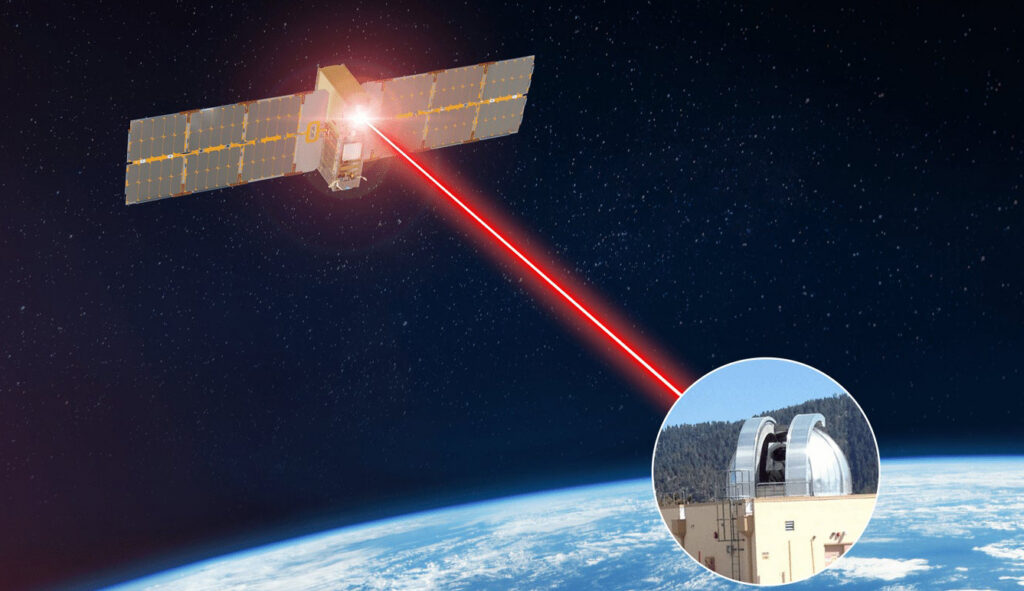

As radio frequency (RF) bands encounter severe spectral congestion and licensing constraints, flight demonstrations cited by NASA demonstrate that space-qualified optical terminals are delivering data transfer speeds up to 10 gigabits per second (Gbps) across low Earth orbit (LEO) constellations and deep-space relays.

Spectrum Congestion and Optical Link Evolution

The shift toward space-based laser communications addresses structural capacity limitations inherent to traditional radio frequency links. With thousands of new spacecraft entering low Earth orbit, satellite operators face escalating co-channel interference, strict International Telecommunication Union spectrum allocations, and limited bandwidth availability across C, Ku, and Ka bands.

To bypass RF bottlenecks, NASA and commercial space developers have spent years advancing space-based optical communications prototypes. Early experimental payloads, including NASA’s Laser Communications Relay Demonstration (LCRD) and Deep Space Optical Communications (DSOC) projects, validated the physics of modulating infrared laser signals over space distances. In 2026, these technological foundations have matured into standardized commercial hardware platforms capable of supporting high-throughput Earth observation, defense surveillance, and broadband constellation architectures.

Hardware Parameters and Spatial Security Capabilities

Optical communications payloads deliver operational advantages over legacy radio frequency transceivers by operating in the near-infrared spectrum, typically around 1,550 nanometers. Because optical wavelengths are orders of magnitude shorter than radio waves, laser communications systems achieve extremely narrow beam divergence, concentrating radiated power into tight directional signals.

  • Transmission Rates: Flight-verified data throughput reaching 10 gigabits per second over orbital distances
  • Terminal Dimensions: Reduced Size, Weight, and Power (SWaP) footprint compared to equivalent high-gain radio frequency reflector antennas
  • Payload Power Consumption: Lower electrical power draw required per transmitted gigabit of data
  • Primary Use Cases: Direct optical crosslinking between low Earth orbit satellite clusters and high-rate downlinks during brief ground station passes
  • Data Privacy Profile: Narrow spatial beamwidth prevents side-lobe emissions, offering resistance to signal interception, jamming, and spoofing

The reduced physical mass and lower power requirements of modern optical terminals enable satellite manufacturers to integrate laser transceivers into smallsat and microsatellite buses without exhausting spacecraft mass budgets or thermal dissipation limits.

Operational Challenges and Hybrid Optical-RF Architecture

Despite the throughput advantages of laser communications, optical systems face atmospheric and environmental constraints during space-to-ground downlink operations. Infrared light signals suffer severe attenuation and scatter when passing through clouds, dense moisture, dust, and atmospheric turbulence.

To maintain continuous mission availability, ground station operators require precise pointing, acquisition, and tracking (PAT) systems. Satellite laser terminals must maintain sub-microradian pointing accuracy to lock onto moving ground receivers or maneuvering spacecraft across hundreds of kilometers in space.

To mitigate weather interruptions, satellite operators are deploying hybrid network architectures that pair primary optical terminals with backup radio frequency transceivers. When cloud cover obstructs optical ground stations, automated software reroutes mission data across optical inter-satellite links to a clear ground site or downlinks priority data through secondary Ka-band radio channels.

Operational Flight Outlook

As commercial payload manufacturers standardize optical terminal interfaces, laser communications will serve as the primary backhaul layer for proliferated military constellations, high-resolution remote sensing fleets, and orbital computing platforms. Commercial satellite operators will continue expanding ground station networks across geographically diverse, low-cloud regions to maximize direct optical downlink availability through 2027 and beyond.

Filed Under: LEO Constellations, Satellite Communications, SmallSat

Primary Sidebar

Coverage

  • Missions & Constellations
  • Business & Finance
  • Military & Defense
  • Launch
  • Software Automation & Ground Systems
  • Government & Regulation
  • Services & Applications

Most Read Stories

  • Blue Origin Reconstructs Launch Complex 36 Tower, Targets November Return to Flight for New Glenn
  • Amazon Navigates Launch Delays with Under 400 Satellites in Orbit Ahead of Nov. 13 Vulcan Return
  • Northwood Space Secures $375M Series C at $2B Valuation to Expand Shared Ground Station Network
  • NASA Outlines Artemis IV Starship Refueling Architecture as Launch Estimates Vary
  • SpaceX Explores Boost Mobile Acquisition in Push to Build Hybrid Terrestrial-Satellite Network

Secondary Sidebar

Footer


Satnews is a leading provider of satellite news, events, publications, research and other satellite industry information in both commercial and military enterprises worldwide.

Stories By Category

  • Business & Finance
  • Government & Regulation
  • Launch
  • Military & Defense
  • Missions & Constellations
  • Services & Applications
  • Software Automation & Ground Systems
  • Spectrum & Licensing
  • Startups & NewSpace Business

About Us

  • Leadership & Editorial Team
  • SatNews History
  • Free Satnews Subscription
  • SatNews Events
  • Magazines

Navigation

  • Latest Stories
  • Magazines
  • Events
  • Contact
  • Cookie & Privacy Policy for Satnews

We use cookies to ensure that we give you the best experience on our website. If you continue to use this site we will assume that you are happy with it.
x
Sign up Now (For Free)
Access daily or weekly satellite news updates covering all aspects of the commercial and military satellite industry.
Invalid email address
Notify Me Regarding ( At least one ):
We value your privacy and will not sell or share your email or other information with any other company. You may also unsubscribe at anytime.

Click Here to see our full privacy policy.
Thanks for subscribing!