

On Sept. 23, 2026, satellite communications provider Viasat announced that its subsidiary, Inmarsat Government, Inc., received the Marine Enterprise Commercial Satcom Satellite Services (MECS2) contract from the U.S. Space Force Commercial Satellite Communications Office (CSCO).
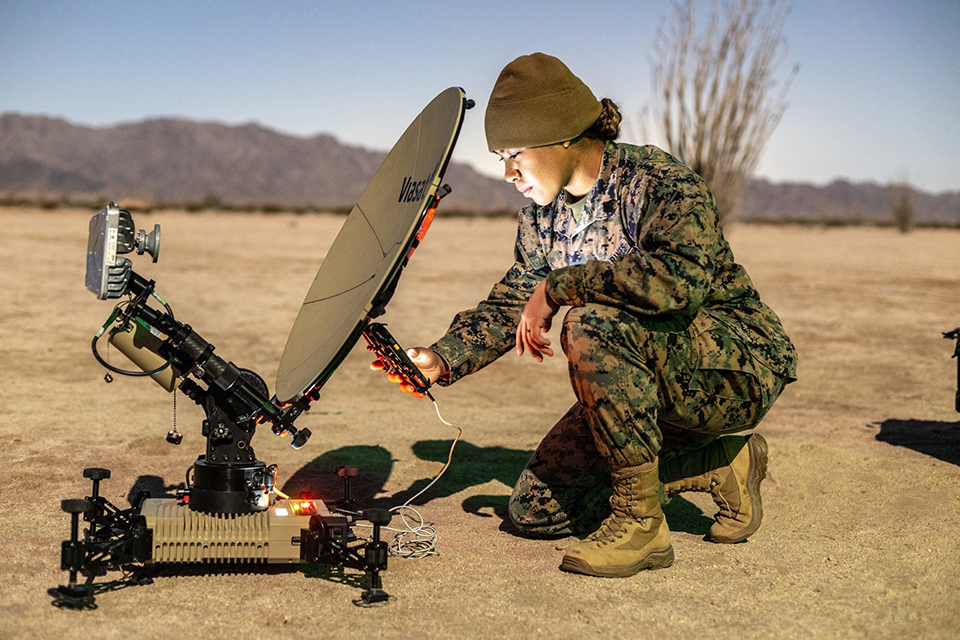
Under the vehicle, Viasat received an initial $42 million task order award toward a seven-year Indefinite Delivery/Indefinite Quantity (IDIQ) contract with a potential ceiling of up to $307 million.
Program History and Fleet Integration Context
The MECS2 procurement provides the United States Marine Corps (USMC) with managed satellite connectivity, building on prior tactical commercial satellite communications (COMSATCOM) services delivered across expeditionary units. The contract execution relies on integrated orbital assets following Viasat’s acquisition of Inmarsat in May 2023, which consolidated high-throughput geostationary payloads, global L-band safety services, and government SATCOM infrastructure under a unified operational network.
Administered by the Space Force CSCO, the IDIQ structure allows Marine Corps communications units to procure commercial satellite capacity, terrestrial data backhaul, and field terminal equipment through standardized task orders. The framework supports the Marine Corps Enterprise Network (MCEN) by establishing secure data custody between deployed expeditionary forces and fixed command infrastructure.
Network Hardware and Multi-Orbit Architecture
The managed communications architecture integrates multi-band, multi-orbit satellite capacity delivered across Viasat’s space segment alongside third-party partner networks.
- Contract Ceiling Value: $307 million across a seven-year performance period
- Initial Award Allocation: $42 million task order for immediate network activation
- Frequency Allocations: Fully managed communications across L-band, Ku-band, and Ka-band spectra
- Space Segment Platforms: High-throughput ViaSat-3 geostationary satellites combined with multi-orbit partner constellations
- Ground & Security Operations: Continuous 24/7/365 coverage provided by Network Operations Centers (NOC) and Security Operations Centers (SOC)
The service incorporates high-capacity ViaSat-3 geostationary satellites, which utilize dynamic beam-forming capabilities to redirect throughput into concentrated operational areas. Land, air, and maritime forces access these multi-band links through flexible terminal configurations, ensuring secure communications across contested and austere environments. Ground transport is protected via Viasat’s global terrestrial network, which feeds telemetry and command data through dedicated NOC and SOC facilities for continuous bandwidth orchestration, inventory management, and cybersecurity monitoring.
Executive Perspectives
“We’re extremely proud the Marine Corps has selected Viasat to continue as its trusted partner for enterprise, multi-orbit SATCOM services,” stated Victor Farah, Senior Vice President of Government Solutions and Services at Viasat. “Our team is committed to delivering an information advantage through flexible, high-performance and secure connectivity that will support the communications demands of rapidly evolving and expeditionary operations.”
“In the modern warfare environment, there is a critical need to maintain information dominance across the battlespace,” added Qasim Rana, Vice President of Market Entry for Government at Viasat. “We are excited to continue supporting this objective by providing a comprehensive enterprise solution that leverages Viasat’s expertise and ecosystem to meet current USMC technology needs, as well as the ability to scale with new, integrated technologies and platform capabilities for the future.”
Expeditionary SATCOM Operational Outlook
Viasat will initiate initial task order execution, configuring terminal fleets and routing multi-band satellite capacity to active USMC operational commands. Over the seven-year IDIQ window, the CSCO will issue additional task orders under the $307 million ceiling to scale bandwidth allocation, integrate emerging non-geostationary orbit (NGSO) connectivity options, and sustain global expeditionary communications for Marine Air-Ground Task Forces.
