

On Sept. 14, 2026, an Avio-built Vega C rocket lifted off from the Guiana Space Centre in Kourou, French Guiana, at 9:21 p.m. Eastern Time.
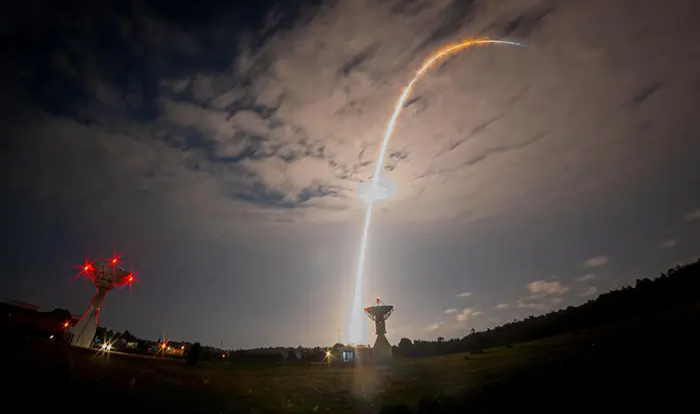
The vehicle successfully deployed the European Union’s Copernicus Sentinel-3C Earth observation satellite into sun-synchronous orbit approximately one hour after launch, followed by the release of the European Space Agency’s (ESA) Fluorescence Explorer (FLEX) Earth science spacecraft nearly an hour later.
Payload Mission Profiles
The dual-manifest mission placed two primary Earth science payloads into orbit to collect environmental and biological measurements.
- Sentinel-3C: Part of the European Union’s Copernicus environmental monitoring constellation, equipped to measure global sea-surface topography, ocean and land-surface temperatures, and ocean color to support marine forecasting and climate monitoring.
- Fluorescence Explorer (FLEX): An ESA science mission designed to map vegetation fluorescence globally, providing data on photosynthetic activity and plant health to improve agricultural monitoring and carbon cycle models.
- Launch Vehicle: Vega C four-stage light-lift launch vehicle operated by Arianespace and manufactured by Avio.
Industrial Flight Cadence and Production Scaling
The orbital insertion marks the second successful Vega C mission executed in 2026, with a third flight scheduled before the end of the year. Speaking at an industry summit in Paris, Avio Chief Executive Officer Giulio Ranzo confirmed that the Italian rocket manufacturer is scaling its manufacturing and assembly operations to achieve a near-term launch rate of six Vega C flights per year, with an ultimate target capacity of nine launches annually to satisfy European institutional and commercial launch manifests.
Operational Schedule
Avio and launch operator Arianespace will prepare the Guiana Space Centre launch pad for the final 2026 Vega C campaign, while ground controllers complete initial orbit calibration and payload checkout operations for both Sentinel-3C and FLEX.
