

On August 29, 2026, European aerospace group Airbus initiated a strategic review of its U.S. satellite manufacturing business, evaluating options that include a potential sale of its automated production facility in Merritt Island, Florida.
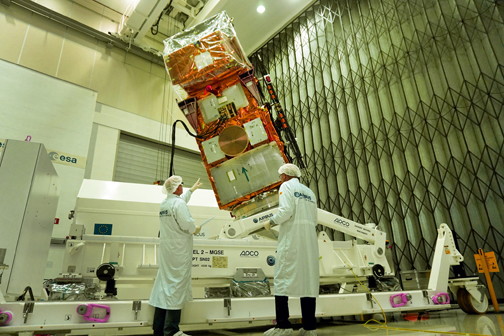
The review follows a decision by Airbus Defence and Space to shift manufacturing for next-generation OneWeb broadband satellites from the United States to its primary industrial hub in Toulouse, France.
Program Context and Ownership Evolution
The Merritt Island facility was originally constructed as a 50/50 joint venture between Airbus and Eutelsat OneWeb to manufacture first-generation Low Earth Orbit (LEO) communications satellites. The 105,000-square-foot industrial plant was designed to apply automated, high-rate assembly lines to satellite production, producing up to two spacecraft per day during peak operations.
Airbus expanded its operational control over the Florida plant in early 2024, when Airbus acquired full ownership of the Airbus OneWeb Satellites joint venture. Following the transaction, Airbus integrated the site into its broader space systems division to target commercial constellation contracts and U.S. government satellite manifests.
Production Infrastructure and Facility Capabilities
Located adjacent to NASA’s Kennedy Space Center, the Merritt Island facility houses two automated satellite assembly lines equipped with automated guided vehicles (AGVs), solar array integration bays, and integrated thermal vacuum and acoustic testing chambers. The facility produced more than 600 first-generation OneWeb satellites, proving high-rate smallsat manufacturing models for commercial communications constellations.
Key facility parameters include:
- Production Footprint: 105,000 square feet of high-bay manufacturing and integration cleanrooms.
- Peak Output Capacity: Configured to assemble, integrate, and test up to two 150-to-300 kilogram smallsats per day.
- Testing Infrastructure: On-site automated environmental test cells, including thermal vacuum chambers, vibration tables, and radio frequency (RF) anechoic test bays.
Market Rationale and European Consolidation
The potential divestment aligns with a broader restructuring of Airbus’s space division aimed at restoring profitability within its satellite manufacturing operations. Facing competitive pressure from commercial mega-constellations and shifting government procurement models, Airbus is consolidating its industrial footprint around core European manufacturing assets.
Consolidating next-generation constellation production in Toulouse allows Airbus to streamline engineering overhead and align with European sovereign capability mandates. The move operates independently of ongoing industrial consolidation discussions between European aerospace leaders—including proposed structural joint ventures involving Thales Alenia Space and Leonardo—which seek to create a unified European space prime.
To optimize space division margins and address technical skill bottlenecks, Airbus has also pursued cross-sector manufacturing partnerships, including negotiations with European automotive manufacturers to scale automated satellite assembly lines.
Strategic Realignment and Industrial Outlook
The strategic review of the Merritt Island facility reflects a recalibration of trans-Atlantic aerospace manufacturing strategies. As Airbus shifts constellation production back to Europe, the Florida facility represents an active high-rate manufacturing asset for potential U.S. defense prime contractors, commercial constellation operators, or domestic smallsat manufacturers seeking established integration infrastructure near Cape Canaveral launch pads.
Airbus continues to execute its broader space systems manifest, maintaining commercial and defense satellite design, payload integration, and prime contractor operations across its primary European facilities.
