

On Sept. 15, 2026, satellite audio operator SiriusXM confirmed that its SXM-11 geostationary communications satellite completed in-orbit testing and entered full commercial service.
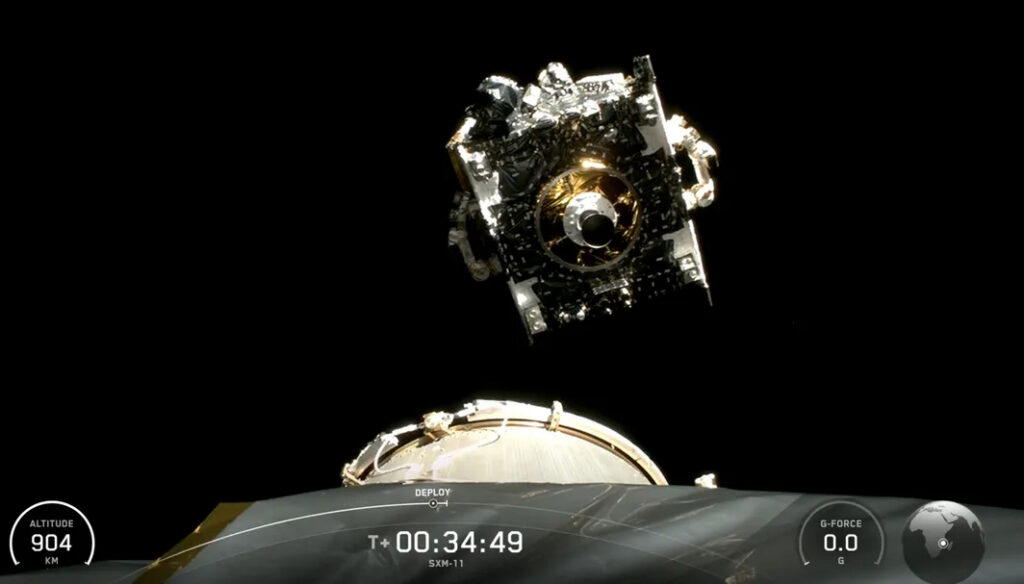
Built by Intuitive Machines on its IM 1300 bus architecture, the high-power Digital Audio Radio Service (DARS) spacecraft expands broadcast coverage across North America, improves signal reception in Alaska, and increases network bandwidth for in-vehicle and marine entertainment services.
Broadcaster Ownership and Space Infrastructure Ownership Models
The deployment of SXM-11 represents a rare operational model in modern media broadcasting, where a commercial entertainment operator directly owns, funds, and manages a dedicated constellation of geostationary communications satellites. While most terrestrial media companies rent capacity from global satellite fleet operators like SES, Intelsat, or Eutelsat, SiriusXM operates its own high-power satellite network.
Direct ownership of space-segment infrastructure allows SiriusXM to maintain high-power direct-to-vehicle signal delivery across 8 million square miles without relying on terrestrial cell towers or third-party leasing agreements. The spacecraft join an active fleet supporting more than 210 million satellite-radio-equipped vehicles on the road across North America.
Fleet Refresh History and Constellation Context
The commissioning of SXM-11 marks a key milestone in SiriusXM’s multi-year constellation replenishment program designed to replace aging first- and second-generation satellites. Launched aboard a SpaceX Falcon 9 rocket from Cape Canaveral on June 28, 2026, SXM-11 replaces the legacy XM-5 satellite, which reached the end of its primary design lifecycle.
The SXM-11 deployment follows the introduction of SXM-9 and SXM-10, both of which commenced operational service in 2025. Together, the modernized satellites provide redundant broadcast beams operating in the S-band spectrum, ensuring continuous signal reception for moving vehicles under dense canopy, urban canyons, and mountainous terrain.
Technical Specifications and Spacecraft Architecture
The SXM-11 platform incorporates high-power transmission arrays and structural systems engineered to support high-throughput digital audio broadcasting.
- Spacecraft Bus: Intuitive Machines IM 1300 platform (engineered at manufacturing facilities in Palo Alto, California)
- Launch Mass: Exceeds 15,000 pounds (6,800 kilograms), with approximately 60 percent comprised of liquid propellant for orbital maneuvering and station-keeping
- Dimensions: 28 feet in height with a solar array wingspan exceeding 106 feet when fully deployed in geostationary orbit
- Primary Antenna: 30-foot (9-meter) unfurlable mesh S-band reflector
- Operational Position: Geostationary orbit approximately 22,000 miles above Earth
- Payload Capacity: High-power S-band digital audio transmitters alongside a secondary communications payload supporting expanded Wireless Communications Service (WCS) band operations
The 30-foot unfurlable main reflector allows high-power S-band audio signals to reach small, non-directional antennas integrated into consumer vehicles, marine vessels, and aircraft without requiring motorized satellite tracking dishes.
Executive Perspectives
“Bringing SXM-11 into service strengthens our next-generation satellite fleet and reinforces the long-term resilience of our network,” said Sean Gibbons, Chief Product and Technology Officer at SiriusXM. “For listeners, that means a premium in-car experience with broad, reliable coverage, including where cellular service may be limited. Through SiriusXM with 360L, we combine that reach with the choice, personalization and interactivity of streaming, to bring the best of both technologies together in millions of vehicles.”
“The handover of SXM-11 represents our 13th spacecraft delivered in partnership with SiriusXM,” added Chris Johnson, President of Intuitive Machines. “Achieving full commercial operation demonstrates the capability of our IM 1300 platform to meet demanding power, thermal, and payload requirements for mission-critical commercial satellite infrastructure.”
Future Launch Manifest and Fleet Outlook
SiriusXM and Intuitive Machines will continue preparations for the final planned spacecraft in the current fleet refresh cycle, SXM-12, which is scheduled for launch in 2027. Once SXM-12 achieves operational status, SiriusXM’s fully modernized orbital network will maintain satellite audio and data broadcast operations through the late 2030s.
