

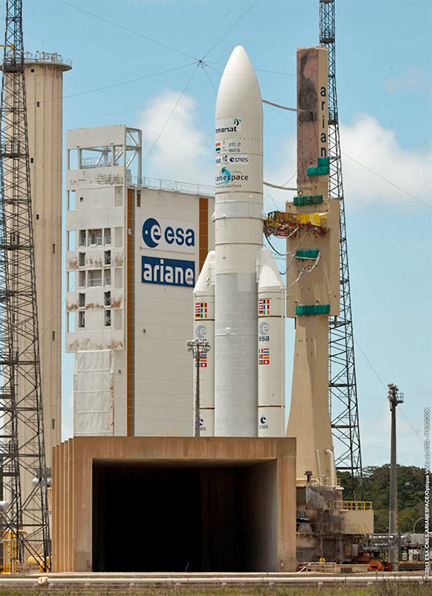
The Ariane 5 with Alphasat and INSAT-3D nears its final location on the launch pad to complete this morning’s rollout at the Spaceport.
Photo courtesy of Arianespace.
The launcher has India’s INSAT-3D satellite installed in the lower position of its payload “stack,” with Europe’s Alphasat as the upper passenger. The launch window opens at 4:53 p.m. and continues until 6:11 p.m. After liftoff, the flight sequence will last nearly 33 minutes, with Alphasat deployed at just under 28 minutes after launch, followed by the separation of INSAT-3D five minutes later.
Alphasat is Europe’s largest telecommunications satellite ever manufactured and results from a large-scale public-private partnership between the European Space Agency (ESA) and Inmarsat. Built by prime contractor Astrium, it is the first flight model of Europe’s Alphabus high-capacity satellite platform, configured with a new-generation L-band geo-mobile mobile communication relay system and four technology demonstration payloads for ESA.
INSAT-3D was developed by India’s Indian Space Research Organisation (ISRO) space agency and its ISRO Space Applications Centre, designed to provide meteorological observation and monitoring of land/ocean surfaces. The satellite is equipped with a six-channel imager and 19-channel sounder, as well as a data relay transponder and a payload for satellite-aided search and rescue operations.
This mission—designated Flight VA214 in Arianespace’s launcher family numbering system—will be the 214th launch since operations began with the Ariane series of vehicles in 1979, as well as the 70th flight for the heavy-lift Ariane 5 version.
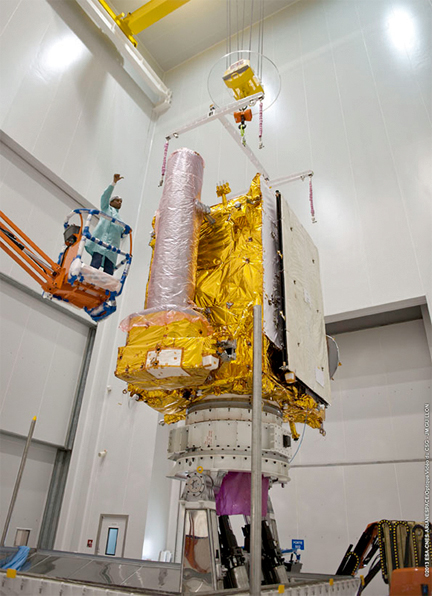
The GSAT-7 satellite is readied for the startup of its pre-launch checkout in the Spaceport’s S5 payload preparation facility.
Photo courtesy of Arianespace.
Flight VA215’s heavy-lift vehicle has completed its initial build-up in the Spaceport’s Launcher Integration Building for Ariane 5, and soon will be transferred to the Final Assembly Building to receive its payloads. The Final Assembly Building became available this morning when the Ariane 5 for Arianespace’s Flight VA214 rolled out to the launch zone for a liftoff today (July 25th.).
GSAT-7 has now begun its checkout at the Spaceport to confirm the multi-band satellite’s readiness with payloads in the UHF, S-band, C-band and Ku-bands. Developed by the Indian Space Research Organisation, it utilizes India’s standard I-2K bus—the same as employed for the Indian INSAT-3D satellite, which is only hours away from liftoff on Arianespace’s VA214 mission. The GSAT-7 spacecraft’s mass at liftoff is estimated at 2,550kg., and its power handling capability is rated at approximately 3,000 Watts. After being deployed by Ariane 5, the satellite will operate from an orbital position of 74 degrees East.
Joining the Indian satellite on Arianespace’s VA215 mission will be EUTELSAT 25B/Es’hail 1, built by SSL for Eutelsat and Es’hailSat—The Qatar Satellite Company. Weighing more than 6,000kg. at liftoff, this platform was conceived to provide direct broadcast services (DBS) to expanding markets in the Middle East, North Africa, and Central Asia regions. EUTELSAT 25B/Es’hail 1 will replace Eutelsat’s EUROBIRD 2 satellite at 25.5 deg. East. In addition to ensuing Ku-band continuity for Eutelsat and providing additional Ku-band resources for the Qatar Satellite Company, the spacecraft will initiate a Ka-band capability to open business opportunities for both companies.
