

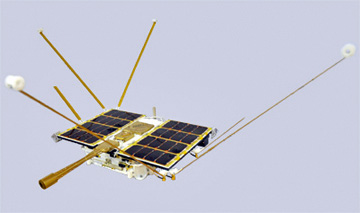
Artistic rendition of the Venta-1 nanosatellite.
The optimistically-named Venta-1 (as if to imply that Venta-2 is to follow) is the brainchild of Ventspils University College and Ventspils High Technology Park, together with the University of Applied Sciences in Bremen, Germany, and with input from the University of Latvia and Riga Technical University. As the large number of universities in the project suggests, it is an educational project whose main goal is to give Latvian scientists and engineers a hands-on experience with constructing and launching satellites. Nevertheless, it also has a practical purpose: The satellite will be part of a ship traffic automatic identification system developed by German space tech company OHB Technology AG. The German company has also contributed its technical experience and expertise to the project.
Another company contributing towards the project is Swedish ÅAC Microtec AB, which is using the satellite to test a module for its Space Plug-and-Play Avionics (SPA) system. SPA aims to make satellite design much faster and affordable using off-the-shelf standardized components—much like putting together Lego blocks. The SPA standard is still under development, and the launch would test some of the components further. The satellite will also carry a camera. It weights 7.5kg and is classified as a nanosatellite.
Most of the funding for the satellite has come from the Latvian Ministry of Education and Science. Its launch was initially planned for 2009, but, as the Latvian government adopted austerity measures in response to the recession, it also cut the Latvian space program. The “space program” bit is not necessarily as far-fetched as it sounds: In addition to being developed in Latvia, the satellite’s Earth tracking station, which will listen to its signals from space, will also be located in Latvia. It will use the Irbene Radio Astronomy Centre near Ventspils, which features a 32m radio telescope which is built around a former Soviet Army satellite dish. Backup stations will be located in Bremen and Italy. Although no dates have yet been named, the satellite is now planned to be launched by the European Space Agency’s Vega rocket.
