

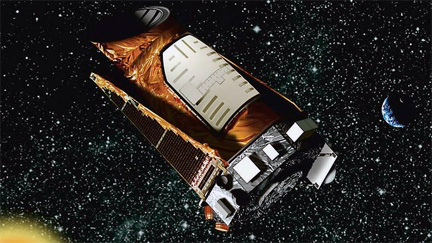
Artistic rendition of the Kepler space telescope.
The problem has been linked with the probable failure of the second of four “reaction wheels”. The first failed in January. The spacecraft needs three of these wheels to enable it to make the precise movements it needs to stare at a point in the sky long enough and stable enough for accurate readings. Attempts to halt the spin have so far failed.
“This is a clear indication that there has been an internal failure within the reaction wheel, likely a structural failure of the wheel bearing,” a NASA statement says.
Ground control teams continue to examine exactly what can be done to alleviate the problem, and what science can continue to be done. Kepler can continue to be pointed by traditional thrusters, but these are not as accurate or as stable as the reaction wheels.
“With the failure of a second reaction wheel, it’s unlikely that the spacecraft will be able to return to the high pointing accuracy that enables its high-precision photometry. However, no decision has been made to end data collection,” a NASA statement reads.
Kepler was launched in March of 2009. The planet finder completed its expected three-and-a-half year mission life in November 2012. It has since been in an “extended mission phase”.
