

• Skip to primary navigation
  • Skip to main content
  • Skip to primary sidebar
  • Skip to secondary sidebar
  • Skip to footer
  • NEWS:
  • SatNews
  • SatMagazine
  • MilSatMagazine
  • SmallSat News
  • |     EVENTS:
  • SmallSat Symposium
  • Satellite Innovation
  • MilSat Symposium
  • SmallSat Europe

SatNews

Satellite Industry Intelligence Since 1983

Subscribe
  • LATEST
  • SatNews Events
  • Magazines
  • Calendar
  • Subscribe
  • Missions & Constellations
    • Exploration & Science Missions
    • In-Orbit Servicing & Orbital Operations
    • LEO Constellations
    • Mission Autonomy & Onboard Systems
    • Mission Deployments & Manifests
    • Navigation & PNT
    • SmallSat
    • Spacecraft & Payload Technology
    View All in Missions & Constellations →
    NASA Shifts Focus to Permanent Lunar Base and Nuclear PropulsionNASA Shifts Focus to Permanent Lunar Base and Nuclear Propulsion
    Kepler and Astrolight Secure ESA Contract for HydRON Optical NetworkKepler and Astrolight Secure ESA Contract for HydRON Optical Network
    Amazon to Acquire Globalstar for $11.6 Billion to Fuel D2D ExpansionAmazon to Acquire Globalstar for $11.6 Billion to Fuel D2D Expansion
    SmallSat Europe Speaker Focus: Daniel Metzler, Isar AerospaceSmallSat Europe Speaker Focus: Daniel Metzler, Isar Aerospace
  • Business
    • Contracts & Commercial Deals
    • Earnings & Financial Reporting
    • Events & Conferences
    • Funding & Venture Capital
    • Market Forecasts
    • Mergers & Acquisitions
    • Personnel Moves & Appointments
    View All in Business & Finance →
    SmallSat Europe Speaker Focus: Col. Marcin Mazur, Polish Space AgencySmallSat Europe Speaker Focus: Col. Marcin Mazur, Polish Space Agency
    Oklahoma Positions as Commercial Space Manufacturing Hub at Space SymposiumOklahoma Positions as Commercial Space Manufacturing Hub at Space Symposium
    Global Defense Leaders Convene as Space Symposium 41 Addresses Orbital SecurityGlobal Defense Leaders Convene as Space Symposium 41 Addresses Orbital Security
    SmallSat Europe Speaker Focus: Chris Quilty, Quilty SpaceSmallSat Europe Speaker Focus: Chris Quilty, Quilty Space
  • Defense
    • Counterspace & ASAT
    • Defense Budgets & Procurement
    • ISR & Reconnaissance
    • MILSATCOM
    • Missile Warning & Defense
    • National Security Programs
    • Space Domain Awareness
    View All in Military & Defense →
    US Space Force Awards $68.6M Modification to Lockheed Martin for Next-Gen OPIRUS Space Force Awards $68.6M Modification to Lockheed Martin for Next-Gen OPIR
    General Atomics Completes Pre-Ship Review for Space Force Weather PayloadGeneral Atomics Completes Pre-Ship Review for Space Force Weather Payload
    NRL to Showcase Sovereign Space Capabilities at 41st Space SymposiumNRL to Showcase Sovereign Space Capabilities at 41st Space Symposium
    Northrop Grumman Minotaur IV Lofted USSF Tech Demonstration Payloads to OrbitNorthrop Grumman Minotaur IV Lofted USSF Tech Demonstration Payloads to Orbit
  • Gov
    • Export Controls & Compliance
    • International Space Agreements
    • National Space Policy
    • Space Law & Treaties
    • Space Sustainability & Debris Policy
    • Space Traffic Management / Debris Removal
    View All in Government & Regulation →
    FCC Modernizes Satellite Spectrum Rules to Unleash Next-Generation BroadbandFCC Modernizes Satellite Spectrum Rules to Unleash Next-Generation Broadband
    SmallSat Europe Speaker Focus: Daniel Bock, Morpheus SpaceSmallSat Europe Speaker Focus: Daniel Bock, Morpheus Space
    SmallSat Europe Speaker Focus: Dr. Ane Aanesland, ThrustMeSmallSat Europe Speaker Focus: Dr. Ane Aanesland, ThrustMe
    Isaacman’s Budget Math: How NASA Plans to Reach the Moon With a Quarter Less MoneyIsaacman’s Budget Math: How NASA Plans to Reach the Moon With a Quarter Less Money
  • Launch
    • Launch Providers
    • Launch Schedule & Calendars
    • Launch Sites & Infrastructure
    • Rocket Technology & Vehicles
    View All in Launch →
    Ensign-Bickford Hardware Supports Successful Artemis II Lunar MissionEnsign-Bickford Hardware Supports Successful Artemis II Lunar Mission
    China Accelerates Orbital Internet Deployment with Successful Smart Dragon-3 Sea LaunchChina Accelerates Orbital Internet Deployment with Successful Smart Dragon-3 Sea Launch
    What the SpaceX IPO Changes for Every Satellite OperatorWhat the SpaceX IPO Changes for Every Satellite Operator
    €30 million Financing for PLD Space’s Small Satellite Launcher€30 million Financing for PLD Space’s Small Satellite Launcher
  • Software
    • Autonomous Ground Operations
    • Data Processing & AI/ML
    • Digital Twins & Modeling
    • Ground Segment & Teleports
    • Mission Planning & Simulation
    • Space Systems Software Engineering
    • Spectrum & Licensing
    View All in Software Automation & Ground Systems →
    Cloudcomputing Targets 1.5M Identities in Spain and Finalizes Innovate IT AcquisitionCloudcomputing Targets 1.5M Identities in Spain and Finalizes Innovate IT Acquisition
    Archangel Lightworks Secures £10M Series A to Scale Optical Ground InfrastructureArchangel Lightworks Secures £10M Series A to Scale Optical Ground Infrastructure
    Keysight and Sateliot Win ESA and GSMA Foundry Challenge for 6G InnovationKeysight and Sateliot Win ESA and GSMA Foundry Challenge for 6G Innovation
    Automation and Agility: How SSC Space Go is Designed for the New Age of GroundAutomation and Agility: How SSC Space Go is Designed for the New Age of Ground
  • Services & Apps
    • Climate & Environmental Monitoring
    • Disaster Response & Security Mapping
    • Earth Observation & Imaging
    • Maritime & Aviation Satcom
    • Satellite Communications
    View All in Services & Applications →
    Kraken Robotics Integrates KATFISH Sonar on SEFINE RD-22 USV Following Multi-Naval DemonstrationsKraken Robotics Integrates KATFISH Sonar on SEFINE RD-22 USV Following Multi-Naval Demonstrations
    Astroscale Plans World-First Multi-Orbit Satellite Inspection MissionAstroscale Plans World-First Multi-Orbit Satellite Inspection Mission
    The Downlink Deficit: The Pentagon’s Optical Mesh Network and the Terrestrial BottleneckThe Downlink Deficit: The Pentagon’s Optical Mesh Network and the Terrestrial Bottleneck
    Cinemo Reimagines the Vehicle as a Software-Defined Entertainment HubCinemo Reimagines the Vehicle as a Software-Defined Entertainment Hub

NASA/ESA Hubble… White Dwarfs Are No Fairy Tale, Resemble Earth

May 9, 2013

[SatNews] Besides finding silicon in the Hyades stars’ atmospheres, Hubble also detected low levels of carbon.

The NASA/ESA Hubble Space Telescope has found signs of Earth-like planets in an unlikely place: the atmospheres of a pair of burnt-out stars in a nearby star cluster. The white dwarf stars are being polluted by debris from asteroid-like objects falling onto them. This discovery suggests that rocky planet assembly is common in clusters, say researchers.
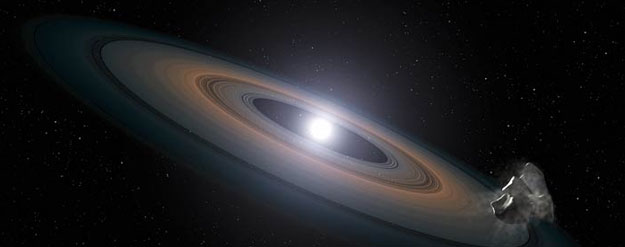

This illustration is an artist’s impression of the thin, rocky debris disc discovered around the two Hyades white dwarfs. Rocky asteroids are thought to have been perturbed by planets within the system and diverted inwards towards the star, where they broke up, circled into a debris ring, and were then dragged onto the star itself. Credit:NASA, ESA, STScI, and G. Bacon (STScI)

The stars, known as white dwarfs—small, dim remnants of stars once like the Sun—reside 150 light-years away in the Hyades star cluster, in the constellation of Taurus (The Bull). The cluster is relatively young, at only 625 million years old.

Astronomers believe that all stars formed in clusters. However, searches for planets in these clusters have not been fruitful—of the roughly 800 exoplanets known, only four are known to orbit stars in clusters. This scarcity may be due to the nature of the cluster stars, which are young and active, producing stellar flares and other outbursts that make it difficult to study them in detail.

A new study led by Jay Farihi of the University of Cambridge, UK, instead observed “retired” cluster stars to hunt for signs of planet formation [1].

Hubble’s spectroscopic observations identified silicon in the atmospheres of two white dwarfs, a major ingredient of the rocky material that forms Earth and other terrestrial planets in the Solar System. This silicon may have come from asteroids that were shredded by the white dwarfs’ gravity when they veered too close to the stars. The rocky debris likely formed a ring around the dead stars, which then funneled the material inwards.

The debris detected whirling around the white dwarfs suggests that terrestrial planets formed when these stars were born. After the stars collapsed to form white dwarfs, surviving gas giant planets may have gravitationally nudged members of any leftover asteroid belts into star-grazing orbits [2].

“We have identified chemical evidence for the building blocks of rocky planets,” says Farihi. “When these stars were born, they built planets, and there’s a good chance that they currently retain some of them. The signs of rocky debris we are seeing are evidence of this — it is at least as rocky as the most primitive terrestrial bodies in our Solar System.”

Besides finding silicon in the Hyades stars’ atmospheres, Hubble also detected low levels of carbon. This is another sign of the rocky nature of the debris, as astronomers know that carbon levels should be very low in rocky, Earth-like material. Finding its faint chemical signature required Hubble’s powerful Cosmic Origins Spectrograph (COS), as carbon’s fingerprints can be detected only in ultraviolet light, which cannot be observed from ground-based telescopes.

“The one thing the white dwarf pollution technique gives us that we won’t get with any other planet detection technique is the chemistry of solid planets,” Farihi says. “Based on the silicon-to-carbon ratio in our study, for example, we can actually say that this material is basically Earth-like.”

This new study suggests that asteroids less than 160 kilometres across [3] were gravitationally torn apart by the white dwarfs’ strong tidal forces, before eventually falling onto the dead stars [4].

The team plans to analyse more white dwarfs using the same technique to identify not only the rocks’ composition, but also their parent bodies. “The beauty of this technique is that whatever the Universe is doing, we’ll be able to measure it,” Farihi said. “We have been using the Solar System as a kind of map, but we don’t know what the rest of the Universe does. Hopefully with Hubble and its powerful ultraviolet-light spectrograph COS, and with the upcoming ground-based 30- and 40-meter telescopes, we’ll be able to tell more of the story.”

Notes

[1] The two “polluted” Hyades white dwarfs are part of a search of planetary debris around more than 100 white dwarfs, led by Boris Gänsicke of the University of Warwick, United Kingdom. Using computer models of white dwarf atmospheres, Detlev Koester from the University of Kiel in Germany is determining the abundances of various elements that can be traced to planets in the COS data.

[2] Seeing evidence of asteroids points to the possibility of Earth-sized planets in the same system. Asteroids are the building blocks of major planets. Planet-forming processes are inefficient, and spawn many times more small bodies than large bodies — but once rocky embryos the size of asteroids are built, planets are sure to follow.

[3] The team estimated the size of the infalling asteroids by measuring the amount of dust being gobbled up by the stars — about 10 million grams per second, equal to the flow rate of a small river. They then compared that data with measurements of material falling onto other white dwarfs.

[4] The Hyades study offers insight into what will happen in the Solar System when the Sun burns out, five billion years from now.

Filed Under: Exploration & Science Missions

Primary Sidebar

Coverage

  • Missions & Constellations
  • Business & Finance
  • Military & Defense
  • Launch
  • Software Automation & Ground Systems
  • Government & Regulation
  • Services & Applications

Most Read Stories

  • SpaceX Loses Contact With Starlink Satellite
  • L3Harris Unveils XL-300P: The First P25 Handheld with 5G and Satellite Direct-to-Device Connectivity
  • Rocket Lab Emerging as Potential Bus Provider for 2,800-Satellite Equatys Constellation
  • Rheinmetall Walked Away. Germany Should Take the Hint.
  • SpaceX Accelerates Record-Breaking IPO Following Trillion-Dollar xAI Merger

Secondary Sidebar

Footer


Satnews is a leading provider of satellite news, events, publications, research and other satellite industry information in both commercial and military enterprises worldwide.

Stories By Category

  • Business & Finance
  • Government & Regulation
  • Launch
  • Military & Defense
  • Missions & Constellations
  • Services & Applications
  • Software Automation & Ground Systems
  • Spectrum & Licensing
  • Startups & NewSpace Business

About Us

  • Leadership & Editorial Team
  • SatNews History
  • Free Satnews Subscription
  • SatNews Events
  • Magazines

Navigation

  • Latest Stories
  • Magazines
  • Events
  • Contact
  • Cookie & Privacy Policy for Satnews

We use cookies to ensure that we give you the best experience on our website. If you continue to use this site we will assume that you are happy with it.
x
Sign up Now (For Free)
Access daily or weekly satellite news updates covering all aspects of the commercial and military satellite industry.
Invalid email address
Notify Me Regarding ( At least one ):
We value your privacy and will not sell or share your email or other information with any other company. You may also unsubscribe at anytime.

Click Here to see our full privacy policy.
Thanks for subscribing!