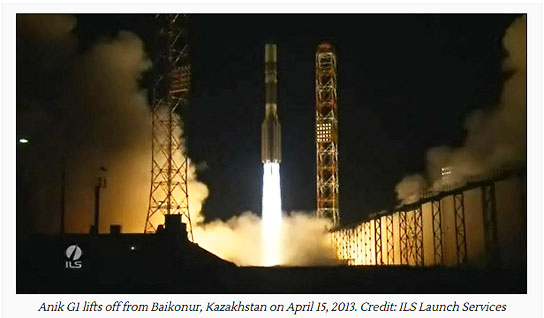
International Launch Services (ILS) launched their Proton-M rocket from the Baikonur Cosmodrome in Kazakhstan on Tuesday at 19:36 GMT. The Proton’s Briz-M (Breeze-M) Upper Stage is being tasked with a multi-hour mission to deploy Canada’s Anik G1 telecommunications satellite into its desired transfer orbit.

The Proton booster that was used to launch the satellite was 4.1 m (13.5 ft) in diameter along its second and third stages, with a first stage diameter of 7.4 m (24.3 ft). Overall height of the three stages of the Proton booster is 42.3 m (138.8 ft).
The Proton vehicle has a heritage of nearly 400 launches since 1965 and is built by Khrunichev Research and State Production Center, one of the pillars of the global space industry and the majority owner of ILS.
The first stage consists of a central tank containing the oxidizer surrounded by six outboard fuel tanks. Each fuel tank also carries one of the six RD-276 engines that provide first stage power. Total first stage vacuum-rated level thrust is 11.0 MN (2,500,000 lbf).
Of a conventional cylindrical design, the second stage is powered by three RD-0210 engines plus one RD-0211 engine and develops a vacuum thrust of 2.4 MN (540,000 lbf).