

• Skip to primary navigation
  • Skip to main content
  • Skip to primary sidebar
  • Skip to secondary sidebar
  • Skip to footer
  • NEWS:
  • SatNews
  • SatMagazine
  • MilSatMagazine
  • SmallSat News
  • |     EVENTS:
  • SmallSat Symposium
  • Satellite Innovation
  • MilSat Symposium
  • SmallSat Europe

SatNews

Satellite Industry Intelligence Since 1983

Subscribe
  • LATEST
  • SatNews Events
  • Magazines
  • Calendar
  • Subscribe
  • Missions & Constellations
    • Exploration & Science Missions
    • In-Orbit Servicing & Orbital Operations
    • LEO Constellations
    • Mission Autonomy & Onboard Systems
    • Mission Deployments & Manifests
    • Navigation & PNT
    • SmallSat
    • Spacecraft & Payload Technology
    View All in Missions & Constellations →
    Northrop Grumman Contracted for Hungary’s HUGEO Sovereign Communications SatelliteNorthrop Grumman Contracted for Hungary’s HUGEO Sovereign Communications Satellite
    SmallSat Europe Speaker Focus: Chiara Manfletti, NeuraspaceSmallSat Europe Speaker Focus: Chiara Manfletti, Neuraspace
    SmallSat Europe Speaker Focus: Daniel Bock, Morpheus SpaceSmallSat Europe Speaker Focus: Daniel Bock, Morpheus Space
    Firefly Aerospace Prepares for Blue Ghost Mission 2 Following Historic Lunar SuccessFirefly Aerospace Prepares for Blue Ghost Mission 2 Following Historic Lunar Success
  • Business
    • Contracts & Commercial Deals
    • Earnings & Financial Reporting
    • Events & Conferences
    • Funding & Venture Capital
    • Market Forecasts
    • Mergers & Acquisitions
    • Personnel Moves & Appointments
    View All in Business & Finance →
    Lockheed Martin Outlines Strategic Space Technology Roadmap for 2026Lockheed Martin Outlines Strategic Space Technology Roadmap for 2026
    Industry Sentiment Shifts as Quilty Space Reveals Top 5 Takeaways from Satellite 2026Industry Sentiment Shifts as Quilty Space Reveals Top 5 Takeaways from Satellite 2026
    e-GEOS and VENG Strengthen Global Partnership for SAOCOM Satellite Data Distributione-GEOS and VENG Strengthen Global Partnership for SAOCOM Satellite Data Distribution
    What the SpaceX IPO Changes for Every Satellite OperatorWhat the SpaceX IPO Changes for Every Satellite Operator
  • Defense
    • Counterspace & ASAT
    • Defense Budgets & Procurement
    • ISR & Reconnaissance
    • MILSATCOM
    • Missile Warning & Defense
    • National Security Programs
    • Space Domain Awareness
    View All in Military & Defense →
    NRL to Showcase Sovereign Space Capabilities at 41st Space SymposiumNRL to Showcase Sovereign Space Capabilities at 41st Space Symposium
    Northrop Grumman Minotaur IV Lofted USSF Tech Demonstration Payloads to OrbitNorthrop Grumman Minotaur IV Lofted USSF Tech Demonstration Payloads to Orbit
    The End of the VSAT Parts BinThe End of the VSAT Parts Bin
    Procurement Lag vs. Conflict Speed: Can Defense Buying Cycles Keep Up with Space Innovation?Procurement Lag vs. Conflict Speed: Can Defense Buying Cycles Keep Up with Space Innovation?
  • Gov
    • Export Controls & Compliance
    • International Space Agreements
    • National Space Policy
    • Space Law & Treaties
    • Space Sustainability & Debris Policy
    • Space Traffic Management / Debris Removal
    View All in Government & Regulation →
    FCC Modernizes Satellite Spectrum Rules to Unleash Next-Generation BroadbandFCC Modernizes Satellite Spectrum Rules to Unleash Next-Generation Broadband
    SmallSat Europe Speaker Focus: Dr. Ane Aanesland, ThrustMeSmallSat Europe Speaker Focus: Dr. Ane Aanesland, ThrustMe
    Isaacman’s Budget Math: How NASA Plans to Reach the Moon With a Quarter Less MoneyIsaacman’s Budget Math: How NASA Plans to Reach the Moon With a Quarter Less Money
    FCC Seeks Comment on Expanding Spectrum Access for “Weird Space Stuff”FCC Seeks Comment on Expanding Spectrum Access for “Weird Space Stuff”
  • Launch
    • Launch Providers
    • Launch Schedule & Calendars
    • Launch Sites & Infrastructure
    • Rocket Technology & Vehicles
    View All in Launch →
    €30 million Financing for PLD Space’s Small Satellite Launcher€30 million Financing for PLD Space’s Small Satellite Launcher
    Satellite Deployers to be Used on JAXA Small Satellite Mission by ExolaunchSatellite Deployers to be Used on JAXA Small Satellite Mission by Exolaunch
    CAS Space Successfully Launches Kinetica-2, Aiming for Global Cost LeadershipCAS Space Successfully Launches Kinetica-2, Aiming for Global Cost Leadership
    Liftoff: NASA Successfully Launches Artemis II to the MoonLiftoff: NASA Successfully Launches Artemis II to the Moon
  • Software
    • Autonomous Ground Operations
    • Data Processing & AI/ML
    • Digital Twins & Modeling
    • Ground Segment & Teleports
    • Mission Planning & Simulation
    • Space Systems Software Engineering
    • Spectrum & Licensing
    View All in Software Automation & Ground Systems →
    Test
    Keysight and Sateliot Win ESA and GSMA Foundry Challenge for 6G InnovationKeysight and Sateliot Win ESA and GSMA Foundry Challenge for 6G Innovation
    Automation and Agility: How SSC Space Go is Designed for the New Age of GroundAutomation and Agility: How SSC Space Go is Designed for the New Age of Ground
    Intellian Unveils Future Military and Aerospace Antenna Technologies at Satellite 2026Intellian Unveils Future Military and Aerospace Antenna Technologies at Satellite 2026
  • Services & Apps
    • Climate & Environmental Monitoring
    • Disaster Response & Security Mapping
    • Earth Observation & Imaging
    • Maritime & Aviation Satcom
    • Satellite Communications
    View All in Services & Applications →
    Kraken Robotics Integrates KATFISH Sonar on SEFINE RD-22 USV Following Multi-Naval DemonstrationsKraken Robotics Integrates KATFISH Sonar on SEFINE RD-22 USV Following Multi-Naval Demonstrations
    Astroscale Plans World-First Multi-Orbit Satellite Inspection MissionAstroscale Plans World-First Multi-Orbit Satellite Inspection Mission
    The Downlink Deficit: The Pentagon’s Optical Mesh Network and the Terrestrial BottleneckThe Downlink Deficit: The Pentagon’s Optical Mesh Network and the Terrestrial Bottleneck
    Cinemo Reimagines the Vehicle as a Software-Defined Entertainment HubCinemo Reimagines the Vehicle as a Software-Defined Entertainment Hub

NASA… IRIS To Eyeball The Sun (Satellite)

January 24, 2013

[SatNews] NASA‘s next Small Explorer (SMEX) mission to study the little-understood lower levels of the…

…sun’s atmosphere has been fully integrated and final testing is underway. Scheduled to launch in April of 2013, the Interface Region Imaging Spectrograph (IRIS) will make use of high-resolution images, data and advanced computer models to unravel how matter, light, and energy move from the sun’s 6,000 K (10,240 F / 5,727 C) surface to its million K (1.8 million F / 999,700 C) outer atmosphere, the corona. Such movement ultimately heats the sun’s atmosphere to temperatures much hotter than the surface, and also powers solar flares and coronal mass ejections, which can have societal and economic impacts on Earth.

“This is the first time we’ll be directly observing this region since the 1970s,” says Joe Davila, IRIS project scientist at NASA’s Goddard Space Flight Center in Greenbelt, Maryland. “We’re excited to bring this new set of observations to bear on the continued question of how the corona gets so hot.”
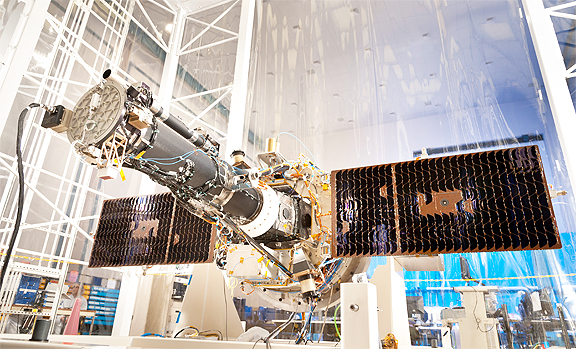

The fully integrated spacecraft and science instrument for NASA’s Interface Region Imaging Spectrograph (IRIS) mission is seen in a clean room at the Lockheed Martin Space Systems Sunnyvale, Calif. facility. The solar arrays are deployed in the configuration they will assume when in orbit. Credit: Lockheed Martin

A fundamentally mysterious region that helps drive heat into the corona, the lower levels of the atmosphere—namely two layers called the chromosphere and the transition region—have been notoriously hard to study. IRIS will be able to tease apart what’s happening there better than ever before by providing observations to pinpoint physical forces at work near the surface of the sun. The mission carries a single instrument: an ultraviolet telescope combined with an imaging spectrograph that will both focus on the chromosphere and the transition region. The telescope will see about one percent of the sun at a time and resolve that image to show features on the sun as small as 150 miles (241.4 km) across. The instrument will capture a new image every five to ten seconds, and spectra about every one to two seconds. Spectra will cover temperatures from 4,500 K to 10,000,000 K (7,640 F/4,227 C to 18 million F/10 million C), with images covering temperatures from 4,500 K to 65,000 K (116,500 F/64,730 C).

These unique capabilities will be coupled with state of the art 3D numerical modeling on supercomputers, such as Pleiades, housed at NASA’s Ames Research Center in Moffett Field, California. Indeed, recent improvements in computer power to analyze the large amount of data is crucial to why IRIS will provide better information about the region than ever seen before.

“The interpretation of the IRIS spectra is a major effort coordinated by the IRIS science team that will utilize the full extent of the power of the most advanced computational resources in the world. It is this new capability, along with development of state of the art codes and numerical models by the University of Oslo that captures the complexities of this region, which make the IRIS mission possible. Without these important elements we would be unable to fully interpret the IRIS spectra,” said Alan Title, the IRIS principal investigator at the Advanced Technology Center (ATC) Solar and Astrophysics Laboratory in Palo Alto, Calif.
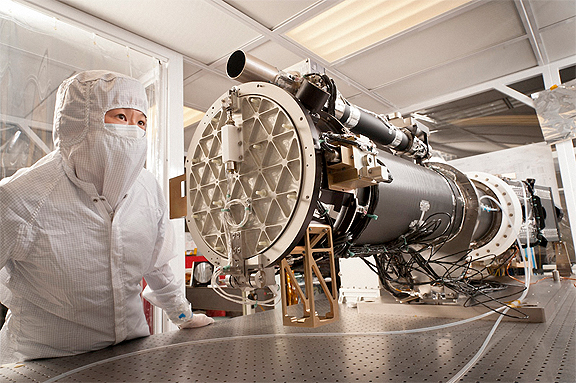

Lockheed Martin Space Systems engineer Cathy Chou, integration and test lead for NASA’s Interface Region Imaging Spectrograph (IRIS) observatory, inspects the IRIS solar telescope in a clean room at the company’s Advanced Technology Center in Palo Alto, Calif. Credit: Lockheed Martin

The IRIS observatory will launch from Vandenberg Air Force Base, Calif., and will fly in a sun-synchronous polar orbit for continuous solar observations during a two-year mission. IRIS was designed and built at the Lockheed Martin Space Systems ATC in Palo Alto, California, with support from the company’s Civil Space line of business and major partners Smithsonian Astrophysical Observatory and Montana State University. Ames is responsible for mission operations and the ground data system. The Norwegian Space Agency will provide the primary ground station at Svalbard, Norway, inside the Arctic Circle. The science data will be managed by the Joint Science Operations Center, run by Stanford and Lockheed Martin. Goddard oversees the SMEX program.

The NASA SMEX Program is designed to provide frequent, low-cost access to space for heliophysics and astrophysics missions using small to mid-sized spacecraft. The program also seeks to raise public awareness of NASA’s space science missions through educational and public outreach activities.

Filed Under: Exploration & Science Missions

Primary Sidebar

Coverage

  • Missions & Constellations
  • Business & Finance
  • Military & Defense
  • Launch
  • Software Automation & Ground Systems
  • Government & Regulation
  • Services & Applications

Most Read Stories

  • L3Harris Unveils XL-300P: The First P25 Handheld with 5G and Satellite Direct-to-Device Connectivity
  • Rheinmetall Walked Away. Germany Should Take the Hint.
  • Rocket Lab Emerging as Potential Bus Provider for 2,800-Satellite Equatys Constellation
  • SpaceX Loses Contact With Starlink Satellite
  • FAA Rescinds Proposed Orbital Debris Rule Amid Industry Pressure and Regulatory Reassessment

Secondary Sidebar

Footer


Satnews is a leading provider of satellite news, events, publications, research and other satellite industry information in both commercial and military enterprises worldwide.

Stories By Category

  • Business & Finance
  • Government & Regulation
  • Launch
  • Military & Defense
  • Missions & Constellations
  • Services & Applications
  • Software Automation & Ground Systems
  • Spectrum & Licensing
  • Startups & NewSpace Business

About Us

  • Leadership & Editorial Team
  • SatNews History
  • Free Satnews Subscription
  • SatNews Events
  • Magazines

Navigation

  • Latest Stories
  • Magazines
  • Events
  • Contact
  • Cookie & Privacy Policy for Satnews

We use cookies to ensure that we give you the best experience on our website. If you continue to use this site we will assume that you are happy with it.
x
Sign up Now (For Free)
Access daily or weekly satellite news updates covering all aspects of the commercial and military satellite industry.
Invalid email address
Notify Me Regarding ( At least one ):
We value your privacy and will not sell or share your email or other information with any other company. You may also unsubscribe at anytime.

Click Here to see our full privacy policy.
Thanks for subscribing!