

• Skip to primary navigation
  • Skip to main content
  • Skip to primary sidebar
  • Skip to secondary sidebar
  • Skip to footer
  • NEWS:
  • SatNews
  • SatMagazine
  • MilSatMagazine
  • SmallSat News
  • |     EVENTS:
  • SmallSat Symposium
  • Satellite Innovation
  • MilSat Symposium
  • SmallSat Europe

SatNews

Satellite Industry Intelligence Since 1983

Subscribe
  • LATEST
  • Missions & Constellations
    • Exploration & Science Missions
    • In-Orbit Servicing & Orbital Operations
    • LEO Constellations
    • Mission Autonomy & Onboard Systems
    • Mission Deployments & Manifests
    • Navigation & PNT
    • SmallSat
    • Spacecraft & Payload Technology
    View All in Missions & Constellations →
    SmallSat Europe Speaker Focus: Daniel Bock, Morpheus SpaceSmallSat Europe Speaker Focus: Daniel Bock, Morpheus Space
    Firefly Aerospace Prepares for Blue Ghost Mission 2 Following Historic Lunar SuccessFirefly Aerospace Prepares for Blue Ghost Mission 2 Following Historic Lunar Success
    New Boeing Satellite Spacecraft Delivered.New Boeing Satellite Spacecraft Delivered.
    What the SpaceX IPO Changes for Every Satellite OperatorWhat the SpaceX IPO Changes for Every Satellite Operator
  • Business
    • Contracts & Commercial Deals
    • Earnings & Financial Reporting
    • Events & Conferences
    • Funding & Venture Capital
    • Market Forecasts
    • Mergers & Acquisitions
    • Personnel Moves & Appointments
    View All in Business & Finance →
    Lockheed Martin Outlines Strategic Space Technology Roadmap for 2026Lockheed Martin Outlines Strategic Space Technology Roadmap for 2026
    Industry Sentiment Shifts as Quilty Space Reveals Top 5 Takeaways from Satellite 2026Industry Sentiment Shifts as Quilty Space Reveals Top 5 Takeaways from Satellite 2026
    e-GEOS and VENG Strengthen Global Partnership for SAOCOM Satellite Data Distributione-GEOS and VENG Strengthen Global Partnership for SAOCOM Satellite Data Distribution
    Empowering the Next Generation at SmallSat Europe 2026Empowering the Next Generation at SmallSat Europe 2026
  • Defense
    • Counterspace & ASAT
    • Defense Budgets & Procurement
    • ISR & Reconnaissance
    • MILSATCOM
    • Missile Warning & Defense
    • National Security Programs
    • Space Domain Awareness
    View All in Military & Defense →
    The End of the VSAT Parts BinThe End of the VSAT Parts Bin
    Procurement Lag vs. Conflict Speed: Can Defense Buying Cycles Keep Up with Space Innovation?Procurement Lag vs. Conflict Speed: Can Defense Buying Cycles Keep Up with Space Innovation?
    ParaZero Technologies Expands Israeli Defense Contract with New Order for Anti-Drone SystemsParaZero Technologies Expands Israeli Defense Contract with New Order for Anti-Drone Systems
    Russia Replaces Starlink With European-Built SatellitesRussia Replaces Starlink With European-Built Satellites
  • Gov
    • Export Controls & Compliance
    • International Space Agreements
    • National Space Policy
    • Space Law & Treaties
    • Space Sustainability & Debris Policy
    • Space Traffic Management / Debris Removal
    View All in Government & Regulation →
    FCC Modernizes Satellite Spectrum Rules to Unleash Next-Generation BroadbandFCC Modernizes Satellite Spectrum Rules to Unleash Next-Generation Broadband
    SmallSat Europe Speaker Focus: Dr. Ane Aanesland, ThrustMeSmallSat Europe Speaker Focus: Dr. Ane Aanesland, ThrustMe
    Isaacman’s Budget Math: How NASA Plans to Reach the Moon With a Quarter Less MoneyIsaacman’s Budget Math: How NASA Plans to Reach the Moon With a Quarter Less Money
    FCC Seeks Comment on Expanding Spectrum Access for “Weird Space Stuff”FCC Seeks Comment on Expanding Spectrum Access for “Weird Space Stuff”
  • Launch
    • Launch Providers
    • Launch Schedule & Calendars
    • Launch Sites & Infrastructure
    • Rocket Technology & Vehicles
    View All in Launch →
    €30 million Financing for PLD Space’s Small Satellite Launcher€30 million Financing for PLD Space’s Small Satellite Launcher
    Satellite Deployers to be Used on JAXA Small Satellite Mission by ExolaunchSatellite Deployers to be Used on JAXA Small Satellite Mission by Exolaunch
    CAS Space Successfully Launches Kinetica-2, Aiming for Global Cost LeadershipCAS Space Successfully Launches Kinetica-2, Aiming for Global Cost Leadership
    Liftoff: NASA Successfully Launches Artemis II to the MoonLiftoff: NASA Successfully Launches Artemis II to the Moon
  • Software
    • Autonomous Ground Operations
    • Data Processing & AI/ML
    • Digital Twins & Modeling
    • Ground Segment & Teleports
    • Mission Planning & Simulation
    • Space Systems Software Engineering
    • Spectrum & Licensing
    View All in Software Automation & Ground Systems →
    Keysight and Sateliot Win ESA and GSMA Foundry Challenge for 6G InnovationKeysight and Sateliot Win ESA and GSMA Foundry Challenge for 6G Innovation
    Automation and Agility: How SSC Space Go is Designed for the New Age of GroundAutomation and Agility: How SSC Space Go is Designed for the New Age of Ground
    Intellian Unveils Future Military and Aerospace Antenna Technologies at Satellite 2026Intellian Unveils Future Military and Aerospace Antenna Technologies at Satellite 2026
    The Downlink Deficit: The Pentagon’s Optical Mesh Network and the Terrestrial BottleneckThe Downlink Deficit: The Pentagon’s Optical Mesh Network and the Terrestrial Bottleneck
  • Services & Apps
    • Climate & Environmental Monitoring
    • Disaster Response & Security Mapping
    • Earth Observation & Imaging
    • Maritime & Aviation Satcom
    • Satellite Communications
    View All in Services & Applications →
    Kraken Robotics Integrates KATFISH Sonar on SEFINE RD-22 USV Following Multi-Naval DemonstrationsKraken Robotics Integrates KATFISH Sonar on SEFINE RD-22 USV Following Multi-Naval Demonstrations
    Astroscale Plans World-First Multi-Orbit Satellite Inspection MissionAstroscale Plans World-First Multi-Orbit Satellite Inspection Mission
    Cinemo Reimagines the Vehicle as a Software-Defined Entertainment HubCinemo Reimagines the Vehicle as a Software-Defined Entertainment Hub
    IEC Telecom Wins CSR Initiative of the Year at the Oil & Gas Middle East Awards 2026IEC Telecom Wins CSR Initiative of the Year at the Oil & Gas Middle East Awards 2026
  • SatNews Events
  • Magazines
  • Calendar

Hubble…13 Billion Year-Old Galaxies May Explain “Missing Satellite” Problem

July 10, 2012

[SatNews] “These galaxies are all ancient and…the same age, so you know something came down like a guillotine and turned off the star formation at the same time in these galaxies.”

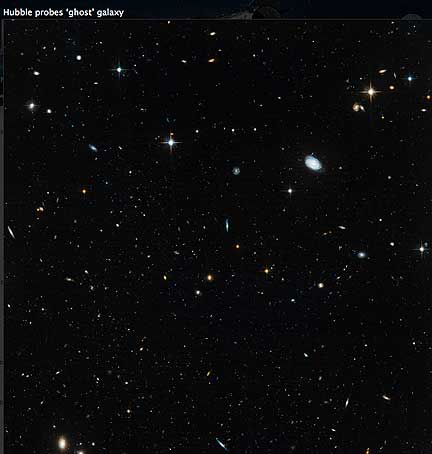
Astronomers have used the NASA/ESA Hubble Space Telescope to study some of the smallest and faintest galaxies in our cosmic neighborhood. These galaxies are fossils of the early Universe: they have barely changed for 13 billion years. The discovery could help explain the so-called “missing satellite” problem, where only a handful of satellite galaxies have been found around the Milky Way, against the thousands that are predicted by theories.

Astronomers have puzzled over why some extremely faint dwarf galaxies spotted in our Milky Way galaxy’s backyard contain so few stars. The galaxies are thought to be some of the tiniest, oldest, and most pristine galaxies in the Universe. They have been discovered over the past decade by astronomers using automated computer techniques to search through the images of the Sloan Digital Sky Survey. But an international team of astronomers needed the NASA/ESA Hubble Space Telescope to help solve the mystery of why these galaxies are starved of stars, and why so few of them have been found.

Hubble views of three of these small galaxies, the Hercules, Leo IV and Ursa Major dwarf galaxies, reveal that they all started forming stars more than 13 billion years ago — and then abruptly stopped — all in the first billion years after the Universe was born in the Big Bang. In fact, the extreme age of their stars is similar to Messier 92, the oldest known globular cluster [1] in the Milky Way.

“These galaxies are all ancient and they’re all the same age, so you know something came down like a guillotine and turned off the star formation at the same time in these galaxies,” said Tom Brown of the Space Telescope Science Institute in Baltimore, USA, the study’s leader. “The most likely explanation is a process called reionisation.”

The relic galaxies are evidence for a transitional phase in the early Universe that shut down star-making factories in tiny galaxies. This phase seems to coincide with the time when the first stars burned off a fog of cold hydrogen, a process called reionisation. In this period, which began in the first billion years after the Big Bang, radiation from the first stars knocked electrons off primeval hydrogen atoms, ionising the Universe’s cool hydrogen gas. [2] The same radiation that sparked universal reionisation also appears to have squelched star-making activities in dwarf galaxies, such as those in Brown’s study. The small irregular galaxies were born about 100 million years before reionisation began and had just started to churn out stars at that time. Roughly 2000 light-years wide, these galaxies are the lightweight cousins of the more luminous and higher-mass star-making dwarf galaxies near our Milky Way. Unlike their higher-mass relatives, the puny galaxies were not massive enough to shield themselves from the harsh ultraviolet light. What little gas they had was stripped away as the flood of ultraviolet light rushed through them. Their gas supply depleted, the galaxies could not make new stars.

The discovery could help explain the so-called “missing satellite problem,” where only a few dozen dwarf galaxies have been observed around the Milky Way while the computer simulations predict that thousands should exist. One possible explanation for the low number discovered to date is that there has been very little, or even no star formation in the smallest of these dwarf galaxies, leaving them virtually invisible.

The Sloan survey recently uncovered more than a dozen of these galaxies in our cosmic neighbourhood. These have very few stars — only a few hundred or thousand — but a great deal of dark matter, the underlying scaffolding upon which galaxies are built. Normal dwarf galaxies near the Milky Way contain 10 times more dark matter than the ordinary matter that makes up gas and stars, while in these so-called ultra-faint dwarf galaxies, dark matter outweighs ordinary matter by at least a factor of 100. Astronomers think the rest of the sky should contain dozens more of these ultra-faint dwarf galaxies with few stars, and the evidence for squelched star formation in the smallest of these dwarfs suggests that there may be still thousands more with essentially no stars at all.

“By measuring the star formation histories of the observed dwarfs, Hubble has supported the theoretical explanation for the paucity of such objects, according to which star formation in the smaller clumps would be shut down by reionisation,” said Jason Tumlinson of the Space Telescope Science Institute, a member of the research team. The results are published in the 1 July issue of The Astrophysical Journal Letters.

The results are published in the 1 July issue of The Astrophysical Journal Letters.

Notes
The Hubble Space Telescope is a project of international cooperation between ESA and NASA.

The international team of astronomers in this study consists of T. M. Brown (STScI), J. Tumlinson (STScI), M. Geha (Yale), E. N. Kirby (Cal Tech), D. A. VandenBerg (University of Victoria), R. R. Munoz (University of Chile), J. S. Kalirai (STScI), J. D. Simon (Carnegie Institution), R. J. Avila (STScI), P. Guhathakurta (UCO/Lick), A. Renzini (Osservatorio Astronomico di Padova) and, H. C. Ferguson (STScI)

[1] Globular clusters are tightly-bound spherical collections of up to a few hundred thousand stars. They are known to contain some of the most ancient stars in the Universe. In addition, globular clusters are known to have formed in single events, so all the stars in them have the same age.

[2] The period of reionisation is also the limit for how far telescopes can see: the process is what rendered the Universe’s hydrogen gas transparent to ultraviolet light. Image credit: NASA, ESA, and T. Brown (STScI) 

Filed Under: Exploration & Science Missions

Primary Sidebar

Coverage

  • Missions & Constellations
  • Business & Finance
  • Military & Defense
  • Launch
  • Software Automation & Ground Systems
  • Government & Regulation
  • Services & Applications

Most Read Stories

  • Rheinmetall Withdraws From Mynaric Bidding Process; Rocket Lab Acquisition Clears Major Competitive Hurdle
  • L3Harris Unveils XL-300P: The First P25 Handheld with 5G and Satellite Direct-to-Device Connectivity
  • Rheinmetall Walked Away. Germany Should Take the Hint.
  • Rocket Lab Emerging as Potential Bus Provider for 2,800-Satellite Equatys Constellation
  • SpaceX Loses Contact With Starlink Satellite

Secondary Sidebar

Footer


Satnews is a leading provider of satellite news, events, publications, research and other satellite industry information in both commercial and military enterprises worldwide.

Stories By Category

  • Business & Finance
  • Government & Regulation
  • Launch
  • Military & Defense
  • Missions & Constellations
  • Services & Applications
  • Software Automation & Ground Systems
  • Spectrum & Licensing
  • Startups & NewSpace Business

About Us

  • Leadership & Editorial Team
  • SatNews History
  • Free Satnews Subscription
  • SatNews Events
  • Magazines

Navigation

  • Latest Stories
  • Magazines
  • Events
  • Contact
  • Cookie & Privacy Policy for Satnews

We use cookies to ensure that we give you the best experience on our website. If you continue to use this site we will assume that you are happy with it.
x
Sign up Now (For Free)
Access daily or weekly satellite news updates covering all aspects of the commercial and military satellite industry.
Invalid email address
Notify Me Regarding ( At least one ):
We value your privacy and will not sell or share your email or other information with any other company. You may also unsubscribe at anytime.

Click Here to see our full privacy policy.
Thanks for subscribing!