

• Skip to primary navigation
  • Skip to main content
  • Skip to primary sidebar
  • Skip to secondary sidebar
  • Skip to footer
  • NEWS:
  • SatNews
  • SatMagazine
  • MilSatMagazine
  • SmallSat News
  • |     EVENTS:
  • SmallSat Symposium
  • Satellite Innovation
  • MilSat Symposium
  • SmallSat Europe

SatNews

Satellite Industry Intelligence Since 1983

Subscribe
  • LATEST
  • SatNews Events
  • Magazines
  • Calendar
  • Subscribe
  • Missions & Constellations
    • Exploration & Science Missions
    • In-Orbit Servicing & Orbital Operations
    • LEO Constellations
    • Mission Autonomy & Onboard Systems
    • Mission Deployments & Manifests
    • Navigation & PNT
    • SmallSat
    • Spacecraft & Payload Technology
    View All in Missions & Constellations →
    Gen Z Influence on AI-Driven Audio MarketGen Z Influence on AI-Driven Audio Market
    SmallSat Europe Speaker Focus: Stefano Antonetti, D-OrbitSmallSat Europe Speaker Focus: Stefano Antonetti, D-Orbit
    Satellite and the Upcoming Spectrum AuctionSatellite and the Upcoming Spectrum Auction
    ExoMars 2028 Structural Models Arrive in Cannes for Environmental TestingExoMars 2028 Structural Models Arrive in Cannes for Environmental Testing
  • Business
    • Contracts & Commercial Deals
    • Earnings & Financial Reporting
    • Events & Conferences
    • Funding & Venture Capital
    • Market Forecasts
    • Mergers & Acquisitions
    • Personnel Moves & Appointments
    View All in Business & Finance →
    SmallSat Europe Speaker Focus: Gregg Burgess, Orion Space SolutionsSmallSat Europe Speaker Focus: Gregg Burgess, Orion Space Solutions
    Space42 Taps Skylo for Standards-Based Direct-to-Device Services via Thuraya-4Space42 Taps Skylo for Standards-Based Direct-to-Device Services via Thuraya-4
    SmallSat Europe Speaker Focus: Frank M. Salzgeber, Nadir Space VentureSmallSat Europe Speaker Focus: Frank M. Salzgeber, Nadir Space Venture
    Ted Turner: “Shake with Terror”Ted Turner: “Shake with Terror”
  • Defense
    • Counterspace & ASAT
    • Defense Budgets & Procurement
    • ISR & Reconnaissance
    • MILSATCOM
    • Missile Warning & Defense
    • National Security Programs
    • Space Domain Awareness
    View All in Military & Defense →
    iDirect Government Launches 450 Rackmount Software-Defined Modem for Multi-Orbit DefenseiDirect Government Launches 450 Rackmount Software-Defined Modem for Multi-Orbit Defense
    US Air Force Taps L3Harris to Bolster ABMS Digital InfrastructureUS Air Force Taps L3Harris to Bolster ABMS Digital Infrastructure
    U.S. and Australia Expand Space Surveillance Network to Counter Emerging ASAT ThreatsU.S. and Australia Expand Space Surveillance Network to Counter Emerging ASAT Threats
    U.S. Space Force Awards $3.2 Billion for Space-Based Interceptor LayerU.S. Space Force Awards $3.2 Billion for Space-Based Interceptor Layer
  • Gov
    • Export Controls & Compliance
    • International Space Agreements
    • National Space Policy
    • Space Law & Treaties
    • Space Sustainability & Debris Policy
    • Space Traffic Management / Debris Removal
    View All in Government & Regulation →
    FCC Approves Landmark Spectrum Sharing and Direct-to-Device FrameworksFCC Approves Landmark Spectrum Sharing and Direct-to-Device Frameworks
    ATVA Urges FCC to Close “Affiliation-Swap” Loopholes Impacting Satellite OperatorsATVA Urges FCC to Close “Affiliation-Swap” Loopholes Impacting Satellite Operators
    UAE Space Agency Drives Public-Private Collaboration at MIITE 2026UAE Space Agency Drives Public-Private Collaboration at MIITE 2026
    SmallSat Europe Speaker Focus: Araz Feyzi, Kayhan SpaceSmallSat Europe Speaker Focus: Araz Feyzi, Kayhan Space
  • Launch
    • Launch Providers
    • Launch Schedule & Calendars
    • Launch Sites & Infrastructure
    • Rocket Technology & Vehicles
    View All in Launch →
    AST SpaceMobile Pivots to SpaceX for Mid-June Launch of Three BlueBird SatellitesAST SpaceMobile Pivots to SpaceX for Mid-June Launch of Three BlueBird Satellites
    SpaceX Accelerates Transition from Falcon 9 to Next-Generation Starship FleetSpaceX Accelerates Transition from Falcon 9 to Next-Generation Starship Fleet
    NanoAvionics Satellites Reach Orbit on SpaceX CAS500-2 MissionNanoAvionics Satellites Reach Orbit on SpaceX CAS500-2 Mission
    GalaxEye Successfully Launches “Mission Drishti” OptoSAR SatelliteGalaxEye Successfully Launches “Mission Drishti” OptoSAR Satellite
  • Software
    • Autonomous Ground Operations
    • Data Processing & AI/ML
    • Digital Twins & Modeling
    • Ground Segment & Teleports
    • Mission Planning & Simulation
    • Space Systems Software Engineering
    • Spectrum & Licensing
    View All in Software Automation & Ground Systems →
    Your anomaly detection isn’t the problemYour anomaly detection isn’t the problem
    SmallSat Europe Speaker Focus: Olaf Eckart, BMW GroupSmallSat Europe Speaker Focus: Olaf Eckart, BMW Group
    SES Accelerates Multi-Orbit IFC Strategy with meoSphere and Next-Gen ESA DevelopmentSES Accelerates Multi-Orbit IFC Strategy with meoSphere and Next-Gen ESA Development
    SmallSat Europe Speaker Focus: Koen Willems, ST Engineering iDirect EuropeSmallSat Europe Speaker Focus: Koen Willems, ST Engineering iDirect Europe
  • Services & Apps
    • Climate & Environmental Monitoring
    • Disaster Response & Security Mapping
    • Earth Observation & Imaging
    • Maritime & Aviation Satcom
    • Satellite Communications
    View All in Services & Applications →
    Consumer NPU Boom Accelerates Autonomous Satellite ProcessingConsumer NPU Boom Accelerates Autonomous Satellite Processing
    Satellite Technology and the Legacy of the Media PioneerSatellite Technology and the Legacy of the Media Pioneer
    SmallSat Europe Speaker Focus: Massimo Comparini, Leonardo Space DivisionSmallSat Europe Speaker Focus: Massimo Comparini, Leonardo Space Division
    The waiver was the policy. Thursday is the paperwork.The waiver was the policy. Thursday is the paperwork.

European Space Agency (ESA)… Orbits Acquired (Satellites)

November 6, 2011


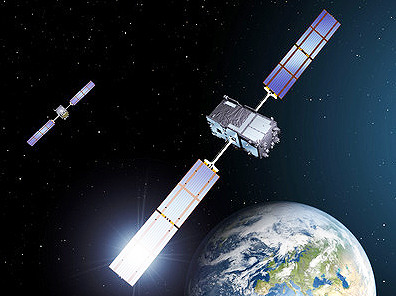
The first two of four Galileo In-Orbit Validation satellites were launched on 21 October 2011. Credits: ESA – P. Carril
[SatNews] Europe’s first two Galileo satellites have reached their final operating orbits…

This opens the way for activating and testing their navigation payloads. Marking the formal end of their LEOP (Launch and Early Operations Phase), control of the satellites was passed yesterday from the CNES French space agency center in Toulouse to the Galileo Control Centre in Oberpfaffenhofen in Germany.
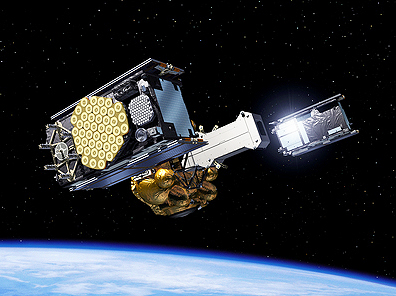

The Galileo launch dispenser, designed for Arianespace by RUAG Space Sweden, secured the twin Galileo IOV satellites in place during the take-off of their Soyuz ST-B. Credits: ESA – P. Carril
Oberfaffenhofen, operated by the German Aerospace Center (DLR), will be in charge of the satellites’ command and control for their entire 12-year operating lives. The two Galileo satellites were launched by a Soyuz launch vehicle from the Arianespace French Guiana launch site on October 21st. Three hours and 49 minutes after launch, their Fregat-MT upper stage carried them into their planned 23,222km orbit, where they were released simultaneously. At this point, a joint team from CNES and ESA’s ESOC European Space Operations Centre moved into action, beginning the crucial task of bringing the two satellites to life.

The first signals were heard almost simultaneously, confirming they were in good health – but there was still plenty of work to be done to keep them that way. Like parachutists jumping from an aircraft, they were left tumbling through space. This spinning had to be brought under control before it was safe to deploy the power-giving solar panels, ending the satellites’ reliance on their rapidly dwindling battery power. Once the reaction wheels steadied them, the satellites sought the Sun and began recharging their batteries, around 70 minutes after separation.


Galileo’s Ground Control Segment (GCS) in the Oberpfaffenhofen Control Center in Germany is in charge of overseeing the performance of the Galileo satellites Credits: DLR
The thrusters were then tested – an important milestone because the Fregat had carried them most of the way into space but they would have to manoeuvre the last 100 km or so into their planned final orbits by themselves. The pair then switched from Sun-pointing to Earth-pointing, using infrared sensors that detect our planet as a warm object in cold space. After that, they settled into their normal mode, with the solar arrays tracking the Sun and the navigation antenna pointed towards Earth.

The section of satellite housing the sensitive atomic clocks – the most accurate ever flown in space for navigation purposes – is kept permanently cool in shadow to help stabilise their performance. In this configuration, the Toulouse centre commanded a set of thruster firings to relocate the satellites to their intended orbits inclined at 56 degrees to the equator.
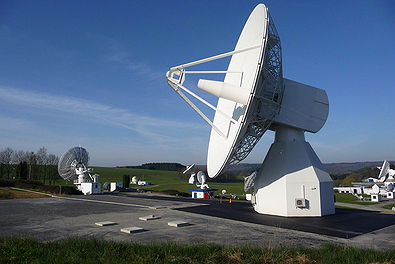

Galileo IOT L-band antenna at ESA’s Redu ground station. Credits: ESA

The handover to Oberpfaffenhofen occurred directly after LEOP was completed, taking place at 22:00 CEST on 3 November. Ground controllers began by encrypting the telemetry and telecommand links, ensuring secure satellite control. Then they started commissioning the platform, verifying that all prime and redundant subsystems perform as expected. The next few days will see the navigation payload being switched on, marking the start of Galileo’s In-Orbit Test campaign. This rigorous check of the navigation signals is being conducted from ESA’s ground station in Redu, Belgium. In particular, a 20m diameter antenna will measure the precise shape of the navigation signals to a very high degree of accuracy. Once the navigation payload is fully checked-out and activated, a second Galileo Control Centre in Fucino, Italy – operated by the Telespazio company – will oversee all navigation services. All the entities participating in these activities – ESOC, CNES, DLR and Telespazio – do so under contract to SpaceOpal, a joint subsidiary company of DLR and Telespazio for Galileo operations.

Filed Under: Mission Deployments & Manifests, Navigation & PNT

Primary Sidebar

Coverage

  • Missions & Constellations
  • Business & Finance
  • Military & Defense
  • Launch
  • Software Automation & Ground Systems
  • Government & Regulation
  • Services & Applications

Most Read Stories

  • NASA Shuts Off Instrument on Voyager 1 to Extend Interstellar Mission
  • Bad news, but good news followed
  • Amazon to Acquire Globalstar for $11.6 Billion to Fuel D2D Expansion
  • Blue Origin Achieves First Booster Reuse but Satellite Enters Off-Nominal Orbit
  • The Smartest Money in the Room Is Looking Up

Secondary Sidebar

Footer


Satnews is a leading provider of satellite news, events, publications, research and other satellite industry information in both commercial and military enterprises worldwide.

Stories By Category

  • Business & Finance
  • Government & Regulation
  • Launch
  • Military & Defense
  • Missions & Constellations
  • Services & Applications
  • Software Automation & Ground Systems
  • Spectrum & Licensing
  • Startups & NewSpace Business

About Us

  • Leadership & Editorial Team
  • SatNews History
  • Free Satnews Subscription
  • SatNews Events
  • Magazines

Navigation

  • Latest Stories
  • Magazines
  • Events
  • Contact
  • Cookie & Privacy Policy for Satnews

We use cookies to ensure that we give you the best experience on our website. If you continue to use this site we will assume that you are happy with it.
x
Sign up Now (For Free)
Access daily or weekly satellite news updates covering all aspects of the commercial and military satellite industry.
Invalid email address
Notify Me Regarding ( At least one ):
We value your privacy and will not sell or share your email or other information with any other company. You may also unsubscribe at anytime.

Click Here to see our full privacy policy.
Thanks for subscribing!