

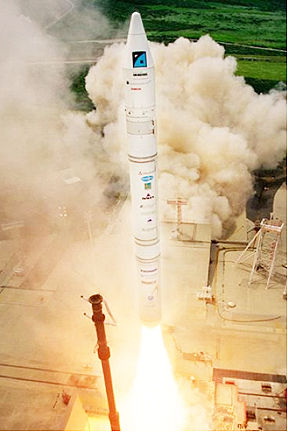
Athena 2 launch vehicle, photo courtesy of Lockheed Martin
Lockheed Martin will provide mission management, payload integration, and launch operations, and ATK will provide integrated vehicle propulsion, launch vehicle structures, booster integration and launch site operations. The two-stage Athena Ic and three-stage Athena IIc launch vehicles incorporate the new CASTOR® 30 upper stage motor and upgrades to electronic systems. Athena is available for launches starting in 2012, with a payload lift capability that supports a variety of customer mission requirements including NASA, the Department of Defense and other space markets.
Athena can carry payloads up to 3,775 pounds (1,712 kg) to low Earth orbit as well as missions to the moon. Using a large 92-inch diameter payload fairing, the vehicle accommodates a wide range of satellites and missions. The rockets can be launched from multiple locations including Cape Canaveral Air Force Station, Kodiak Launch Complex, Vandenberg Air Force Base and NASA Wallops Mid-Atlantic Regional Spaceport. First-generation Athena I and II rockets became operational in 1995 and have flown seven times. Athena II launched the Lunar Prospector to the moon in 1998 and remains the only commercially developed launch vehicle to fly a lunar mission. These 2G Athena launch vehicles use the same flight-proven ATK CASTOR 120® for Stage I and Stage II. The modernized launch vehicles benefit from the latest technology of a newly-developed and ground-tested CASTOR® 30 for their upper stage, and Lockheed Martin’s modernized electronic systems. Both solid rocket motors are in production and are being used on other launch vehicles in the industry.
