

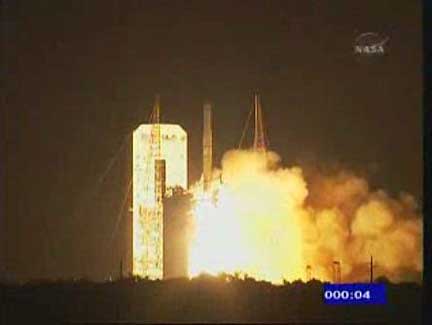
“Roger, you’re go for launch,” the much awaited command for ULA/NASA’s GOES P to lift off sucessfully from Space Launch Complex-37 at Cape Canaveral Air Force Station, Florida at 7:12 pm EST. The multi-mission GOES series will be a vital contributor to weather, solar, and space operations and science. On board GOES-P will be a highly advanced attitude control system that will foster enhanced instrument performance for improved weather service quality. GOES-P data will add to the global climate change databases of knowledge, embracing many civil and government environmental forecasting organizations that work to benefit people everywhere and help save lives.
And a second launch that of ULA’s new site. You can check out all of ULA’s information from their new site at.
The project is developed in partnership with the U.S. Air Force (USAF) Evolved Expendable Launch Vehicle (EELV) program, the Delta IV family of launch vehicles combines design simplicity, manufacturing efficiency, and streamlined mission and vehicle integration to meet customer requirements to launch high-priority USAF, National Reconnaissance Office (NRO), NASA, and commercial payloads to orbit. With operational launch pads on both coasts — Space Launch Complex-37 at Cape Canaveral Air Force Station, Florida, and Space Launch Complex-6 at Vandenberg Air Force Base, California — every Delta IV configuration is available to service the requirements of current and future satellite programs.
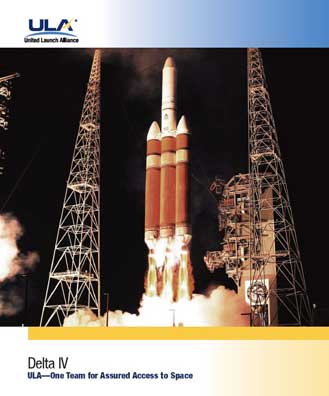
The Delta IV launch system is available in five configurations: the Delta IV Medium (Delta IV M), three variants of the Delta IV Medium-Plus (Delta IV M+), and the Delta IV Heavy (Delta IV H). Each configuration is comprised of a common booster core (CBC), a cryogenic upper stage and either a 4-m-diameter or 5-m-diameter payload fairing (PLF).
There are three variants of Delta IV M+ configuration. The Delta IV M+(4,2) uses two strap-on solid rocket motors (SRMs) to augment the first-stage CBC and a 4-m diameter PLF. The Delta IV M+(5,2) and Delta IV M+(5,4) have two and four SRMs, respectively and 5-m-diameter PLF.
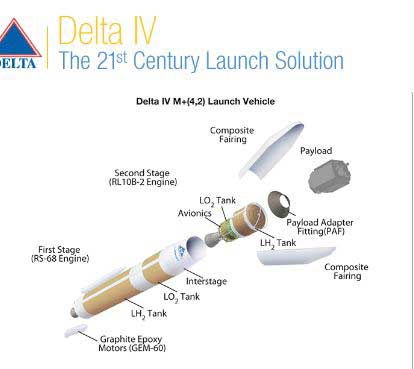
Propulsion of the main engine involves design simplicity, demonstrated capability and cost-efficiency define the RS-68, the main engine for the Delta IV. Designed and manufactured by Pratt & Whitney Rocketdyne, the throttleable RS-68 engine is the largest existing hydrogen-burning engine. Conceived using a simplified design approach, the resulting engine requires 80 percent fewer parts than the Space Shuttle main engine, is lower risk, has reduced development and production costs and has inherently reliable operation.
For missions requiring additional thrust at liftoff, the Delta IV M+ configurations use either two or four Alliant Techsystems-manufactured solid rocket motors (SRM). Separation is accomplished by initiating ordnance thrusters that provide a radial thrust to jettison the expended SRMs away from the first stage.
Both the Atlas and the Delta IV upper stages rely on the RL10 propulsion system to power their second stages. Logging an impressive record of more than 385 successful flights and nearly 700 firings in space, RL10 engines, manufactured by Pratt & Whitney Rocketdyne, harness the power of high-energy liquid hydrogen and boast a precision control system and restart capability to accurately place critical payloads into orbit. The Delta IV employs the RL10B-2 with the world’s largest carbon-carbon extendible nozzle.
