

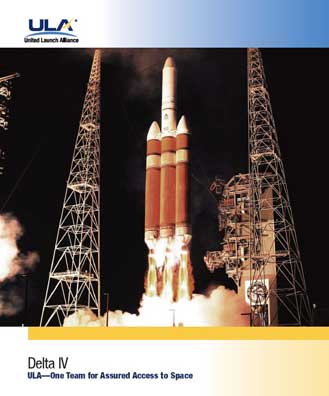
During launch processing inspections and reviews Sunday, mission managers determined that a quick disconnect in a line which flows fuel to the rocket on launch day needed to be removed and replaced. This work, in addition to the normal processing timeline, required the launch to move one day to March 4. A faulty steering control valve located on a solid rocket motor discovered Friday was replaced and the resulting system checks are in-process. The Delta IV and GOES-P spacecraft are safe and secure. Further updates on the status of the Delta IV GOES-P mission will be issued as warranted.
Originally a United Launch Alliance Delta IV medium rocket, on behalf of Boeing Launch Services, was scheduled to launch the NASA/NOAA Geostationary Operational Environmental Satellite P (GOES P) on March 2 from Space Launch Complex-37 at Cape Canaveral Air Force Station, Florida.
The multi-mission GOES series will be a vital contributor to weather, solar, and space operations and science. On board GOES-P will be a highly advanced attitude control system that will foster enhanced instrument performance for improved weather service quality. GOES-P data will add to the global climate change databases of knowledge, embracing many civil and government environmental forecasting organizations that work to benefit people everywhere and help save lives.
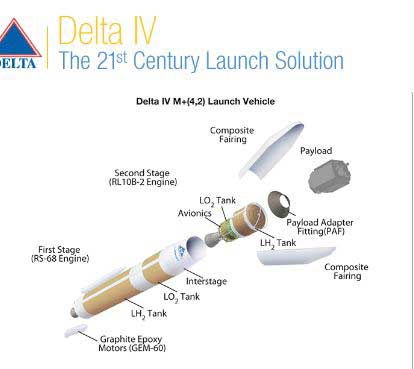
The Delta IV launch system is available in five configurations: the Delta IV Medium (Delta IV M), three variants of the Delta IV Medium-Plus (Delta IV M+), and the Delta IV Heavy (Delta IV H). Each configuration is comprised of a common booster core (CBC), a cryogenic upper stage and either a 4-m-diameter or 5-m-diameter payload fairing (PLF).
There are three variants of Delta IV M+ configuration. The Delta IV M+(4,2) uses two strap-on solid rocket motors (SRMs) to augment the first-stage CBC and a 4-m diameter PLF. The Delta IV M+(5,2) and Delta IV M+(5,4) have two and four SRMs, respectively and 5-m-diameter PLF.
