

• Skip to primary navigation
  • Skip to main content
  • Skip to primary sidebar
  • Skip to secondary sidebar
  • Skip to footer
  • NEWS:
  • SatNews
  • SatMagazine
  • MilSatMagazine
  • SmallSat News
  • |     EVENTS:
  • SmallSat Symposium
  • Satellite Innovation
  • MilSat Symposium
  • SmallSat Europe

SatNews

Satellite Industry Intelligence Since 1983

Subscribe
  • LATEST
  • SatNews Events
  • Magazines
  • Calendar
  • Subscribe
  • Missions & Constellations
    • Exploration & Science Missions
    • In-Orbit Servicing & Orbital Operations
    • LEO Constellations
    • Mission Autonomy & Onboard Systems
    • Mission Deployments & Manifests
    • Navigation & PNT
    • SmallSat
    • Spacecraft & Payload Technology
    View All in Missions & Constellations →
    Intuitive Machines Secures Prime Contracts to Operate Key NASA and KARI Lunar Imaging InstrumentsIntuitive Machines Secures Prime Contracts to Operate Key NASA and KARI Lunar Imaging Instruments
    Cowboy Raises $275M and Files for 20,000 Orbital Data Centers, Forcing the ODC Thesis Into ViewCowboy Raises $275M and Files for 20,000 Orbital Data Centers, Forcing the ODC Thesis Into View
    NASA Outlines Preliminary Artemis III Low Earth Orbit Test Flight ProfileNASA Outlines Preliminary Artemis III Low Earth Orbit Test Flight Profile
    Ubotica and NOVI Space Form Strategic Partnership for Real-Time Onboard Space AIUbotica and NOVI Space Form Strategic Partnership for Real-Time Onboard Space AI
  • Business
    • Contracts & Commercial Deals
    • Earnings & Financial Reporting
    • Events & Conferences
    • Funding & Venture Capital
    • Market Forecasts
    • Mergers & Acquisitions
    • Personnel Moves & Appointments
    View All in Business & Finance →
    York Space Systems to Acquire Solestial to Verticalize Space Solar Supply ChainYork Space Systems to Acquire Solestial to Verticalize Space Solar Supply Chain
    Teleste and Polystar Partner to Launch AI Automation for Next Generation Cable InfrastructureTeleste and Polystar Partner to Launch AI Automation for Next Generation Cable Infrastructure
    The end of GEO?The end of GEO?
    SmallSat Europe Speaker Focus: Moritz Novak, GATE SpaceSmallSat Europe Speaker Focus: Moritz Novak, GATE Space
  • Defense
    • Counterspace & ASAT
    • Defense Budgets & Procurement
    • ISR & Reconnaissance
    • MILSATCOM
    • Missile Warning & Defense
    • National Security Programs
    • Space Domain Awareness
    View All in Military & Defense →
    iDirect Government Launches WCore to Virtualize Military Satellite ModemsiDirect Government Launches WCore to Virtualize Military Satellite Modems
    The transatlantic space defense timeline mismatch is now a NATO problemThe transatlantic space defense timeline mismatch is now a NATO problem
    Kymeta Flat Panel Antennas Integrated into Red Cat Variant 7 USV for Resilient Military SatcomKymeta Flat Panel Antennas Integrated into Red Cat Variant 7 USV for Resilient Military Satcom
    iDirect Government Launches 450 Rackmount Software-Defined Modem for Multi-Orbit DefenseiDirect Government Launches 450 Rackmount Software-Defined Modem for Multi-Orbit Defense
  • Gov
    • Export Controls & Compliance
    • International Space Agreements
    • National Space Policy
    • Space Law & Treaties
    • Space Sustainability & Debris Policy
    • Space Traffic Management / Debris Removal
    View All in Government & Regulation →
    Do Satellite Providers Have a Say in Ground-Level RestrictionsDo Satellite Providers Have a Say in Ground-Level Restrictions
    SES Extends IRIS² Review as Consortium Reaches Initial Project MilestoneSES Extends IRIS² Review as Consortium Reaches Initial Project Milestone
    FCC Approves Landmark Spectrum Sharing and Direct-to-Device FrameworksFCC Approves Landmark Spectrum Sharing and Direct-to-Device Frameworks
    Satellite and the Upcoming Spectrum AuctionSatellite and the Upcoming Spectrum Auction
  • Launch
    • Launch Providers
    • Launch Schedule & Calendars
    • Launch Sites & Infrastructure
    • Rocket Technology & Vehicles
    View All in Launch →
    The Stratospheric Toll of the Megaconstellation EraThe Stratospheric Toll of the Megaconstellation Era
    NASA and Eta Space Finalize Integration for LOXSAT Cryogenic Fuel DemonstrationNASA and Eta Space Finalize Integration for LOXSAT Cryogenic Fuel Demonstration
    Exotrail Confirms Successful Deployment of NASA-Funded AEPEX CubeSat via Spacevan 002Exotrail Confirms Successful Deployment of NASA-Funded AEPEX CubeSat via Spacevan 002
    SpaceX Debuts Starship V3: Redefining Heavy-Lift Launch CapabilitySpaceX Debuts Starship V3: Redefining Heavy-Lift Launch Capability
  • Software
    • Autonomous Ground Operations
    • Data Processing & AI/ML
    • Digital Twins & Modeling
    • Ground Segment & Teleports
    • Mission Planning & Simulation
    • Space Systems Software Engineering
    • Spectrum & Licensing
    View All in Software Automation & Ground Systems →
    Lightpath Expands Dense Northeast Fiber Infrastructure Across 2,400 Macro Cell TowersLightpath Expands Dense Northeast Fiber Infrastructure Across 2,400 Macro Cell Towers
    Astrolight and ESA Unveil Operational Optical Ground Station in Greece for Satellite Laser LinksAstrolight and ESA Unveil Operational Optical Ground Station in Greece for Satellite Laser Links
    Global Space Economy Reaches 429 Billion Dollars as Commercial Satellite Sector DominatesGlobal Space Economy Reaches 429 Billion Dollars as Commercial Satellite Sector Dominates
    SpinLaunch Partners with Aalyria for Meridian Constellation Network OrchestrationSpinLaunch Partners with Aalyria for Meridian Constellation Network Orchestration
  • Services & Apps
    • Climate & Environmental Monitoring
    • Disaster Response & Security Mapping
    • Earth Observation & Imaging
    • Maritime & Aviation Satcom
    • Satellite Communications
    View All in Services & Applications →
    Apple Prepares for Pivot at WWDC 2026 MilestoneApple Prepares for Pivot at WWDC 2026 Milestone
    Energy Efficient E-Paper Displays Redefine Professional Digital SignageEnergy Efficient E-Paper Displays Redefine Professional Digital Signage
    Consumer NPU Boom Accelerates Autonomous Satellite ProcessingConsumer NPU Boom Accelerates Autonomous Satellite Processing
    Ted Turner: “Shake with Terror”Ted Turner: “Shake with Terror”

MESSENGER’s Message For Mercury In 4.9 Billion Mile Final Fly By “I’ve Got You Mapped”

September 23, 2009

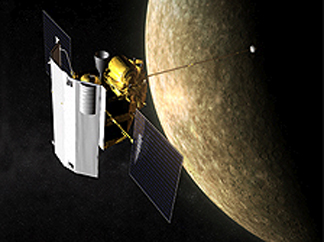
MESSENGER NASA’s Mercury Surface, Space Environment, Geochemistry, and Ranging spacecraft (MESSENGER) will fly by Mercury for the third and final time on September 29, at a distance of only 142 miles above the planet’s rocky surface for a final gravity assist that will enable it to enter Mercury’s orbit in 2011.
Messenger at Mercury. Credit: NASA/Johns Hopkins University Applied Physics Laboratory/Carnegie Institution of Washington

Determining the composition of Mercury’s surface is a major goal of the orbital phase of the mission. The spacecraft already has imaged more than 90 percent of the planet’s surface. The spacecraft’s team will activate instruments during this flyby to view specific features to uncover more information about the planet.

“This flyby will be our last close look at the equatorial regions of Mercury, and it is our final planetary gravity assist, so it is important for the entire encounter to be executed as planned,” said Sean Solomon, principal investigator at the Carnegie Institution in Washington. “As enticing as these flybys have been for discovering some of Mercury’s secrets, they are the hors d’oeuvres to the mission’s main course — observing Mercury from orbit for an entire year.”

The spacecraft may observe how the planet interacts with conditions in interplanetary space as a result of activity on the sun. During this encounter, high spectral- and high spatial-resolution measurements will be taken again of Mercury’s tenuous atmosphere and tail.

“Scans of the planet’s comet-like tail will provide important clues regarding the processes that maintain the atmosphere and tail,” said Noam Izenberg, the instrument’s scientist at the Johns Hopkins University Applied Physics Laboratory, or APL, in Laurel, Maryland. “The Mercury Atmospheric and Surface Composition Spectrometer will give us a snapshot of how the distribution of sodium and calcium vary with solar and planetary conditions. In addition, we will target the north and south polar regions for detailed observations and look for several new atmospheric constituents.”

As the spacecraft approaches Mercury, cameras will photograph previously unseen terrain. As the spacecraft departs, it will take high-resolution images of the southern hemisphere. Scientists expect the spacecraft’s imaging system to take more than 1,500 pictures. Those images will be used to create a mosaic to complement the high resolution, northern-hemisphere mosaic obtained during the second Mercury flyby. The first flyby took the spacecraft over the eastern hemisphere in January 2008, and the second flyby took it over western side in October 2008.

“We are going to collect high resolution, color images of scientifically interesting targets that we identified from the second flyby,” said Ralph McNutt, a project scientist at APL. “The spectrometer also will make measurements of those targets at the same time.”

Two spacecraft maneuvers will improve the ability of the spacecraft’s Neutron Spectrometer to detect low-energy neutrons sensitive to the abundances of iron and titanium on Mercury’s surface. These two elements absorb neutrons and are critical to an understanding of how the planet and its crust formed. A combination of day and night measurements will enable scientists to test the influence that planetary surface temperature has on the neutron population. The data are important for interpreting measurements that will be made after the probe is in orbit around Mercury.

An altimeter will make a topographic profile along the instrument ground track of Mercury’s surface. The data gathered will provide additional topography of Mercury’s surface features for ongoing studies of the form and structure of its craters and large faults. The information also will extend scientists’ equatorial view of Mercury’s global shape and allow them to confirm the discovery made during the first and second flyby that Mercury’s equatorial region is slightly elliptical.

The spacecraft has completed nearly three-quarters of its 4.9-billion-mile journey to enter orbit around Mercury. The trip includes more than 15 trips around the sun. In addition to flying by Mercury, the spacecraft flew past Earth in August 2005 and Venus in October 2006 and June 2007.

The project is the seventh in NASA’s Discovery Program of low-cost, scientifically focused space missions. The spacecraft was designed and built by APL. The mission also is managed and operated by APL for NASA’s Science Mission Directorate in Washington.

For more information about the mission, visit.

Filed Under: Exploration & Science Missions

Primary Sidebar

Coverage

  • Missions & Constellations
  • Business & Finance
  • Military & Defense
  • Launch
  • Software Automation & Ground Systems
  • Government & Regulation
  • Services & Applications

Most Read Stories

  • NASA Shuts Off Instrument on Voyager 1 to Extend Interstellar Mission
  • SmallSat Europe Speaker Focus: Merek Chertkow, The Radiation Team
  • Bad news, but good news followed
  • AST SpaceMobile Pivots to SpaceX for Mid-June Launch of Three BlueBird Satellites
  • Blue Origin Achieves First Booster Reuse but Satellite Enters Off-Nominal Orbit

Secondary Sidebar

Footer


Satnews is a leading provider of satellite news, events, publications, research and other satellite industry information in both commercial and military enterprises worldwide.

Stories By Category

  • Business & Finance
  • Government & Regulation
  • Launch
  • Military & Defense
  • Missions & Constellations
  • Services & Applications
  • Software Automation & Ground Systems
  • Spectrum & Licensing
  • Startups & NewSpace Business

About Us

  • Leadership & Editorial Team
  • SatNews History
  • Free Satnews Subscription
  • SatNews Events
  • Magazines

Navigation

  • Latest Stories
  • Magazines
  • Events
  • Contact
  • Cookie & Privacy Policy for Satnews

We use cookies to ensure that we give you the best experience on our website. If you continue to use this site we will assume that you are happy with it.
x
Sign up Now (For Free)
Access daily or weekly satellite news updates covering all aspects of the commercial and military satellite industry.
Invalid email address
Notify Me Regarding ( At least one ):
We value your privacy and will not sell or share your email or other information with any other company. You may also unsubscribe at anytime.

Click Here to see our full privacy policy.
Thanks for subscribing!