

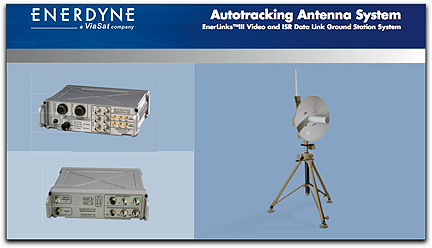
 Using the ETAS, EnerLinksIII can deliver downlink line-of-sight range of at least 75 nautical miles at 11 Mbps, and over 100 nautical miles range at 5 Mbps, operating at L-, S-, or C-band frequencies. The complete ETAS system includes a 24-inch parabolic antenna, an omni-directional antenna, a radio interface module (RIM), a gimbal to point the antenna, a rugged tripod to support the equipment, and two transit cases for the antenna assembly and electronics. The parabolic reflector is an ideal choice for the ground station antenna because the reflector gain varies in a way that offsets any propagation loss variation, providing a constant link margin. The omni-directional antenna enables operation at close range where the angular velocity of the aircraft may exceed the ability of the tracking gimbal to follow it. Both the downlink and uplink are switched seamlessly and automatically between the two antennas.
Demos of the ETAS will take place in the ViaSat booth number 215 in the AUVSI Unmanned Systems North America 2009 exhibition, August 10-13 at the Washington Convention Center.
Using the ETAS, EnerLinksIII can deliver downlink line-of-sight range of at least 75 nautical miles at 11 Mbps, and over 100 nautical miles range at 5 Mbps, operating at L-, S-, or C-band frequencies. The complete ETAS system includes a 24-inch parabolic antenna, an omni-directional antenna, a radio interface module (RIM), a gimbal to point the antenna, a rugged tripod to support the equipment, and two transit cases for the antenna assembly and electronics. The parabolic reflector is an ideal choice for the ground station antenna because the reflector gain varies in a way that offsets any propagation loss variation, providing a constant link margin. The omni-directional antenna enables operation at close range where the angular velocity of the aircraft may exceed the ability of the tracking gimbal to follow it. Both the downlink and uplink are switched seamlessly and automatically between the two antennas.
Demos of the ETAS will take place in the ViaSat booth number 215 in the AUVSI Unmanned Systems North America 2009 exhibition, August 10-13 at the Washington Convention Center.
A Thorough Grounding For Enerdyne’s ETAS
The Enerdyne division of ViaSat Inc. (Nasdaq:VSAT) is now shipping the EnerLinks™III Autotracking Antenna System (ETAS), a complete, high-performance ground station for video and ISR data links using the EnerLinksIII Ground Modem Transceiver.
Using the ETAS, EnerLinksIII can deliver downlink line-of-sight range of at least 75 nautical miles at 11 Mbps, and over 100 nautical miles range at 5 Mbps, operating at L-, S-, or C-band frequencies. The complete ETAS system includes a 24-inch parabolic antenna, an omni-directional antenna, a radio interface module (RIM), a gimbal to point the antenna, a rugged tripod to support the equipment, and two transit cases for the antenna assembly and electronics. The parabolic reflector is an ideal choice for the ground station antenna because the reflector gain varies in a way that offsets any propagation loss variation, providing a constant link margin. The omni-directional antenna enables operation at close range where the angular velocity of the aircraft may exceed the ability of the tracking gimbal to follow it. Both the downlink and uplink are switched seamlessly and automatically between the two antennas.
Demos of the ETAS will take place in the ViaSat booth number 215 in the AUVSI Unmanned Systems North America 2009 exhibition, August 10-13 at the Washington Convention Center.
Using the ETAS, EnerLinksIII can deliver downlink line-of-sight range of at least 75 nautical miles at 11 Mbps, and over 100 nautical miles range at 5 Mbps, operating at L-, S-, or C-band frequencies. The complete ETAS system includes a 24-inch parabolic antenna, an omni-directional antenna, a radio interface module (RIM), a gimbal to point the antenna, a rugged tripod to support the equipment, and two transit cases for the antenna assembly and electronics. The parabolic reflector is an ideal choice for the ground station antenna because the reflector gain varies in a way that offsets any propagation loss variation, providing a constant link margin. The omni-directional antenna enables operation at close range where the angular velocity of the aircraft may exceed the ability of the tracking gimbal to follow it. Both the downlink and uplink are switched seamlessly and automatically between the two antennas.
Demos of the ETAS will take place in the ViaSat booth number 215 in the AUVSI Unmanned Systems North America 2009 exhibition, August 10-13 at the Washington Convention Center.
