

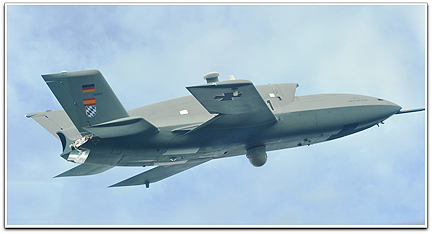
 Technologies and procedures to be used in future mission-ready unmanned aerial systems have now been put to the test in realistic conditions. During the test campaign in the Goose Bay area of the Canadian province of Newfoundland and Labrador, the jet-propelled demonstrator flew completely autonomously along pre-programmed flight profiles. It was monitored from the ground station with respect to flight safety only. The new, successfully tested unmanned aerial system is a further development of the first Barracuda technology test bed which performed its maiden flight in April 2006. Since that time, the software, systems, and solutions for the methods and processes carried out under the Agile UAV program have been continuously developed to form an integrated system. The results of these modifications, which had so far only existed as computer models, have now been successfully tried and tested in flight on the Barracuda. The flexibility of the software and the modular capabilities have also been enhanced. This makes the system even easier to adapt to a wide range of UAV missions which will then be verified and validated using the Barracuda built by EADS Defence & Security.
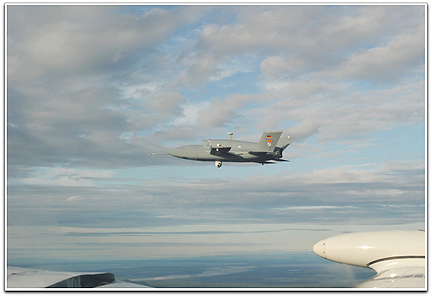 These successful flights in Goose Bay have given EADS Defence & Security practical confirmation of the results of technology programmes it had already conducted on its own initiative. Moreover, the Barracuda is used for test flights in the ‘Agile UAV in Network Centric Environment’ technology program commissioned by the Federal Office of Defence Technology and Procurement (BWB – Bundesamt für Wehrtechnik und Beschaffung). Even if this new version of the UAV demonstrator is not destined for series production, EADS will be able to gather fundamental insights for operationally mature next-generation UAV products – either alone or in cooperation with European partners. With this demonstrator, EADS Defence & Security will gain practical experience in the interoperability of unmanned systems within Network-Centric Operations conducted in line with the latest NATO criteria and in autonomous operation involving interaction with other systems. This also makes it possible to reduce any risks involved in developing the planned new UAV Talarion.
