

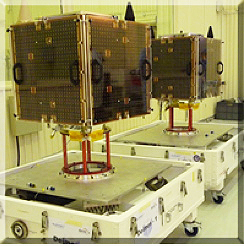
 The new satellite will be operated by subsidiary company DMCii to provide an enhanced imaging capability and operational service to the Disaster Monitoring Constellation (DMC). UK-DMC2 has a number of enhancements over previous DMC spacecraft contributing to SSTL‘s continuing evolutionary design approach. The satellite is also being used as a test bed for new technologies and is supporting a BNSC sponsored school science experiment called POISE. UK-DMC2 carries a higher resolution optical payload which will provide 22m ground sample distance (GSD) images, compared with 32m GSD on then four operational satellites currently in the constellation. The 22m imagery has twice the data density of the 32m imagery without loss of Signal to Noise Ratio (SNR) and maintains the ultra-wide 600+km swath.
The satellite carries two high-speed X-band transmitters that will both operate at 20Mbps or 80Mbps. This will enable the satellite to download images up to 10 times faster than previous DMC spacecraft. Storage capacity has increased from 1 to 1.5 GByte on the first generation of DMC spacecraft up to 12 GByte on UK-DMC2. These advancements, in combination with improved power generation and storage systems, will allow UK-DMC2 to rapidly map large areas such as Europe or other continents. The advances in data throughput and power generation have enabled two new operational modes. Firstly, a near-real time imaging and downlink mode allows imagery acquired within a ~2000 km radius of a ground station to be downlinked within the same pass and, secondly, the implementation of a broadcast downlink mode that enables customers with a receive-only ground station to receive data directly from UK-DMC2. These technology improvements not only make the satellite more flexible than previous designs, but also dramatically increase the operational imaging capacity by allowing the satellite to store and download much larger volumes of multi-spectral image data. The 96kg UK-DMC2 satellite is based upon SSTL’s SSTL-100 small satellite platform, which uses solar cells integrated into the spacecraft’s surface to generate power. UK-DMC2 includes an additional deployable solar panel that will increase power generation by approximately 50 percent. UK-DMC2 will be launched into a sun-synchronous orbit alongside Deimos-1, another DMC satellite built by SSTL for Spanish company Deimos Space. This will bring the number of operational DMC satellites to six.
