

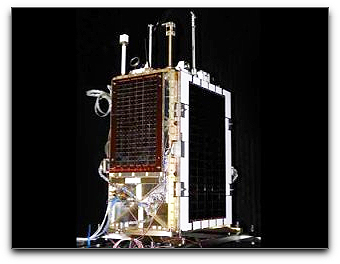
 The launch, she told the International Geoscience and Remote Sensing Symposium at the University of Cape Town, on Monday, “is planned for August 2009 from Russia”. “The main objectives of this program [SumbandilaSat] are to strengthen the technological capabilities and space resources that exist in South Africa, to develop capacity in satellite engineering, and to provide earth observation data for a wide range of applications,” she said. “The development of SumbandilaSat offers our country and region a number of advantages, including scientific and economic growth, and information to use for sustainable development, security and planning.”
The R26-million SumbandilaSat was designed and built by specialist South African microsatellite company SunSpace & Information Systems (SunSpace), which is based in Stellenbosch in the Western Cape. It has a mass of 81 kg and its function is Earth observation. Its name, sumbandila, means “lead the way” in the Venda language. It is based around a new satellite platform developed by SunSpace. The microsatellite’s main payload is a 6,25 m multispectral imager — that is, the imager has a resolution of 6,25 m x 6,25 m. This imager was also designed, developed and made by SunSpace. The microsatellite is already at the Baikonur Cosmodrome, as is its Soyuz launch rocket. The primary payload for the launch, a Russian Meteor M meteorological satellite, should also now be at Baikonur. It takes some 40 days to prepare a satellite for its flight, including its integration on to the topmost stage of its carrier rocket. It is expected that the Soyuz rocket carrying SumbandilaSat (which is the secondary payload) and the Meteor M will be launched on or around August 20th. (Source: Creamer Media’s Engineering News, Keith Campbell)
