

• Skip to primary navigation
  • Skip to main content
  • Skip to primary sidebar
  • Skip to secondary sidebar
  • Skip to footer
  • NEWS:
  • SatNews
  • SatMagazine
  • MilSatMagazine
  • SmallSat News
  • |     EVENTS:
  • SmallSat Symposium
  • Satellite Innovation
  • MilSat Symposium
  • SmallSat Europe

SatNews

Satellite Industry Intelligence Since 1983

Subscribe
  • LATEST
  • SatNews Events
  • Magazines
  • Calendar
  • Subscribe
  • Missions & Constellations
    • Exploration & Science Missions
    • In-Orbit Servicing & Orbital Operations
    • LEO Constellations
    • Mission Autonomy & Onboard Systems
    • Mission Deployments & Manifests
    • Navigation & PNT
    • SmallSat
    • Spacecraft & Payload Technology
    View All in Missions & Constellations →
    Sovereign Milestone: OQ Technology Achieves Europe’s First Drone Video Transmission via 3GPP NTN LEO SatelliteSovereign Milestone: OQ Technology Achieves Europe’s First Drone Video Transmission via 3GPP NTN LEO Satellite
    Hybrid Cabin Architecture: Mapping the Next Generation of In-Flight Connectivity (IFC)Hybrid Cabin Architecture: Mapping the Next Generation of In-Flight Connectivity (IFC)
    Fleet-Wide Hybrid Networks: Marlink Integrates Starlink Across 80+ Oldendorff Carriers VesselsFleet-Wide Hybrid Networks: Marlink Integrates Starlink Across 80+ Oldendorff Carriers Vessels
    Navigating Contested Battlespaces: Military GPS Receiver Market Approaches $3 Billion Amid Electronic Warfare SurgeNavigating Contested Battlespaces: Military GPS Receiver Market Approaches $3 Billion Amid Electronic Warfare Surge
  • Business
    • Contracts & Commercial Deals
    • Earnings & Financial Reporting
    • Events & Conferences
    • Funding & Venture Capital
    • Market Forecasts
    • Mergers & Acquisitions
    • Personnel Moves & Appointments
    View All in Business & Finance →
    Next-Gen Spatial Intelligence: BAE Systems Secures Agreement to Build High-Resolution Vantage Satellite Buses for VantorNext-Gen Spatial Intelligence: BAE Systems Secures Agreement to Build High-Resolution Vantage Satellite Buses for Vantor
    New Lobbying Force: Top NGSO Operators Unveil “SpaceConnect Association” in WashingtonNew Lobbying Force: Top NGSO Operators Unveil “SpaceConnect Association” in Washington
    Ghost Viewers trigger secondary ripple effect on Satellite Communications (SatCom)Ghost Viewers trigger secondary ripple effect on Satellite Communications (SatCom)
    Lightpath expands fiber footprint as demand for AI-ready connectivity infrastructure acceleratesLightpath expands fiber footprint as demand for AI-ready connectivity infrastructure accelerates
  • Defense
    • Counterspace & ASAT
    • Defense Budgets & Procurement
    • ISR & Reconnaissance
    • MILSATCOM
    • Missile Warning & Defense
    • National Security Programs
    • Space Domain Awareness
    View All in Military & Defense →
    Digital Twins for Space Command: Sedaro Tapped by Space Force to Build Federated Engineering PlatformDigital Twins for Space Command: Sedaro Tapped by Space Force to Build Federated Engineering Platform
    The Strategic Redistribution of Iranian Aerospace CapabilityThe Strategic Redistribution of Iranian Aerospace Capability
    Preparing for Day One: DARPA Solicits Tech to Rebuild Destroyed Satellite Fleets Within HoursPreparing for Day One: DARPA Solicits Tech to Rebuild Destroyed Satellite Fleets Within Hours
    Sovereign Space Expansion: Portugal Procures Dual ICEYE Radar Satellites to Broaden Maritime SurveillanceSovereign Space Expansion: Portugal Procures Dual ICEYE Radar Satellites to Broaden Maritime Surveillance
  • Gov
    • Export Controls & Compliance
    • International Space Agreements
    • National Space Policy
    • Space Law & Treaties
    • Space Sustainability & Debris Policy
    • Space Traffic Management / Debris Removal
    View All in Government & Regulation →
    Who Has Authority to Intervene in a Space-Based Emergency?Who Has Authority to Intervene in a Space-Based Emergency?
    Staying in Their Lanes: SpaceX and Globalstar Join Forces to Defend Spectrum ExclusivityStaying in Their Lanes: SpaceX and Globalstar Join Forces to Defend Spectrum Exclusivity
    Orbital Paperwork War: China’s Spectrum Squatting Reserves 244,000 Satellite Slots to Combat SpaceX’s LEO MonopolyOrbital Paperwork War: China’s Spectrum Squatting Reserves 244,000 Satellite Slots to Combat SpaceX’s LEO Monopoly
    The Next Arena: Why the WRC-27 Summit in Shanghai is the New Space Tech FrontlineThe Next Arena: Why the WRC-27 Summit in Shanghai is the New Space Tech Frontline
  • Launch
    • Launch Providers
    • Launch Schedule & Calendars
    • Launch Sites & Infrastructure
    • Rocket Technology & Vehicles
    View All in Launch →
    Arianespace fights back – possibly!Arianespace fights back – possibly!
    Direct-to-Device Momentum: AST SpaceMobile Successfully Launches Giant Next-Gen BlueBird Satellites Atop SpaceX Falcon 9Direct-to-Device Momentum: AST SpaceMobile Successfully Launches Giant Next-Gen BlueBird Satellites Atop SpaceX Falcon 9
    SpaceX’s Secret ‘Starfall’ Capsule Wins FAA Approval for Pacific Reentry TestsSpaceX’s Secret ‘Starfall’ Capsule Wins FAA Approval for Pacific Reentry Tests
    Breaking the TRL Bottleneck: Space Phoenix Systems Debuts Cost-Effective Space Test-and-Return ServiceBreaking the TRL Bottleneck: Space Phoenix Systems Debuts Cost-Effective Space Test-and-Return Service
  • Software
    • Autonomous Ground Operations
    • Data Processing & AI/ML
    • Digital Twins & Modeling
    • Ground Segment & Teleports
    • Mission Planning & Simulation
    • Space Systems Software Engineering
    • Spectrum & Licensing
    View All in Software Automation & Ground Systems →
    Powering the Automated Floor: Intralogistics Operators Must Unify AGV Charging InfrastructurePowering the Automated Floor: Intralogistics Operators Must Unify AGV Charging Infrastructure
    Poland Sovereignty: GMV to Develop Core Ground Control Platform for CAMILA ConstellationPoland Sovereignty: GMV to Develop Core Ground Control Platform for CAMILA Constellation
    Software Over the Air: FatPipe Launches Acceleration Tool to Unclog Starlink and Amazon LEO LinksSoftware Over the Air: FatPipe Launches Acceleration Tool to Unclog Starlink and Amazon LEO Links
    Three LEO Operators Bet 2026 on a Supply Chain Built for 2027Three LEO Operators Bet 2026 on a Supply Chain Built for 2027
  • Services & Apps
    • Climate & Environmental Monitoring
    • Disaster Response & Security Mapping
    • Earth Observation & Imaging
    • Maritime & Aviation Satcom
    • Satellite Communications
    View All in Services & Applications →
    Fragmentation Over Funds: Why System Disconnection, Not Under-Investment, Is Maritime’s True Cyber ThreatFragmentation Over Funds: Why System Disconnection, Not Under-Investment, Is Maritime’s True Cyber Threat
    U.S. viewership of the 2026 World Cup via satellite television is strong and easily accessibleU.S. viewership of the 2026 World Cup via satellite television is strong and easily accessible
    Space-Based Underwriting: Liberty and ICEYE Launch Satellite-Powered Parametric Wildfire InsuranceSpace-Based Underwriting: Liberty and ICEYE Launch Satellite-Powered Parametric Wildfire Insurance
    Rapid Deployment: ZeroUSV Streamlines Uncrewed Vessel Portability for Defense and Survey MissionsRapid Deployment: ZeroUSV Streamlines Uncrewed Vessel Portability for Defense and Survey Missions

Report from the UK: Space Missions to Visit the Sun

April 27, 2009

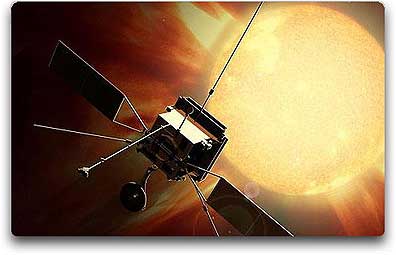
ESA Solar Orbiter Two space probes are to be sent to explore the Sun, in an attempt to get closer to the centre of the star than any previous mission.

The spacecraft will travel more than 70 million miles to one of the least hospitable regions of our solar system, where temperatures are hot enough to melt metal and intense radiation along with chaotic magnetic fields can tear manmade structures apart.

Scientists hope the missions will help them answer a long list of questions that still exist about the sun, including why its outer atmosphere is hotter than its surface, and what causes solar wind, sun spots and flares.

The missions are to be outlined by scientists at a major conference of solar physicists in Bournemouth this week.

One of the missions, known as Solar Orbiter, will orbit the sun to give scientists a view of its poles, which have never been seen before. Led by the European Space Agency (ESA) with backing from Nasa, the mission is expected to launch in 2017, and design work is already under way.

The spacecraft, fitted with a 15-inch-thick heat shield to protect it from the intense heat and radiation, will orbit at around 20 million miles from the Sun’s surface – around two thirds of the distance between the Sun and Mercury, the closest planet.

It will take the most detailed pictures of the Sun’s surface ever achieved while also measuring particle emissions and magnetic fields.

A second mission being planned by Nasa, known as Solar Probe Plus, will enter the Sun’s outer atmosphere, known as the corona, and fly just 4.3 million miles from the star’s surface.

“The Sun influences us in many ways and is central to life on Earth,” said Professor Richard Harrison, a solar scientist at the Rutherford Appleton Laboratory who was one of two scientists who originally proposed the Solar Orbiter mission.

Because the Earth orbits in a flat plane, the Sun can only ever be seen “side-on”.

Prof Harrison said: “Although humans have been studying the Sun for millennia, we still know relatively little. One thing we have never done is to send a spacecraft to visit the Sun or looked at it from above or below.”

Until now the spacecraft that have been closest to the Sun were the Helios space probes, launched in the 1970s.

They went 28 million miles from the star’s surface, just inside the orbit of mercury, the innermost planet in the solar system.

The Solar Orbiter will be the size of a family car and will be equipped with a suite of instruments designed to map the Sun’s surface while also measuring the chemical and magnetic environment around it.

It will use a two-metre-wide heat shield, made of layers of coated plastic and ceramics, to deflect the temperatures of more than 600C along with the streams of highly energetic particles that pour from the Sun and could damage the spacecraft.

The ESA is expected to confirm its plans for the Solar Orbiter mission later this year.

After using the gravity of the Earth, moon and venus to “slingshot” it in the right direction, it will take three-and-a-half years for the spaceship to reach its destination.

Once in orbit, it will circle the Sun every 150 years. Scientists hope it will attain an angle of 30 degrees off the Earth’s orbit, to give views of the solar poles.

“It is a serious engineering challenge,” said Dr Ralph Cordey, science and exploration business development manager at Astrium, a space company that has been charged with designing the Solar Orbiter.

“It is going to a place where the Sun will be beating down 20 times as much as it does here on Earth.

The leading edge is going to get up to about 600 degrees and we have got to make sure that it is room temperature inside the spacecraft.”

Nasa is expected to call for proposals for instruments that can be included in its Solar Probe Plus mission later this year.

The $750 million (£510 million) probe is planned to launch around 2015 and scientists hope both missions will be able to study the sun simultaneously.

Solar Probe Plus, which will be fitted with a nine-foot-wide, six-inch-thick protective carbon foam shield, is expected take a total of seven years to fly the 90 million miles from the Earth to the sun and complete its mission.

It will slice through the upper parts of the Sun’s corona, where it will have to withstand temperatures of up to 2,000C.

MYSTERIES OF THE SUN

1. Why is the sun’s outer atmosphere, or corona, hotter than the surface?

Common sense says as you move further away from a fire, the cooler it gets, but the Sun does the opposite. The surface is 6,000 degrees C while the corona reaches one million degrees C.

2. How is solar wind generated?

Solar wind is a stream of electrically-charged particles that are ejected from the Sun’s atmosphere and accelerate to high speeds to spread out across the solar system.

3. What causes coronal mass ejections?

Massive clouds of particles thrown out by the sun were thought to be associated with solar flares, but have subsequently been found not to be.

4. Can solar activity be predicted?

Sun spots, which are dark spots caused by intense magnetic activity on the Sun’s surface, and solar flares, massive explosions from the Sun’s surface, were thought to run in an 11-year cycle, but the latest quiet period has gone on longer than usual.

5. What is going on in areas of low activity?

From Earth, quiet areas of the Sun with no sunspots or flares look relatively uninteresting, but they are still a boiling mass of activity.

By Richard Gray, Science Correspondent
From Telegraph.co.uk
Last Updated: 11:03PM BST 25 Apr 2009


Filed Under: Exploration & Science Missions

Primary Sidebar

Coverage

  • Missions & Constellations
  • Business & Finance
  • Military & Defense
  • Launch
  • Software Automation & Ground Systems
  • Government & Regulation
  • Services & Applications

Most Read Stories

  • SpaceX’s Secret ‘Starfall’ Capsule Wins FAA Approval for Pacific Reentry Tests
  • SpaceX: 10,000 Launches Annually
  • American military space closed around one company in seven days
  • Analyst Projects Massive Subscription Growth for Starlink Ahead of Imminent SpaceX IPO
  • Major opportunities for 2 GHz over Europe

Secondary Sidebar

Footer


Satnews is a leading provider of satellite news, events, publications, research and other satellite industry information in both commercial and military enterprises worldwide.

Stories By Category

  • Business & Finance
  • Government & Regulation
  • Launch
  • Military & Defense
  • Missions & Constellations
  • Services & Applications
  • Software Automation & Ground Systems
  • Spectrum & Licensing
  • Startups & NewSpace Business

About Us

  • Leadership & Editorial Team
  • SatNews History
  • Free Satnews Subscription
  • SatNews Events
  • Magazines

Navigation

  • Latest Stories
  • Magazines
  • Events
  • Contact
  • Cookie & Privacy Policy for Satnews

We use cookies to ensure that we give you the best experience on our website. If you continue to use this site we will assume that you are happy with it.
x
Sign up Now (For Free)
Access daily or weekly satellite news updates covering all aspects of the commercial and military satellite industry.
Invalid email address
Notify Me Regarding ( At least one ):
We value your privacy and will not sell or share your email or other information with any other company. You may also unsubscribe at anytime.

Click Here to see our full privacy policy.
Thanks for subscribing!