

• Skip to primary navigation
  • Skip to main content
  • Skip to primary sidebar
  • Skip to secondary sidebar
  • Skip to footer
  • NEWS:
  • SatNews
  • SatMagazine
  • MilSatMagazine
  • SmallSat News
  • |     EVENTS:
  • SmallSat Symposium
  • Satellite Innovation
  • MilSat Symposium
  • SmallSat Europe

SatNews

Satellite Industry Intelligence Since 1983

Subscribe
  • LATEST
  • SatNews Events
  • Magazines
  • Calendar
  • Subscribe
  • Missions & Constellations
    • Exploration & Science Missions
    • In-Orbit Servicing & Orbital Operations
    • LEO Constellations
    • Mission Autonomy & Onboard Systems
    • Mission Deployments & Manifests
    • Navigation & PNT
    • SmallSat
    • Spacecraft & Payload Technology
    View All in Missions & Constellations →
    Gen Z Influence on AI-Driven Audio MarketGen Z Influence on AI-Driven Audio Market
    SmallSat Europe Speaker Focus: Stefano Antonetti, D-OrbitSmallSat Europe Speaker Focus: Stefano Antonetti, D-Orbit
    Satellite and the Upcoming Spectrum AuctionSatellite and the Upcoming Spectrum Auction
    ExoMars 2028 Structural Models Arrive in Cannes for Environmental TestingExoMars 2028 Structural Models Arrive in Cannes for Environmental Testing
  • Business
    • Contracts & Commercial Deals
    • Earnings & Financial Reporting
    • Events & Conferences
    • Funding & Venture Capital
    • Market Forecasts
    • Mergers & Acquisitions
    • Personnel Moves & Appointments
    View All in Business & Finance →
    SmallSat Europe Speaker Focus: Gregg Burgess, Orion Space SolutionsSmallSat Europe Speaker Focus: Gregg Burgess, Orion Space Solutions
    Space42 Taps Skylo for Standards-Based Direct-to-Device Services via Thuraya-4Space42 Taps Skylo for Standards-Based Direct-to-Device Services via Thuraya-4
    SmallSat Europe Speaker Focus: Frank M. Salzgeber, Nadir Space VentureSmallSat Europe Speaker Focus: Frank M. Salzgeber, Nadir Space Venture
    Ted Turner: “Shake with Terror”Ted Turner: “Shake with Terror”
  • Defense
    • Counterspace & ASAT
    • Defense Budgets & Procurement
    • ISR & Reconnaissance
    • MILSATCOM
    • Missile Warning & Defense
    • National Security Programs
    • Space Domain Awareness
    View All in Military & Defense →
    iDirect Government Launches 450 Rackmount Software-Defined Modem for Multi-Orbit DefenseiDirect Government Launches 450 Rackmount Software-Defined Modem for Multi-Orbit Defense
    US Air Force Taps L3Harris to Bolster ABMS Digital InfrastructureUS Air Force Taps L3Harris to Bolster ABMS Digital Infrastructure
    U.S. and Australia Expand Space Surveillance Network to Counter Emerging ASAT ThreatsU.S. and Australia Expand Space Surveillance Network to Counter Emerging ASAT Threats
    U.S. Space Force Awards $3.2 Billion for Space-Based Interceptor LayerU.S. Space Force Awards $3.2 Billion for Space-Based Interceptor Layer
  • Gov
    • Export Controls & Compliance
    • International Space Agreements
    • National Space Policy
    • Space Law & Treaties
    • Space Sustainability & Debris Policy
    • Space Traffic Management / Debris Removal
    View All in Government & Regulation →
    FCC Approves Landmark Spectrum Sharing and Direct-to-Device FrameworksFCC Approves Landmark Spectrum Sharing and Direct-to-Device Frameworks
    ATVA Urges FCC to Close “Affiliation-Swap” Loopholes Impacting Satellite OperatorsATVA Urges FCC to Close “Affiliation-Swap” Loopholes Impacting Satellite Operators
    UAE Space Agency Drives Public-Private Collaboration at MIITE 2026UAE Space Agency Drives Public-Private Collaboration at MIITE 2026
    SmallSat Europe Speaker Focus: Araz Feyzi, Kayhan SpaceSmallSat Europe Speaker Focus: Araz Feyzi, Kayhan Space
  • Launch
    • Launch Providers
    • Launch Schedule & Calendars
    • Launch Sites & Infrastructure
    • Rocket Technology & Vehicles
    View All in Launch →
    AST SpaceMobile Pivots to SpaceX for Mid-June Launch of Three BlueBird SatellitesAST SpaceMobile Pivots to SpaceX for Mid-June Launch of Three BlueBird Satellites
    SpaceX Accelerates Transition from Falcon 9 to Next-Generation Starship FleetSpaceX Accelerates Transition from Falcon 9 to Next-Generation Starship Fleet
    NanoAvionics Satellites Reach Orbit on SpaceX CAS500-2 MissionNanoAvionics Satellites Reach Orbit on SpaceX CAS500-2 Mission
    GalaxEye Successfully Launches “Mission Drishti” OptoSAR SatelliteGalaxEye Successfully Launches “Mission Drishti” OptoSAR Satellite
  • Software
    • Autonomous Ground Operations
    • Data Processing & AI/ML
    • Digital Twins & Modeling
    • Ground Segment & Teleports
    • Mission Planning & Simulation
    • Space Systems Software Engineering
    • Spectrum & Licensing
    View All in Software Automation & Ground Systems →
    Your anomaly detection isn’t the problemYour anomaly detection isn’t the problem
    SmallSat Europe Speaker Focus: Olaf Eckart, BMW GroupSmallSat Europe Speaker Focus: Olaf Eckart, BMW Group
    SES Accelerates Multi-Orbit IFC Strategy with meoSphere and Next-Gen ESA DevelopmentSES Accelerates Multi-Orbit IFC Strategy with meoSphere and Next-Gen ESA Development
    SmallSat Europe Speaker Focus: Koen Willems, ST Engineering iDirect EuropeSmallSat Europe Speaker Focus: Koen Willems, ST Engineering iDirect Europe
  • Services & Apps
    • Climate & Environmental Monitoring
    • Disaster Response & Security Mapping
    • Earth Observation & Imaging
    • Maritime & Aviation Satcom
    • Satellite Communications
    View All in Services & Applications →
    Consumer NPU Boom Accelerates Autonomous Satellite ProcessingConsumer NPU Boom Accelerates Autonomous Satellite Processing
    Satellite Technology and the Legacy of the Media PioneerSatellite Technology and the Legacy of the Media Pioneer
    SmallSat Europe Speaker Focus: Massimo Comparini, Leonardo Space DivisionSmallSat Europe Speaker Focus: Massimo Comparini, Leonardo Space Division
    The waiver was the policy. Thursday is the paperwork.The waiver was the policy. Thursday is the paperwork.

Red Planet’s Severe Storms Offer Cleansing Properties

April 15, 2009

Heading into a period of the Martian year prone to major dust storms, the team operating NASA’s twin Mars rovers is taking advantage of eye-in-the-sky weather reports.

On April 21, Mars will be at the closest point to the sun in the planet’s 23-month, elliptical orbit. One month later, the planet’s equinox will mark the start of summer in Mars’ southern hemisphere. This atmospheric-warming combination makes the coming weeks the most likely time of the Martian year for dust storms severe enough to minimize activities of the rovers. Unexplained computer reboots by Spirit in the past week are not related to dust’s effects on the rover’s power supply, but the dust-storm season remains a concern. Spirit received commands Tuesday to transmit more engineering data in coming days to aid in diagnosis of the reboots.

After months of relatively clear air, increased haze in March reduced Spirit‘s daily energy supply by about 20 percent and Opportunity‘s by about 30 percent. Widespread haze resulted from a regional storm that made skies far south of the rovers very dusty. Conditions at the rovers’ sites remained much milder than the worst they have endured. In July 2007, nearly one Martian year ago, airborne dust blocked more than 99 percent of the direct sunlight at each rover’s site. The rovers point cameras toward the sun to check the clarity of the atmosphere virtually every day. These measurements let the planning team estimate how much energy the rovers will have available on the following day. Observations of changes in the Martian atmosphere by NASA‘s Mars Reconnaissance Orbiter, which reached Mars in 2006, and NASA’s Mars Odyssey, which reached Mars in 2001, are available to supplement the rover’s own skywatch. The Mars Color Imager camera on Mars Reconnaissance Orbiter sees the entire planet every day at resolution comparable to weather satellites around Earth.
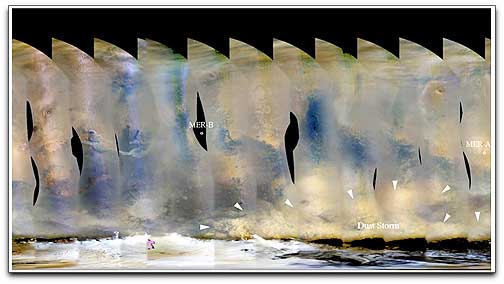
Mars dust storm mosaic (NASA)

Two other instruments — the Thermal Emission Imaging System on Mars Odyssey and the Mars Climate Sounder on Mars Reconnaissance Orbiter — monitor changes in airborne dust or dust-related temperatures in Mars’ upper atmosphere. Orbiters also aid surface missions with radio relays, imaging to aid drive plans, and studies of possible future landing sites. When orbital observations indicate a dust-raising storm is approaching a rover, the rover team can take steps to conserve energy. For example, the team can reduce the length of time the rover will be active or can shorten or delete some communication events. In recent weeks, frequent weather reports from Bruce Cantor of Malin‘s Mars Color Imager team let the rover team know that the March increase in haziness was not the front edge of a bad storm. “Bruce’s weather reports have let us be more aggressive about using the rovers,” said Mark Lemmon, a rover-team atmospheric scientist at Texas A&M University, College Station. “There have been fewer false alarms. Earlier in the mission, we backed off a lot on operations whenever we saw a small increase in dust. Now, we have enough information to know whether there’s really a significant dust storm headed our way.”

At other times, the weather reports prompt quick precautionary actions. On Saturday, November 8, 2008, the rover team received word from Cantor of a dust storm nearing Spirit. The team deleted a communication session that Sunday and sent a minimal-activity set of commands that Monday. Without those responses, Spirit would likely have depleted its batteries to a dangerous level. Winds that can lift dust into the air can also blow dust off the rovers’ solar panels. The five-year-old rover missions, originally planned to last for three months, would have ended long ago if beneficial winds didn’t occasionally remove some of the dust that accumulates on the panels. A cleaning event in early April aided Opportunity’s power output, and Spirit got two minor cleanings in February, but the last major cleaning for Spirit was nearly a full Martian year ago. Nelson said, “We’re all hoping we’ll get another good cleaning.”

(Image: The nearly global mosaic from NASA’s Mars Reconnaissance Orbiter on April 2, 2009, shows billowing clouds of dust being lifted into the atmosphere by a storm near the edge of the seasonal polar cap of southern Mars. Image credit: NASA/JPL-Caltech/MSSS)

Filed Under: Earth Observation & Imaging, Exploration & Science Missions

Primary Sidebar

Coverage

  • Missions & Constellations
  • Business & Finance
  • Military & Defense
  • Launch
  • Software Automation & Ground Systems
  • Government & Regulation
  • Services & Applications

Most Read Stories

  • NASA Shuts Off Instrument on Voyager 1 to Extend Interstellar Mission
  • Bad news, but good news followed
  • Amazon to Acquire Globalstar for $11.6 Billion to Fuel D2D Expansion
  • Blue Origin Achieves First Booster Reuse but Satellite Enters Off-Nominal Orbit
  • The Smartest Money in the Room Is Looking Up

Secondary Sidebar

Footer


Satnews is a leading provider of satellite news, events, publications, research and other satellite industry information in both commercial and military enterprises worldwide.

Stories By Category

  • Business & Finance
  • Government & Regulation
  • Launch
  • Military & Defense
  • Missions & Constellations
  • Services & Applications
  • Software Automation & Ground Systems
  • Spectrum & Licensing
  • Startups & NewSpace Business

About Us

  • Leadership & Editorial Team
  • SatNews History
  • Free Satnews Subscription
  • SatNews Events
  • Magazines

Navigation

  • Latest Stories
  • Magazines
  • Events
  • Contact
  • Cookie & Privacy Policy for Satnews

We use cookies to ensure that we give you the best experience on our website. If you continue to use this site we will assume that you are happy with it.
x
Sign up Now (For Free)
Access daily or weekly satellite news updates covering all aspects of the commercial and military satellite industry.
Invalid email address
Notify Me Regarding ( At least one ):
We value your privacy and will not sell or share your email or other information with any other company. You may also unsubscribe at anytime.

Click Here to see our full privacy policy.
Thanks for subscribing!