

• Skip to primary navigation
  • Skip to main content
  • Skip to primary sidebar
  • Skip to secondary sidebar
  • Skip to footer
  • NEWS:
  • SatNews
  • SatMagazine
  • MilSatMagazine
  • SmallSat News
  • |     EVENTS:
  • SmallSat Symposium
  • Satellite Innovation
  • MilSat Symposium
  • SmallSat Europe

SatNews

Satellite Industry Intelligence Since 1983

Subscribe
  • LATEST
  • SatNews Events
  • Magazines
  • Calendar
  • Subscribe
  • Missions & Constellations
    • Exploration & Science Missions
    • In-Orbit Servicing & Orbital Operations
    • LEO Constellations
    • Mission Autonomy & Onboard Systems
    • Mission Deployments & Manifests
    • Navigation & PNT
    • SmallSat
    • Spacecraft & Payload Technology
    View All in Missions & Constellations →
    Iridium Unveils Core Role in Artemis II and Next-Gen PNT at Space Symposium 2026Iridium Unveils Core Role in Artemis II and Next-Gen PNT at Space Symposium 2026
    Boeing and Millennium Unveil Resolute Mid-Class Satellite PlatformBoeing and Millennium Unveil Resolute Mid-Class Satellite Platform
    NASA Shifts Focus to Permanent Lunar Base and Nuclear PropulsionNASA Shifts Focus to Permanent Lunar Base and Nuclear Propulsion
    Kepler and Astrolight Secure ESA Contract for HydRON Optical NetworkKepler and Astrolight Secure ESA Contract for HydRON Optical Network
  • Business
    • Contracts & Commercial Deals
    • Earnings & Financial Reporting
    • Events & Conferences
    • Funding & Venture Capital
    • Market Forecasts
    • Mergers & Acquisitions
    • Personnel Moves & Appointments
    View All in Business & Finance →
    SmallSat Europe Speaker Focus: Jaume Sanpera, SateliotSmallSat Europe Speaker Focus: Jaume Sanpera, Sateliot
    Ericsson Initiates SEK 15 Billion Share Buyback ProgramEricsson Initiates SEK 15 Billion Share Buyback Program
    Saltzman Unveils 2040 Blueprint to Scale Space Force for Great Power CompetitionSaltzman Unveils 2040 Blueprint to Scale Space Force for Great Power Competition
    SmallSat Europe Speaker Focus: Col. Marcin Mazur, Polish Space AgencySmallSat Europe Speaker Focus: Col. Marcin Mazur, Polish Space Agency
  • Defense
    • Counterspace & ASAT
    • Defense Budgets & Procurement
    • ISR & Reconnaissance
    • MILSATCOM
    • Missile Warning & Defense
    • National Security Programs
    • Space Domain Awareness
    View All in Military & Defense →
    The Rise of Grey Zone Satellites: Ambiguity as a Tactical AdvantageThe Rise of Grey Zone Satellites: Ambiguity as a Tactical Advantage
    US Space Force Awards $68.6M Modification to Lockheed Martin for Next-Gen OPIRUS Space Force Awards $68.6M Modification to Lockheed Martin for Next-Gen OPIR
    General Atomics Completes Pre-Ship Review for Space Force Weather PayloadGeneral Atomics Completes Pre-Ship Review for Space Force Weather Payload
    Global Defense Leaders Convene as Space Symposium 41 Addresses Orbital SecurityGlobal Defense Leaders Convene as Space Symposium 41 Addresses Orbital Security
  • Gov
    • Export Controls & Compliance
    • International Space Agreements
    • National Space Policy
    • Space Law & Treaties
    • Space Sustainability & Debris Policy
    • Space Traffic Management / Debris Removal
    View All in Government & Regulation →
    SmallSat Europe Speaker Focus: Chris Quilty, Quilty SpaceSmallSat Europe Speaker Focus: Chris Quilty, Quilty Space
    NRL to Showcase Sovereign Space Capabilities at 41st Space SymposiumNRL to Showcase Sovereign Space Capabilities at 41st Space Symposium
    FCC Modernizes Satellite Spectrum Rules to Unleash Next-Generation BroadbandFCC Modernizes Satellite Spectrum Rules to Unleash Next-Generation Broadband
    SmallSat Europe Speaker Focus: Daniel Bock, Morpheus SpaceSmallSat Europe Speaker Focus: Daniel Bock, Morpheus Space
  • Launch
    • Launch Providers
    • Launch Schedule & Calendars
    • Launch Sites & Infrastructure
    • Rocket Technology & Vehicles
    View All in Launch →
    Ensign-Bickford Hardware Supports Successful Artemis II Lunar MissionEnsign-Bickford Hardware Supports Successful Artemis II Lunar Mission
    China Accelerates Orbital Internet Deployment with Successful Smart Dragon-3 Sea LaunchChina Accelerates Orbital Internet Deployment with Successful Smart Dragon-3 Sea Launch
    What the SpaceX IPO Changes for Every Satellite OperatorWhat the SpaceX IPO Changes for Every Satellite Operator
    €30 million Financing for PLD Space’s Small Satellite Launcher€30 million Financing for PLD Space’s Small Satellite Launcher
  • Software
    • Autonomous Ground Operations
    • Data Processing & AI/ML
    • Digital Twins & Modeling
    • Ground Segment & Teleports
    • Mission Planning & Simulation
    • Space Systems Software Engineering
    • Spectrum & Licensing
    View All in Software Automation & Ground Systems →
    Cloudcomputing Targets 1.5M Identities in Spain and Finalizes Innovate IT AcquisitionCloudcomputing Targets 1.5M Identities in Spain and Finalizes Innovate IT Acquisition
    Archangel Lightworks Secures £10M Series A to Scale Optical Ground InfrastructureArchangel Lightworks Secures £10M Series A to Scale Optical Ground Infrastructure
    Keysight and Sateliot Win ESA and GSMA Foundry Challenge for 6G InnovationKeysight and Sateliot Win ESA and GSMA Foundry Challenge for 6G Innovation
    Automation and Agility: How SSC Space Go is Designed for the New Age of GroundAutomation and Agility: How SSC Space Go is Designed for the New Age of Ground
  • Services & Apps
    • Climate & Environmental Monitoring
    • Disaster Response & Security Mapping
    • Earth Observation & Imaging
    • Maritime & Aviation Satcom
    • Satellite Communications
    View All in Services & Applications →
    NASA Targets Commercial Relays to Replace Aging TDRSS InfrastructureNASA Targets Commercial Relays to Replace Aging TDRSS Infrastructure
    OQ Technology Awarded ESA Contract to Adapt 5G Beamforming for SpaceOQ Technology Awarded ESA Contract to Adapt 5G Beamforming for Space
    Kraken Robotics Integrates KATFISH Sonar on SEFINE RD-22 USV Following Multi-Naval DemonstrationsKraken Robotics Integrates KATFISH Sonar on SEFINE RD-22 USV Following Multi-Naval Demonstrations
    Astroscale Plans World-First Multi-Orbit Satellite Inspection MissionAstroscale Plans World-First Multi-Orbit Satellite Inspection Mission

Mission — The Key to the Climate Is In Carbon, Reports NASA

January 29, 2009

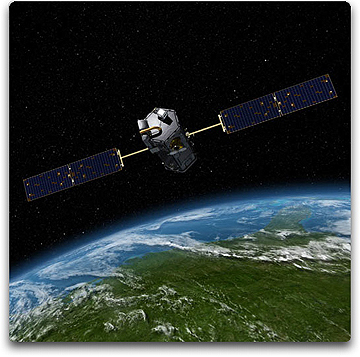
NASA's Carbon Observatory A NASA spacecraft dedicated to studying atmospheric carbon dioxide is in final preparations for a February 23 launch from Vandenberg Air Force Base in California, and is the first of its kind. According to NASA, carbon dioxide is the leading human-produced greenhouse gas driving changes in Earth’s climate. This is an artist’s concept of the Orbiting Carbon Observatory. The mission, scheduled to launch in early 2009, will be the first spacecraft dedicated to studying atmospheric carbon dioxide, the principal human-produced driver of climate change. It will provide the first global picture of the human and natural sources of carbon dioxide and the places where this important greenhouse gas is stored. Such information will improve global carbon cycle models as well as forecasts of atmospheric carbon dioxide levels and of how our climate may change in the future. Image credit: NASA/JPL

The Orbiting Carbon Observatory will provide the first complete picture of human and natural carbon dioxide sources as well as their “sinks,” the places where carbon dioxide is pulled out of the atmosphere and stored. It will map the global geographic distribution of these sources and sinks and study their changes over time. The measurements will be combined with data from ground stations, aircraft and other satellites to help answer questions about the processes that regulate atmospheric carbon dioxide and its role in Earth’s climate and carbon cycle.

Mission data will help scientists reduce uncertainties in predicting future carbon dioxide increases and make more accurate climate change predictions. Policymakers and business leaders can use the data to make more informed decisions that improve the quality of life on Earth. “It’s critical that we understand the processes controlling carbon dioxide in our atmosphere today so we can predict how fast it will build up in the future and how quickly we’ll have to adapt to climate change caused by carbon dioxide buildup,” said David Crisp, principal investigator for the Orbiting Carbon Observatory at NASA’s Jet Propulsion Laboratory in Pasadena, California.

“OCO’s carbon dioxide measurements will be pivotal in advancing our knowledge of virtually all Earth system land, atmosphere, and ocean processes,” said Michael Freilich, director of NASA’s Earth Science Division in Washington. “They will play crucial roles in refining our knowledge of climate forcings and Earth’s response processes.”

The concentration of carbon dioxide in the atmosphere is determined by the balance between its sources and the sinks where it is absorbed on land and in the ocean. Human activities, particularly fossil fuel burning and deforestation, have upset Earth’s carbon cycle balance. Since the Industrial Revolution began in 1750, atmospheric carbon dioxide has increased from about 280 parts per million to about 385 parts per million. Climate models indicate increased greenhouse gases have been the primary driver of Earth’s increasing surface temperature.

Of all the carbon humans have added to Earth’s atmosphere since the start of the Industrial Revolution, only about 40 percent has remained in Earth’s atmosphere. About half of the remaining 60 percent can be accounted for in Earth’s ocean. The rest must have been absorbed somewhere on land, but scientists cannot yet determine specifically where this is taking place or what controls the efficiency of these land sinks. Scientists refer to this as the “missing” carbon sink.

The new observatory will dramatically improve global carbon dioxide measurements, collecting about 8 million measurements every 16 days for at least two years with the precision, resolution and coverage needed to characterize carbon dioxide’s global distribution. Scientists need these precise measurements because carbon dioxide varies by just 10 parts per million throughout the year on regional to continental scales.

The Orbiting Carbon Observatory’s three high-resolution spectrometers spread reflected sunlight into its various colors like a prism. Each spectrometer focuses on a different, narrow color range, detecting light with the specific colors absorbed by carbon dioxide and molecular oxygen. The less carbon dioxide present in the atmosphere, the more light the spectrometers detect. By analyzing the amount of light, scientists can determine relative concentrations of these chemicals. The data will then be input into computer models of the global atmosphere to quantify carbon dioxide sources and sinks.
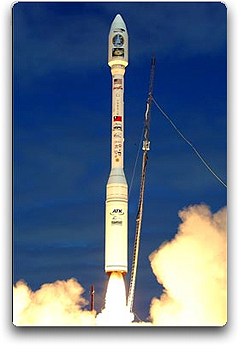
Taurus XL rocket The Orbiting Carbon Observatory will be launched on a Taurus XL rocket into a 438-mile near-polar orbit. It will lead five other NASA satellites that cross the equator each day shortly after noon, making a wide range of nearly simultaneous Earth observations. The Taurus XL rocket blasts off carrying ROCSAT 2. Credit: Gene Blevins

JPL manages the Orbiting Carbon Observatory for NASA’s Science Mission Directorate in Washington. Orbital Sciences Corporation of Dulles, Va., built the spacecraft and the Taurus XL rocket and provides mission operations under JPL leadership. NASA’s Launch Services Program at NASA’s Kennedy Space Center, Florida., leads launch and countdown management. For more information about the Orbiting Carbon Observatory, visit.

Filed Under: Climate & Environmental Monitoring, Launch Providers

Primary Sidebar

Coverage

  • Missions & Constellations
  • Business & Finance
  • Military & Defense
  • Launch
  • Software Automation & Ground Systems
  • Government & Regulation
  • Services & Applications

Most Read Stories

  • SpaceX Loses Contact With Starlink Satellite
  • Rocket Lab Emerging as Potential Bus Provider for 2,800-Satellite Equatys Constellation
  • SpaceX Accelerates Record-Breaking IPO Following Trillion-Dollar xAI Merger
  • Planet Labs Imposes Indefinite Blackout on Iran Satellite Imagery at U.S. Request
  • Amazon in Reported Talks to Acquire Globalstar in $9 Billion Move to Challenge Starlink

Secondary Sidebar

Footer


Satnews is a leading provider of satellite news, events, publications, research and other satellite industry information in both commercial and military enterprises worldwide.

Stories By Category

  • Business & Finance
  • Government & Regulation
  • Launch
  • Military & Defense
  • Missions & Constellations
  • Services & Applications
  • Software Automation & Ground Systems
  • Spectrum & Licensing
  • Startups & NewSpace Business

About Us

  • Leadership & Editorial Team
  • SatNews History
  • Free Satnews Subscription
  • SatNews Events
  • Magazines

Navigation

  • Latest Stories
  • Magazines
  • Events
  • Contact
  • Cookie & Privacy Policy for Satnews

We use cookies to ensure that we give you the best experience on our website. If you continue to use this site we will assume that you are happy with it.
x
Sign up Now (For Free)
Access daily or weekly satellite news updates covering all aspects of the commercial and military satellite industry.
Invalid email address
Notify Me Regarding ( At least one ):
We value your privacy and will not sell or share your email or other information with any other company. You may also unsubscribe at anytime.

Click Here to see our full privacy policy.
Thanks for subscribing!