

While accumulating nearly 3,000 seconds of operation during 11 hot fire tests, the CECE achieved a throttling range from 104 percent down to 8 percent of its maximum power of 13,800 pounds of thrust. The engine is fueled by a mixture of liquid oxygen and liquid hydrogen. It is validating propulsion technologies to support NASA’s Constellation Program.
 “The CECE is demonstrating an ability to operate at such wide
variations of thrust that it will provide substantial design margin
for NASA to meet the lander’s mission to descend from orbit and slowly
approach and land on the moon’s surface,” said Victor Giuliano, CECE
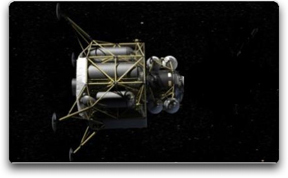
program manager, Pratt & Whitney Rocketdyne. Above: NASA’s Altair Lunar Lander concept floats in space
“The CECE is demonstrating an ability to operate at such wide
variations of thrust that it will provide substantial design margin
for NASA to meet the lander’s mission to descend from orbit and slowly
approach and land on the moon’s surface,” said Victor Giuliano, CECE
program manager, Pratt & Whitney Rocketdyne. Above: NASA’s Altair Lunar Lander concept floats in space
“The CECE demonstrated significant risk mitigation for Altair,” said Frank Peri, program manager, Exploration Technology Development Program, NASA Langley Research Center. “The CECE test demonstrated the full profile of a landing sequence with a throttleable liquid-oxygen, liquid-hydrogen engine, and shows that throttling is extensible not only to the moon but also to Mars and beyond.”
 The latest CECE configuration incorporates a new injector design and
propellant feed system that carefully manages the pressure,
temperature and flow of propellants throughout its range of throttled
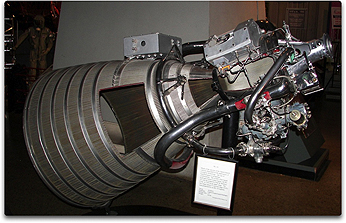
operation. The CECE is a variant of Pratt & Whitney Rocketdyne’s RL10 upper-stage engine that has helped place numerous military, government and
commercial satellites into orbit and powered space probe missions to
every planet in our solar system. The RL10 marks its 46th year of
flight this year, and is currently in production for service on the
latest versions of the Atlas and Delta EELV launch vehicles.
The latest CECE configuration incorporates a new injector design and
propellant feed system that carefully manages the pressure,
temperature and flow of propellants throughout its range of throttled
operation. The CECE is a variant of Pratt & Whitney Rocketdyne’s RL10 upper-stage engine that has helped place numerous military, government and
commercial satellites into orbit and powered space probe missions to
every planet in our solar system. The RL10 marks its 46th year of
flight this year, and is currently in production for service on the
latest versions of the Atlas and Delta EELV launch vehicles.
