

• Skip to primary navigation
  • Skip to main content
  • Skip to primary sidebar
  • Skip to secondary sidebar
  • Skip to footer
  • NEWS:
  • SatNews
  • SatMagazine
  • MilSatMagazine
  • SmallSat News
  • |     EVENTS:
  • SmallSat Symposium
  • Satellite Innovation
  • MilSat Symposium
  • SmallSat Europe

SatNews

Satellite Industry Intelligence Since 1983

Subscribe
  • LATEST
  • SatNews Events
  • Magazines
  • Calendar
  • Subscribe
  • Missions & Constellations
    • Exploration & Science Missions
    • In-Orbit Servicing & Orbital Operations
    • LEO Constellations
    • Mission Autonomy & Onboard Systems
    • Mission Deployments & Manifests
    • Navigation & PNT
    • SmallSat
    • Spacecraft & Payload Technology
    View All in Missions & Constellations →
    SmallSat Europe Speaker Focus: Simon van den Dries, EnduroSatSmallSat Europe Speaker Focus: Simon van den Dries, EnduroSat
    SmallSat Europe Speaker Focus: Stewart Marsh, Cambridge ConsultantsSmallSat Europe Speaker Focus: Stewart Marsh, Cambridge Consultants
    SmallSat Europe Speaker Focus: Luis Gomes, AAC Clyde SpaceSmallSat Europe Speaker Focus: Luis Gomes, AAC Clyde Space
    SmallSat Europe Speaker Focus: Dr. Dietmar Pilz, European Space AgencySmallSat Europe Speaker Focus: Dr. Dietmar Pilz, European Space Agency
  • Business
    • Contracts & Commercial Deals
    • Earnings & Financial Reporting
    • Events & Conferences
    • Funding & Venture Capital
    • Market Forecasts
    • Mergers & Acquisitions
    • Personnel Moves & Appointments
    View All in Business & Finance →
    Viasat Demonstrates First Satellite-Enabled Smartphone Messaging in UzbekistanViasat Demonstrates First Satellite-Enabled Smartphone Messaging in Uzbekistan
    SpaceX: 10,000 Launches AnnuallySpaceX: 10,000 Launches Annually
    SmallSat Europe Speaker Focus: Dr. Thomas Withington, Royal United Services InstituteSmallSat Europe Speaker Focus: Dr. Thomas Withington, Royal United Services Institute
    SmallSat Europe Speaker Focus: Jenna Herrera, Rocket LabSmallSat Europe Speaker Focus: Jenna Herrera, Rocket Lab
  • Defense
    • Counterspace & ASAT
    • Defense Budgets & Procurement
    • ISR & Reconnaissance
    • MILSATCOM
    • Missile Warning & Defense
    • National Security Programs
    • Space Domain Awareness
    View All in Military & Defense →
    Software-Defined Modems and Hardware Bottlenecks Strain Proliferated Defense Space ArchitecturesSoftware-Defined Modems and Hardware Bottlenecks Strain Proliferated Defense Space Architectures
    SPARC AI and Rate Manufacturing Partner to Deliver Software-Defined, GPS-Denied Drone TargetingSPARC AI and Rate Manufacturing Partner to Deliver Software-Defined, GPS-Denied Drone Targeting
    Pentagon Enforces Commercial Satellite Blackout Over Middle East War ZonePentagon Enforces Commercial Satellite Blackout Over Middle East War Zone
    Poland Just Made Sovereign SAR the European DefaultPoland Just Made Sovereign SAR the European Default
  • Gov
    • Export Controls & Compliance
    • International Space Agreements
    • National Space Policy
    • Space Law & Treaties
    • Space Sustainability & Debris Policy
    • Space Traffic Management / Debris Removal
    View All in Government & Regulation →
    Canadian Space Agency Shifts to Agile Procurement and Resets WildFireSat MissionCanadian Space Agency Shifts to Agile Procurement and Resets WildFireSat Mission
    BAE Systems Supplies Sensor Hardware for Space Force Next-Gen Polar SatelliteBAE Systems Supplies Sensor Hardware for Space Force Next-Gen Polar Satellite
    ESA and Spain Establish Formal Framework for Sovereign Satellite ConnectivityESA and Spain Establish Formal Framework for Sovereign Satellite Connectivity
    The transatlantic space defense timeline mismatch is now a NATO problemThe transatlantic space defense timeline mismatch is now a NATO problem
  • Launch
    • Launch Providers
    • Launch Schedule & Calendars
    • Launch Sites & Infrastructure
    • Rocket Technology & Vehicles
    View All in Launch →
    China Launches Shenzhou-23 Mission to Tiangong, Slated for Record Year-Long StayChina Launches Shenzhou-23 Mission to Tiangong, Slated for Record Year-Long Stay
    SpaceX Is Worth $1.75 Trillion. Only 7% of That Is Real.SpaceX Is Worth $1.75 Trillion. Only 7% of That Is Real.
    Lowering the Launch Barrier: Starpath Global Expands Multi-Orbital Leasing NetworkLowering the Launch Barrier: Starpath Global Expands Multi-Orbital Leasing Network
    Joint European-Chinese SMILE Mission Launches to Map Earth’s Magnetic ShieldJoint European-Chinese SMILE Mission Launches to Map Earth’s Magnetic Shield
  • Software
    • Autonomous Ground Operations
    • Data Processing & AI/ML
    • Digital Twins & Modeling
    • Ground Segment & Teleports
    • Mission Planning & Simulation
    • Space Systems Software Engineering
    • Spectrum & Licensing
    View All in Software Automation & Ground Systems →
    LEO Constellations and Ground Infrastructure Scaling Position Optical Satcom for Multi-Billion-Dollar SurgeLEO Constellations and Ground Infrastructure Scaling Position Optical Satcom for Multi-Billion-Dollar Surge
    Lightpath Expands Dense Northeast Fiber Infrastructure Across 2,400 Macro Cell TowersLightpath Expands Dense Northeast Fiber Infrastructure Across 2,400 Macro Cell Towers
    Cowboy Raises $275M and Files for 20,000 Orbital Data Centers, Forcing the ODC Thesis Into ViewCowboy Raises $275M and Files for 20,000 Orbital Data Centers, Forcing the ODC Thesis Into View
    Teleste and Polystar Partner to Launch AI Automation for Next Generation Cable InfrastructureTeleste and Polystar Partner to Launch AI Automation for Next Generation Cable Infrastructure
  • Services & Apps
    • Climate & Environmental Monitoring
    • Disaster Response & Security Mapping
    • Earth Observation & Imaging
    • Maritime & Aviation Satcom
    • Satellite Communications
    View All in Services & Applications →
    Hybrid Viewing Models Solidify as Streaming Integrates into Premium Sports DistributionHybrid Viewing Models Solidify as Streaming Integrates into Premium Sports Distribution
    Astrolight and ESA Unveil Operational Optical Ground Station in Greece for Satellite Laser LinksAstrolight and ESA Unveil Operational Optical Ground Station in Greece for Satellite Laser Links
    Apple Prepares for Pivot at WWDC 2026 MilestoneApple Prepares for Pivot at WWDC 2026 Milestone
    Energy Efficient E-Paper Displays Redefine Professional Digital SignageEnergy Efficient E-Paper Displays Redefine Professional Digital Signage

Super STEREO Sun Sensing

January 25, 2009

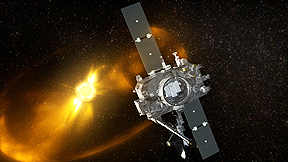
NASA researchers announced an event that will transform our view of the Sun and, in the process, super-charge the field of solar physics for many years to come. NASA’s two STEREO spacecraft will be 180 degrees apart and will image the entire Sun for the first time in history.

STEREO spacecraft
STEREO‘s deployment on opposite sides of the Sun solves a problem that has vexed astronomers for centuries: At any given moment, they can see only half of the stellar surface. The Sun spins on its axis once every 25 days, so over the course of a month, the whole Sun does turn to face Earth. However, a month is not nearly fast enough to keep track of events. Sunspots can materialize, explode, and regroup in a matter of days; coronal holes open and close; magnetic filaments stretch tight and—snap!—they explode, hurling clouds of hot gas into the solar system. Fully half of this action is hidden from view, a fact which places space weather forecasters in an awkward position. How can you anticipate storms when you can’t see them coming? Likewise researchers cannot track the long-term evolution of sunspots or the dynamics of magnetic filaments because they keep ducking over the horizon at inconvenient times. STEREO’s global view will put an end to these difficulties.

The global view is still two years away. Already, however, the two spacecraft are beaming back over-the-horizon images that have researchers and forecasters glued to their monitors. STEREO’s journey to the “dark side” started on Oct. 25, 2006, when the twin probes left Earth together onboard a Delta II rocket. High above the atmosphere, they separated and headed for the Moon. What happened next was a first in space navigation. The Moon acted as a gravitational slingshot, flinging the two probes in opposite directions — STEREO-A ahead of Earth and STEREO-B behind. They’ve been spreading apart ever since, and this is where they are now:
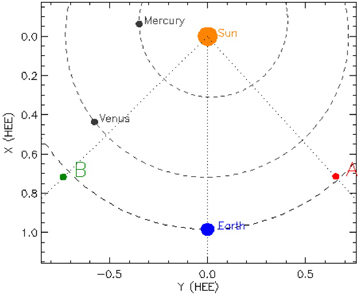
STEREO position diagram Left: The current positions of the STEREO Ahead (red) and Behind (green) spacecraft relative to the Sun (orange) and Earth (blue). The dotted lines show the angular displacement from the Earth. [more]

Due to the way the Sun spins (counterclockwise in the diagram above), STEREO-B gets a sneak preview of sunspots and coronal holes before they turn to face Earth — a boon for forecasters. At the moment, STEREO-B enjoys a 3-day look-ahead advantage over Earth-based observatories. This has allowed researchers to predict geomagnetic storms as much as 72 hours earlier than ever before. On several occasions in late 2008, STEREO-B spotted a coronal hole spewing solar wind before any other spacecraft did. When the solar wind hit Earth, STEREO-B’s long-range forecast was validated by auroras like these:
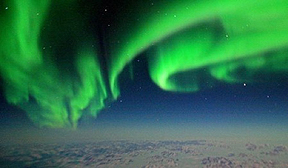
STERO Auroras Right: Photographer Brian Whittaker took this picture from the window of an airplane flying over Greenland on November 9, 2008. The auroras were sparked by a solar wind impact anticipated by STEREO-B. Credit: Spaceweather.com.

The two spacecraft beam their data back to Earth via an X-band radio beacon. Anyone with a 10-meter dish antenna and a suitable receiver can pick up the signals. The data rate is low, 500 bits per second, and it takes 3 to 5 minutes to download a complete image. The two STEREO spacecraft rank among most sophisticated solar observatories launched by NASA to date. They are equipped with sensors that measure the speed, direction and composition of the solar wind; receivers that pick up radio emissions from explosions and shock waves in the sun’s atmosphere; telescopes that image the solar surface and all the tempests that rage there; and coronagraphs to monitor events in the sun’s outer atmosphere.

(Source: Science@NASA, Dr. Tony Phillips)

Filed Under: Exploration & Science Missions

Primary Sidebar

Coverage

  • Missions & Constellations
  • Business & Finance
  • Military & Defense
  • Launch
  • Software Automation & Ground Systems
  • Government & Regulation
  • Services & Applications

Most Read Stories

  • SmallSat Europe Speaker Focus: Merek Chertkow, The Radiation Team
  • AST SpaceMobile Pivots to SpaceX for Mid-June Launch of Three BlueBird Satellites
  • Bad news, but good news followed
  • SmallSat Europe Speaker Focus: Frank M. Salzgeber, Nadir Space Venture
  • FAA Grounds Blue Origin Following New Glenn Upper Stage Failure and Facility Anomaly

Secondary Sidebar

Footer


Satnews is a leading provider of satellite news, events, publications, research and other satellite industry information in both commercial and military enterprises worldwide.

Stories By Category

  • Business & Finance
  • Government & Regulation
  • Launch
  • Military & Defense
  • Missions & Constellations
  • Services & Applications
  • Software Automation & Ground Systems
  • Spectrum & Licensing
  • Startups & NewSpace Business

About Us

  • Leadership & Editorial Team
  • SatNews History
  • Free Satnews Subscription
  • SatNews Events
  • Magazines

Navigation

  • Latest Stories
  • Magazines
  • Events
  • Contact
  • Cookie & Privacy Policy for Satnews

We use cookies to ensure that we give you the best experience on our website. If you continue to use this site we will assume that you are happy with it.
x
Sign up Now (For Free)
Access daily or weekly satellite news updates covering all aspects of the commercial and military satellite industry.
Invalid email address
Notify Me Regarding ( At least one ):
We value your privacy and will not sell or share your email or other information with any other company. You may also unsubscribe at anytime.

Click Here to see our full privacy policy.
Thanks for subscribing!