

• Skip to primary navigation
  • Skip to main content
  • Skip to primary sidebar
  • Skip to secondary sidebar
  • Skip to footer
  • NEWS:
  • SatNews
  • SatMagazine
  • MilSatMagazine
  • SmallSat News
  • |     EVENTS:
  • SmallSat Symposium
  • Satellite Innovation
  • MilSat Symposium
  • SmallSat Europe

SatNews

Satellite Industry Intelligence Since 1983

Subscribe
  • LATEST
  • SatNews Events
  • Magazines
  • Calendar
  • Subscribe
  • Missions & Constellations
    • Exploration & Science Missions
    • In-Orbit Servicing & Orbital Operations
    • LEO Constellations
    • Mission Autonomy & Onboard Systems
    • Mission Deployments & Manifests
    • Navigation & PNT
    • SmallSat
    • Spacecraft & Payload Technology
    View All in Missions & Constellations →
    Starlink in the Crosshairs: How Nations are Utilizing the Constellation for War and National SecurityStarlink in the Crosshairs: How Nations are Utilizing the Constellation for War and National Security
    Europe has ships. SmallSat Europe said it doesn’t have ports.Europe has ships. SmallSat Europe said it doesn’t have ports.
    “Dual-use” is the funding word. It’s also the label operators want off.“Dual-use” is the funding word. It’s also the label operators want off.
    Sovereignty got an answer on Day 3. Two answers, actually, and a commercial veto.Sovereignty got an answer on Day 3. Two answers, actually, and a commercial veto.
  • Business
    • Contracts & Commercial Deals
    • Earnings & Financial Reporting
    • Events & Conferences
    • Funding & Venture Capital
    • Market Forecasts
    • Mergers & Acquisitions
    • Personnel Moves & Appointments
    View All in Business & Finance →
    Viasat Selects Atos to Modernize Its Global Digital Workplace OperationsViasat Selects Atos to Modernize Its Global Digital Workplace Operations
    NewSpace Systems Announces European Expansion with New Netherlands SubsidiaryNewSpace Systems Announces European Expansion with New Netherlands Subsidiary
    Two satellites a month, comfortably. Now the supplier tier underneath has to match.Two satellites a month, comfortably. Now the supplier tier underneath has to match.
    The orbital data center thesis just became an economics question.The orbital data center thesis just became an economics question.
  • Defense
    • Counterspace & ASAT
    • Defense Budgets & Procurement
    • ISR & Reconnaissance
    • MILSATCOM
    • Missile Warning & Defense
    • National Security Programs
    • Space Domain Awareness
    View All in Military & Defense →
    The pixel war is over. The integration war is what comes next.The pixel war is over. The integration war is what comes next.
    AI just reached production in European space. The trust problem is what comes next.AI just reached production in European space. The trust problem is what comes next.
    The threat is operational. European doctrine hasn’t caught up.The threat is operational. European doctrine hasn’t caught up.
    Procurement is the choke point. Everything else on Day 1 is downstream of that.Procurement is the choke point. Everything else on Day 1 is downstream of that.
  • Gov
    • Export Controls & Compliance
    • International Space Agreements
    • National Space Policy
    • Space Law & Treaties
    • Space Sustainability & Debris Policy
    • Space Traffic Management / Debris Removal
    View All in Government & Regulation →
    Dependency killed the old debate. Sovereignty is the new one, and Europe hasn’t agreed what it means.Dependency killed the old debate. Sovereignty is the new one, and Europe hasn’t agreed what it means.
    Canadian Space Agency Shifts to Agile Procurement and Resets WildFireSat MissionCanadian Space Agency Shifts to Agile Procurement and Resets WildFireSat Mission
    BAE Systems Supplies Sensor Hardware for Space Force Next-Gen Polar SatelliteBAE Systems Supplies Sensor Hardware for Space Force Next-Gen Polar Satellite
    Pentagon Enforces Commercial Satellite Blackout Over Middle East War ZonePentagon Enforces Commercial Satellite Blackout Over Middle East War Zone
  • Launch
    • Launch Providers
    • Launch Schedule & Calendars
    • Launch Sites & Infrastructure
    • Rocket Technology & Vehicles
    View All in Launch →
    Pioneering High-Pressure Cold Spray Transforms Manufacturing of Complex Copper Rocket NozzlesPioneering High-Pressure Cold Spray Transforms Manufacturing of Complex Copper Rocket Nozzles
    SEOPS Unveils Waymaker Rideshare Program for Low Earth OrbitSEOPS Unveils Waymaker Rideshare Program for Low Earth Orbit
    SmallSat Europe Speaker Focus: Daniele Dallari, PLD SpaceSmallSat Europe Speaker Focus: Daniele Dallari, PLD Space
    China Launches Shenzhou-23 Mission to Tiangong, Slated for Record Year-Long StayChina Launches Shenzhou-23 Mission to Tiangong, Slated for Record Year-Long Stay
  • Software
    • Autonomous Ground Operations
    • Data Processing & AI/ML
    • Digital Twins & Modeling
    • Ground Segment & Teleports
    • Mission Planning & Simulation
    • Space Systems Software Engineering
    • Spectrum & Licensing
    View All in Software Automation & Ground Systems →
    Archangel Lightworks Completes Successful Trials for Miniature Deployable Optical Ground StationArchangel Lightworks Completes Successful Trials for Miniature Deployable Optical Ground Station
    LEO Constellations and Ground Infrastructure Scaling Position Optical Satcom for Multi-Billion-Dollar SurgeLEO Constellations and Ground Infrastructure Scaling Position Optical Satcom for Multi-Billion-Dollar Surge
    Lightpath Expands Dense Northeast Fiber Infrastructure Across 2,400 Macro Cell TowersLightpath Expands Dense Northeast Fiber Infrastructure Across 2,400 Macro Cell Towers
    Cowboy Raises $275M and Files for 20,000 Orbital Data Centers, Forcing the ODC Thesis Into ViewCowboy Raises $275M and Files for 20,000 Orbital Data Centers, Forcing the ODC Thesis Into View
  • Services & Apps
    • Climate & Environmental Monitoring
    • Disaster Response & Security Mapping
    • Earth Observation & Imaging
    • Maritime & Aviation Satcom
    • Satellite Communications
    View All in Services & Applications →
    OmniAccess Launches Unified Multi-Orbit Maritime Connectivity ServiceOmniAccess Launches Unified Multi-Orbit Maritime Connectivity Service
    Viasat’s Next-Gen Cockpit Service Reaches Milestone as Airlines Modernize Communications to Save FuelViasat’s Next-Gen Cockpit Service Reaches Milestone as Airlines Modernize Communications to Save Fuel
    Hybrid Viewing Models Solidify as Streaming Integrates into Premium Sports DistributionHybrid Viewing Models Solidify as Streaming Integrates into Premium Sports Distribution
    Poland Just Made Sovereign SAR the European DefaultPoland Just Made Sovereign SAR the European Default

Dark Energy In Space Is Quite Repulsive—A Cosmological Constant

December 17, 2008

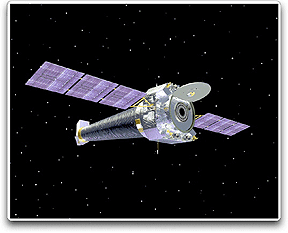
NASA's Chandra X-ray Observatory For the first time, astronomers have clearly seen the effects of “dark energy” on the most massive collapsed objects in the universe using NASA’s Chandra X-ray Observatory. By tracking how dark energy has stifled the growth of galaxy clusters and combining this with previous studies, scientists have obtained the best clues yet about what dark energy is and what the destiny of the universe could be.

This work, which took years to complete, is separate from other methods of dark energy research such as supernovas. These new X-ray results provide a crucial independent test of dark energy, long sought by scientists, which depends on how gravity competes with accelerated expansion in the growth of cosmic structures. Techniques based on distance measurements, such as supernova work, do not have this special sensitivity. Scientists believe dark energy is a form of repulsive gravity that now dominates the universe, although they have no clear picture of what it actually is. Understanding the nature of dark energy is one of the biggest problems in science. Possibilities include the cosmological constant, which is equivalent to the energy of empty space. Other possibilities include a modification in general relativity on the largest scales, or a more general physical field. To help decide between these options, a new way of looking at dark energy is required. It is accomplished by observing how cosmic acceleration affects the growth of galaxy clusters over time.
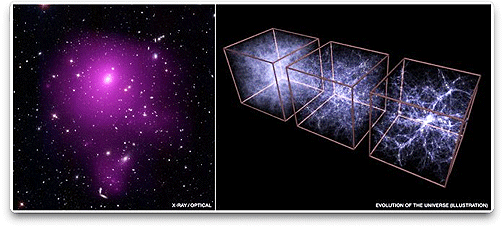
NASA's Chandra Dark Energy images
“This result could be described as ‘arrested development of the universe’,” said Alexey Vikhlinin of the Smithsonian Astrophysical Observatory in Cambridge, Mass., who led the research. “Whatever is forcing the expansion of the universe to speed up is also forcing its development to slow down.”

Vikhlinin and his colleagues used Chandra to observe the hot gas in dozens of galaxy clusters, which are the largest collapsed objects in the universe. Some of these clusters are relatively close and others are more than halfway across the universe. The results show the increase in mass of the galaxy clusters over time aligns with a universe dominated by dark energy. It is more difficult for objects like galaxy clusters to grow when space is stretched, as caused by dark energy. Vikhlinin and his team see this effect clearly in their data. The results are remarkably consistent with those from the distance measurements, revealing general relativity applies, as expected, on large scales. The study strengthens the evidence that dark energy is the cosmological constant. Although it is the leading candidate to explain dark energy, theoretical work suggests it should be about 10 raised to the power of 120 times larger than observed. Therefore, alternatives to general relativity, such as theories involving hidden dimensions, are being explored.

The work by Vikhlinin and his colleagues will be published in two separate papers in the Feb. 10 issue of The Astrophysical Journal. NASA’s Marshall Space Flight Center in Huntsville, Ala., manages the Chandra program for NASA’s Science Mission Directorate in Washington. The Smithsonian Astrophysical Observatory controls Chandra’s science and flight operations from Cambridge, Mass.

Regarding the images above, the composite image on the left is of the galaxy cluster Abell 85, located about 740 million light years from Earth. The purple emission is multi-million degree gas detected in X-rays by NASA’s Chandra X-ray Observatory and the other colors show galaxies in an optical image from the Sloan Digital Sky Survey. This galaxy cluster is one of 86 observed by Chandra to trace how dark energy has stifled the growth of these massive structures over the last 7 billion years. Galaxy clusters are the largest collapsed objects in the Universe and are ideal for studying the properties of dark energy, the mysterious form of repulsive gravity that is driving the accelerated expansion of the Universe.

The illustration on the right shows snapshots from a simulation by Volker Springel, representing the growth of cosmic structure when the Universe was 0.9 billion, 3.2 billion and 13.7 billion years old (now). This shows how the Universe has evolved from a smooth state to one containing a vast amount of structure. Gas is shown in these snapshots, where the yellow regions are stars and the brightest structures are galaxies and galaxy clusters. The growth of these structures was initially driven only by the attractive force of gravity, but then later there was competition with the repulsive force of dark energy.

(X-ray image credit: NASA/CXC/SAO/A. Vikhlinin et al. Illustration credit: MPE/v. Springel.)


hgl

Filed Under: Exploration & Science Missions

Primary Sidebar

Coverage

  • Missions & Constellations
  • Business & Finance
  • Military & Defense
  • Launch
  • Software Automation & Ground Systems
  • Government & Regulation
  • Services & Applications

Most Read Stories

  • SmallSat Europe Speaker Focus: Merek Chertkow, The Radiation Team
  • AST SpaceMobile Pivots to SpaceX for Mid-June Launch of Three BlueBird Satellites
  • SmallSat Europe Speaker Focus: Frank M. Salzgeber, Nadir Space Venture
  • FAA Grounds Blue Origin Following New Glenn Upper Stage Failure and Facility Anomaly
  • SpaceX Debuts Starship V3: Redefining Heavy-Lift Launch Capability

Secondary Sidebar

Footer


Satnews is a leading provider of satellite news, events, publications, research and other satellite industry information in both commercial and military enterprises worldwide.

Stories By Category

  • Business & Finance
  • Government & Regulation
  • Launch
  • Military & Defense
  • Missions & Constellations
  • Services & Applications
  • Software Automation & Ground Systems
  • Spectrum & Licensing
  • Startups & NewSpace Business

About Us

  • Leadership & Editorial Team
  • SatNews History
  • Free Satnews Subscription
  • SatNews Events
  • Magazines

Navigation

  • Latest Stories
  • Magazines
  • Events
  • Contact
  • Cookie & Privacy Policy for Satnews

We use cookies to ensure that we give you the best experience on our website. If you continue to use this site we will assume that you are happy with it.
x
Sign up Now (For Free)
Access daily or weekly satellite news updates covering all aspects of the commercial and military satellite industry.
Invalid email address
Notify Me Regarding ( At least one ):
We value your privacy and will not sell or share your email or other information with any other company. You may also unsubscribe at anytime.

Click Here to see our full privacy policy.
Thanks for subscribing!