

• Skip to primary navigation
  • Skip to main content
  • Skip to primary sidebar
  • Skip to secondary sidebar
  • Skip to footer
  • NEWS:
  • SatNews
  • SatMagazine
  • MilSatMagazine
  • SmallSat News
  • |     EVENTS:
  • SmallSat Symposium
  • Satellite Innovation
  • MilSat Symposium
  • SmallSat Europe

SatNews

Satellite Industry Intelligence Since 1983

Subscribe
  • LATEST
  • SatNews Events
  • Magazines
  • Calendar
  • Subscribe
  • Missions & Constellations
    • Exploration & Science Missions
    • In-Orbit Servicing & Orbital Operations
    • LEO Constellations
    • Mission Autonomy & Onboard Systems
    • Mission Deployments & Manifests
    • Navigation & PNT
    • SmallSat
    • Spacecraft & Payload Technology
    View All in Missions & Constellations →
    Financial Modeling Validates SpaceX Falcon 9 Booster Economics and MarginsFinancial Modeling Validates SpaceX Falcon 9 Booster Economics and Margins
    LeoLabs Awarded $20.7 Million U.S. Space Force Contract for Mobile Scout-S Surveillance RadarLeoLabs Awarded $20.7 Million U.S. Space Force Contract for Mobile Scout-S Surveillance Radar
    Palladyne AI and NORDA Dynamics Partner to Integrate Autonomous Swarming and Terminal Guidance SoftwarePalladyne AI and NORDA Dynamics Partner to Integrate Autonomous Swarming and Terminal Guidance Software
    AST SpaceMobile’s AST5000 ASIC and Nvidia’s Vera CPU Serve Distinct Technical Roles in Space HardwareAST SpaceMobile’s AST5000 ASIC and Nvidia’s Vera CPU Serve Distinct Technical Roles in Space Hardware
  • Business
    • Contracts & Commercial Deals
    • Earnings & Financial Reporting
    • Events & Conferences
    • Funding & Venture Capital
    • Market Forecasts
    • Mergers & Acquisitions
    • Personnel Moves & Appointments
    View All in Business & Finance →
    Airbus Considers Sale of U.S. Satellite Manufacturing Facility in Strategic Shift Toward European ProductionAirbus Considers Sale of U.S. Satellite Manufacturing Facility in Strategic Shift Toward European Production
    Silicon Valley Space Week Speaker Focus: Ron Faith, RBC SignalsSilicon Valley Space Week Speaker Focus: Ron Faith, RBC Signals
    Saudi Space Investments Projected to Quadruple to $31.6 Billion by 2035, CST Report FindsSaudi Space Investments Projected to Quadruple to $31.6 Billion by 2035, CST Report Finds
    NASA Astronaut Jonny Kim Departs Agency as Civil Space Sector Navigates Broader Human Capital DemandsNASA Astronaut Jonny Kim Departs Agency as Civil Space Sector Navigates Broader Human Capital Demands
  • Defense
    • Counterspace & ASAT
    • Defense Budgets & Procurement
    • ISR & Reconnaissance
    • MILSATCOM
    • Missile Warning & Defense
    • National Security Programs
    • Space Domain Awareness
    View All in Military & Defense →
    How ICEYE Turned Sovereign SAR Into a 12-Month ProductHow ICEYE Turned Sovereign SAR Into a 12-Month Product
    Ground Infrastructure Vulnerabilities Accelerate Industry Transition to Cloud-Based SATCOM VirtualizationGround Infrastructure Vulnerabilities Accelerate Industry Transition to Cloud-Based SATCOM Virtualization
    ThinKom Awarded $49 Million U.S. Army OTA Contract for Mobile C-UAS High-Power Microwave PrototypeThinKom Awarded $49 Million U.S. Army OTA Contract for Mobile C-UAS High-Power Microwave Prototype
    Viasat Selects Rocket Lab to Build Small GEO Satellite Bus for Space Force PTS-G ProgramViasat Selects Rocket Lab to Build Small GEO Satellite Bus for Space Force PTS-G Program
  • Gov
    • Export Controls & Compliance
    • International Space Agreements
    • National Space Policy
    • Space Law & Treaties
    • Space Sustainability & Debris Policy
    • Space Traffic Management / Debris Removal
    View All in Government & Regulation →
    Satellite Industry Association Endorses White House Space Transportation Policy DirectiveSatellite Industry Association Endorses White House Space Transportation Policy Directive
    DarkSky International Petitions Full FCC to Overturn Approval of Reflect Orbital’s Space-Mirror SatelliteDarkSky International Petitions Full FCC to Overturn Approval of Reflect Orbital’s Space-Mirror Satellite
    FCC Opens Proceeding to Unlock 200 MHz of Unlicensed Spectrum for Direct-to-Device Satellite LinksFCC Opens Proceeding to Unlock 200 MHz of Unlicensed Spectrum for Direct-to-Device Satellite Links
    SpaceX Regulatory Strategy at the FCC: Disruptive Expansion Meets Administrative OversightSpaceX Regulatory Strategy at the FCC: Disruptive Expansion Meets Administrative Oversight
  • Launch
    • Launch Providers
    • Launch Schedule & Calendars
    • Launch Sites & Infrastructure
    • Rocket Technology & Vehicles
    View All in Launch →
    Firefly Aerospace CEO Cites Systemic Launch Vehicle Shortage Amid Expanding Satellite BacklogsFirefly Aerospace CEO Cites Systemic Launch Vehicle Shortage Amid Expanding Satellite Backlogs
    ESA Awards PLD Space €158.9M European Launcher Challenge Contract for MIURA 5 Scaling and ReusabilityESA Awards PLD Space €158.9M European Launcher Challenge Contract for MIURA 5 Scaling and Reusability
    Aurora Avionics Secures Contract to Supply Control and Power Electronics for Alpha Impulsion Autophage EngineAurora Avionics Secures Contract to Supply Control and Power Electronics for Alpha Impulsion Autophage Engine
    SpaceX and Louisiana State Officials Announce Major Aerospace Logistics and Spaceport Infrastructure DealSpaceX and Louisiana State Officials Announce Major Aerospace Logistics and Spaceport Infrastructure Deal
  • Software
    • Autonomous Ground Operations
    • Data Processing & AI/ML
    • Digital Twins & Modeling
    • Ground Segment & Teleports
    • Mission Planning & Simulation
    • Space Systems Software Engineering
    • Spectrum & Licensing
    View All in Software Automation & Ground Systems →
    Astrolight Advances End-to-End Lasercom Network to Address Orbital Bandwidth and Spectrum BottlenecksAstrolight Advances End-to-End Lasercom Network to Address Orbital Bandwidth and Spectrum Bottlenecks
    Intellian Unveils CM100 GMDSS Terminal Built for Iridium Certus 100 Safety NetworkIntellian Unveils CM100 GMDSS Terminal Built for Iridium Certus 100 Safety Network
    NASA Joins Federal Genesis Mission Initiative to Process 150 Petabytes of Space Data via AI ArchitecturesNASA Joins Federal Genesis Mission Initiative to Process 150 Petabytes of Space Data via AI Architectures
    IHI Corporation and Kuva Space Partner to Evaluate Japanese Sovereign Hyperspectral ConstellationIHI Corporation and Kuva Space Partner to Evaluate Japanese Sovereign Hyperspectral Constellation
  • Services & Apps
    • Climate & Environmental Monitoring
    • Disaster Response & Security Mapping
    • Earth Observation & Imaging
    • Maritime & Aviation Satcom
    • Satellite Communications
    View All in Services & Applications →
    Arianespace Launches Thales Alenia Space MTG-I2 Satellite Aboard Ariane 62 RocketArianespace Launches Thales Alenia Space MTG-I2 Satellite Aboard Ariane 62 Rocket
    a.i. solutions Debuts FreeFlyer 8 Astrodynamics Platform with Cross-Platform Support and Decoupled Graphicsa.i. solutions Debuts FreeFlyer 8 Astrodynamics Platform with Cross-Platform Support and Decoupled Graphics
    T-Mobile CFO Cites Physical Laws Limiting Satellite Direct-to-Device Networks to Complementary CoverageT-Mobile CFO Cites Physical Laws Limiting Satellite Direct-to-Device Networks to Complementary Coverage
    ICEYE Establishes Indian Subsidiary to Supply Sovereign SAR Intelligence and Domestic ManufacturingICEYE Establishes Indian Subsidiary to Supply Sovereign SAR Intelligence and Domestic Manufacturing

Smells In Space Shuttle — ENose to the Rescue

November 21, 2008

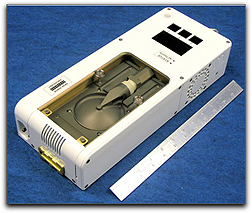
ENose Sensor Something that not everyone thinks about when envisioning life on the ISS, that being smelling dangerous chemicals. NASA astronauts on space shuttle Endeavour’s STS-126 mission will install an instrument that can “smell” dangerous chemicals in the air. Designed to help protect crew members’ health and safety, the experimental “ENose” will monitor the space station’s environment for harmful chemicals such as ammonia, mercury, methanol and formaldehyde. The ENose Sensor Unit (the darker-looking metal object), housed in its Interface Unit (white). The ruler, shown for size comparison, is 12 inches (about 30.5 cm) long. (Photo on right)

The ENose fills the long-standing gap between onboard alarms and complex analytical instruments. Air-quality problems have occurred before on the International Space Station, space shuttle and Russian Space Station Mir. In most cases, the chemicals were identified only after the crew had been exposed to them, if at all. The ENose, which will run continuously and autonomously, is the first instrument on the station that will detect and quantify chemical leaks or spills as they happen.  

“The ENose is a ‘first-responder‘ that will alert crew members of possible contaminants in the air and also analyze and quantify targeted changes in the cabin environment,” said Margaret A. Ryan, the principal investigator of the ENose project at NASA’s Jet Propulsion Laboratory, or JPL, in Pasadena, California. JPL built and manages the device.  

Specifically, the shoebox-sized ENose contains an array of 32 sensors that can identify and quantify several organic and inorganic chemicals, including organic solvents and marker chemicals that signal the start of electrical fires. The ENose sensors are polymer films that change their electrical conductivity in response to different chemicals. The pattern of the sensor array’s response depends on the particular chemical types present in the air.

The instrument can analyze volatile aerosols and vapors, help monitor cleanup of chemical spills or leaks, and enable more intensive chemical analysis by collecting raw data and streaming it to a computer at JPL’s ENose laboratory. The instrument has a wide range of chemical sensitivity, from fractional parts per million to 10,000 parts per million. For all of its capabilities, the ENose weighs less than nine pounds and requires only 20 watts of power.
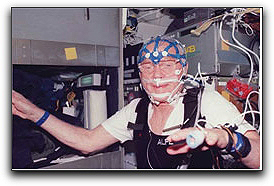
ENose Sensor 1998 This will be the ENose’s second trip into space. An earlier version flew with John Glenn on the STS-95 Space Shuttle in 1998. Since that time, the ENose has increased in sensitivity and reduced in size. The current, third-generation ENose, including its Interface Unit, is about the width and length of a shoe box, and about half as high. The Interface Unit contains 2 computers, one to manage the instrument’s operation and data acquisition, and one to analyze the data, and connects the ENose to the ISS EXPRESS Rack, through which it will transfer data to the support team on Earth. (Photo on left)

Station crew member will unpack the ENose on December 9 to begin the instrument’s six-month demonstration in the crew cabin. If the experiment is successful, the ENose might be used in future space missions as part of an automated system to monitor and control astronauts’ in-space environments.  

The ENose is now in its third generation. The first ENose was tested during a six-day demonstration on the STS-95 shuttle mission in 1998. That prototype could detect 10 compounds, but could not analyze data immediately. The second-generation ENose could detect, identify and quantify 21 different chemicals. It was extensively ground-tested. The third-generation ENose includes data-analysis software to identify and quantify the release of chemicals within 40 minutes of detection. While it will look for 10 chemical types in this six-month experiment, the new ENose can be trained to detect many others.

   

Filed Under: Spacecraft & Payload Technology

Primary Sidebar

Coverage

  • Missions & Constellations
  • Business & Finance
  • Military & Defense
  • Launch
  • Software Automation & Ground Systems
  • Government & Regulation
  • Services & Applications

Most Read Stories

  • SpaceX Finalizes Regulatory Procedures to Close $60 Billion Acquisition of AI Platform Cursor
  • Viasat Advances Equatys D2D Joint Venture Toward Initial Constellation Procurement
  • FCC Opens Proceeding to Unlock 200 MHz of Unlicensed Spectrum for Direct-to-Device Satellite Links
  • AST SpaceMobile Commences Direct-to-Cellular Operations in Japan Alongside Rakuten
  • SpaceX Regulatory Strategy at the FCC: Disruptive Expansion Meets Administrative Oversight

Secondary Sidebar

Footer


Satnews is a leading provider of satellite news, events, publications, research and other satellite industry information in both commercial and military enterprises worldwide.

Stories By Category

  • Business & Finance
  • Government & Regulation
  • Launch
  • Military & Defense
  • Missions & Constellations
  • Services & Applications
  • Software Automation & Ground Systems
  • Spectrum & Licensing
  • Startups & NewSpace Business

About Us

  • Leadership & Editorial Team
  • SatNews History
  • Free Satnews Subscription
  • SatNews Events
  • Magazines

Navigation

  • Latest Stories
  • Magazines
  • Events
  • Contact
  • Cookie & Privacy Policy for Satnews

We use cookies to ensure that we give you the best experience on our website. If you continue to use this site we will assume that you are happy with it.
x
Sign up Now (For Free)
Access daily or weekly satellite news updates covering all aspects of the commercial and military satellite industry.
Invalid email address
Notify Me Regarding ( At least one ):
We value your privacy and will not sell or share your email or other information with any other company. You may also unsubscribe at anytime.

Click Here to see our full privacy policy.
Thanks for subscribing!