

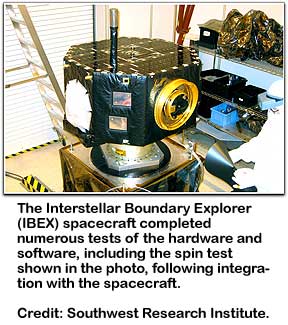
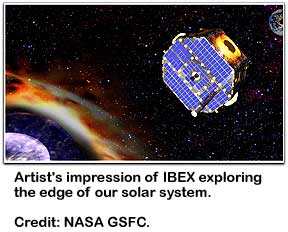
 NASA’s Interstellar Boundary Explorer (IBEX) spacecraft, designed to image global interactions at the outer reaches of the solar system, has started its move to Vandenberg Air Force Base (VAFB) in California. The IBEX spacecraft was loaded into a truck at Orbital Sciences Corporation, Virginia, where engineers integrated the science payload with the spacecraft and completed numerous tests to ensure optimum performance during the launch and operational phases of the mission. IBEX will move once more before its scheduled October 5th launch. In late September, the spacecraft will be transported to a facility on Kwajalein Island, a part of the Marshall Islands, roughly equidistant between Hawaii, Japan, and Australia. There, IBEX will undergo final preparations for its unique launch. An L-1011 aircraft is set to carry IBEX and the Pegasus rocket out over the South Pacific, fly toward the east, and release the package. Shortly after drop, the rocket will ignite and carry IBEX up to about 130 miles above Earth, spin it up to 60 RPM, and release it. Using a concept never before attempted, the IBEX team integrated its own additional solid rocket motor and internal propulsion system to transport the spacecraft all the way up to its final high-altitude orbit (about 200,000 miles high) — most of the way to the Moon. This groundbreaking, relatively inexpensive launch method holds great promise for delivering future small government and commercial spacecraft to high-altitude orbits.
