

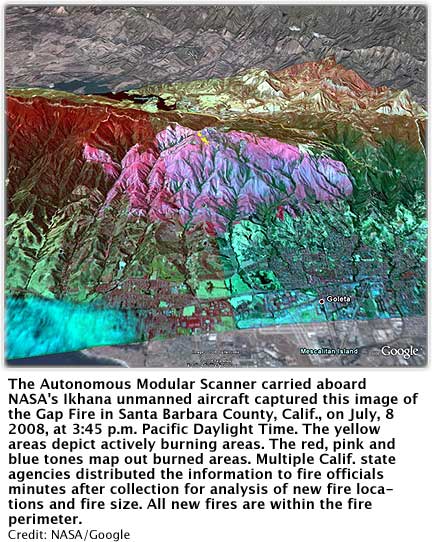
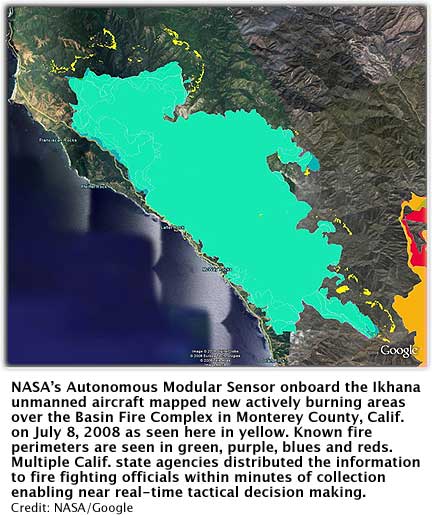
Fire images are collected onboard Ikhana and transmitted through a communications satellite to NASA Ames. There, the imagery is superimposed over Google Earth and Microsoft Virtual Earth maps to better visualize the location and scope of the fires. The imagery is then transmitted to the Multi-Agency Coordination Center in Redding, California, and the State Operations Center in Sacramento, which distribute fire data to incident commanders in the field.
NASA and the U.S. Department of Agriculture’s Forest Service have partnered to obtain imagery of the wildfires in response to requests from the California Department of Forestry and Fire Protection, the California Governor’s Office of Emergency Services, and the National Interagency Fire Center. NASA was working with the Forest Service on a demonstration mission later this summer, but moved up the schedule in response to the widespread fires. The system was proven during a series of wildfire imaging demonstration missions in August and September 2007 and tested operationally during the Southern California fires of October 2007.
“NASA’s emergency imaging gives us immediate information that we can use to manage fires, identify threats and deploy firefighting assets,” California Gov. Arnold Schwarzenegger said. “I thank NASA for providing us with this important firefighting tool that will help us maximize attacks on the more than 300 active fires currently burning in California.”
NASA’s Applied Sciences and Airborne Science programs and the Earth Science Technology Office funded development of the fire sensor. In the hands of operational agencies, the benefits of this NASA research and development effort can support nationwide wildfire fighting efforts. NASA satellites also are capturing imagery of the wildfires to fill in gaps in airborne imagery.
