

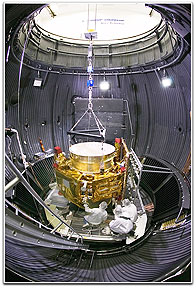
 Northrop Grumman Corporation (NYSE:NOC) has successfully completed one of the most critical spacecraft environmental tests on NASA’s Lunar Crater Observation and Sensing Satellite (LCROSS), two months ahead of schedule. LCROSS will be launched later this year on a mission to impact the moon in the search for water ice and water-bearing compounds in lunar craters. Thermal vacuum testing helps determine a spacecraft’s flight-worthiness. During the 13.5-day test, LCROSS was subjected to thermal cycles with temperatures reaching as high as 230 degrees Fahrenheit (110 Celsius) and as low as -40 degrees F (-40 C) while simulating launch, on-orbit turn-on, and the cruise phase to spacecraft impact on the moon. LCROSS is now undergoing final checkout at Northrop Grumman’s manufacturing facility in Redondo Beach, California. The spacecraft will then be readied for shipment to the Kennedy Space Center in Florida for launch processing and integration onto an Atlas V rocket as a secondary payload to NASA‘s Lunar Reconnaissance Orbiter.
Thermal Vacuum Testing Of LCROSS Finishes Ahead Of Schedule
Northrop Grumman Corporation (NYSE:NOC) has successfully completed one of the most critical spacecraft environmental tests on NASA’s Lunar Crater Observation and Sensing Satellite (LCROSS), two months ahead of schedule. LCROSS will be launched later this year on a mission to impact the moon in the search for water ice and water-bearing compounds in lunar craters. Thermal vacuum testing helps determine a spacecraft’s flight-worthiness. During the 13.5-day test, LCROSS was subjected to thermal cycles with temperatures reaching as high as 230 degrees Fahrenheit (110 Celsius) and as low as -40 degrees F (-40 C) while simulating launch, on-orbit turn-on, and the cruise phase to spacecraft impact on the moon. LCROSS is now undergoing final checkout at Northrop Grumman’s manufacturing facility in Redondo Beach, California. The spacecraft will then be readied for shipment to the Kennedy Space Center in Florida for launch processing and integration onto an Atlas V rocket as a secondary payload to NASA‘s Lunar Reconnaissance Orbiter.
