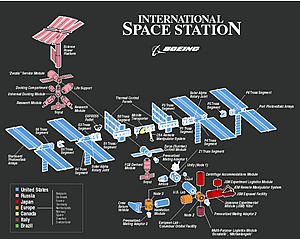
Illustration of the International Space Station
(courtesy Boeing)
One of the chores the crew of the Endeavour during the STS-118 mission was to deliver a variety of hardware components to the International Space Station (ISS). In fact, Boeing produced more than 740 light hardware components that include the Starboard 5 (SS) truss element. This component will increase the available power to the various systems aboard the ISS.
What’s so important about the truss? This Boeing-built, two-ton, 11-foot long SS truss allows one quarter of the space station’s power to be realized. This element is part of the space station’s 11-segment integrated truss structure and the third starboard element to be delivered. The installation of a new Control Moment Gyroscope (CMG) was also installed, an important component of the ISS’ attitude control system. As the prime contractor for the space station, Boeing is also the integrator for the CMG.
NASA also used the Boeing-built Station-Shuttle Power Transfer System (SSPTS) for the first time to extend the shuttle mission. When using the SSPTS, the shuttle orbiters are actually powered by the ISS’ solar arrays. This allowed crew members to conduct additional activities, such as the unloading of needed cargo and the all important science experiments. Additionally, the successful activation of SSPTS allowed NASA to extend the mission by three days and a fourth spacewalk was also added. Due to the threat of Hurricane Dean, the mission had to be cut short—Chicago, Illinois, August 23, 2007
- Skip to primary navigation
- Skip to main content
- Skip to primary sidebar
- Skip to secondary sidebar
- Skip to footer


Satellite Industry Intelligence Since 1983
Footer

Satnews is a leading provider of satellite news, events, publications, research and other satellite industry information in both commercial and military enterprises worldwide.