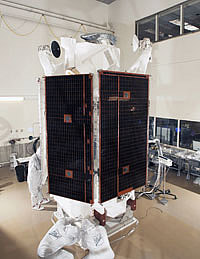
The WorldView-1 satellite going through final testing.
LONGMONT and BOULDER, COLORADO: August 15, 2007—Satnews Daily–Set for launch on Tuesday, September 18th, from Vandenberg Air Force Base in California, is the WorldView-1 satellite. This is but the first of two new, nextgen satellites DigitalGlobe plans to inject into orbit.
Involved in the project are Ball Aerospace & Technologies Corp. and ITT Corporation. Both Ball and DigitalGlobe have worked together for more than a decade on commercial, remote sensing satellites. According to David Taylor, the president and CEO of Ball Aerospace, “The next-generation WorldView-1 and WorldView-2 satellites will capture more imagery than ever before due to the flexibility afforded by the Control Moment Gyro-based system designed by Ball Aerospace.” Echoing like sentiments was the vice president and director, Commercial & Space Sciences programs at ITT Space Systems Division, Frank Koester, “Not only will ITT’s digital imaging sensor for WorldView-1 boast half-meter resolution with three-meter geo-location, it’ll do so using less space, weight and power than any previously launched system.”
After its launch, WorldView-1 will undergo a calibration and check out period. Soon thereafter, imagery will be delivered, prior to October 18th, which also happens to be the anniversary of QuickBird’s launch, DigitalGlobe’s current satellite. WorldView-1 will have an average revisit time of 1.7 days. The satellite will also be capable of collecting as many as 750,000 square kilometers (that’s 290,000 square miles) per day of half-meter imagery. State-of-the-art geo-location accuracy and the agility for rapid targeting and in-track stereo are all part of this craft’s capabilities.
Jill Smith, the CEO of DigitalGlobe, added, "The addition of WorldView-1 and WorldView-2 in the coming months will bring the total number of satellites DigitalGlobe has in orbit to three, completing a constellation of spacecraft that will offer the highest collection capacity, more than 1 million square kilometers per day."
- Skip to primary navigation
- Skip to main content
- Skip to primary sidebar
- Skip to secondary sidebar
- Skip to footer


Satellite Industry Intelligence Since 1983
Footer

Satnews is a leading provider of satellite news, events, publications, research and other satellite industry information in both commercial and military enterprises worldwide.