
The Federal Aviation Administration licensed 187 launches in fiscal 2026, down from 196 and the first decline since fiscal 2019. Counting reentries, it licensed 194 operations against its own projection of 209 to 214. Spacecraft per launch went the other way. Transporter-18 carried 130 spacecraft to orbit on October 1, and on October 10 the Space Development Agency put up 21 more on a single Falcon 9. Sift, which sells software for monitoring hardware, has fifteen minutes on the program. Its co-founder takes the Satellite Innovation stage at Silicon Valley Space Week in October.
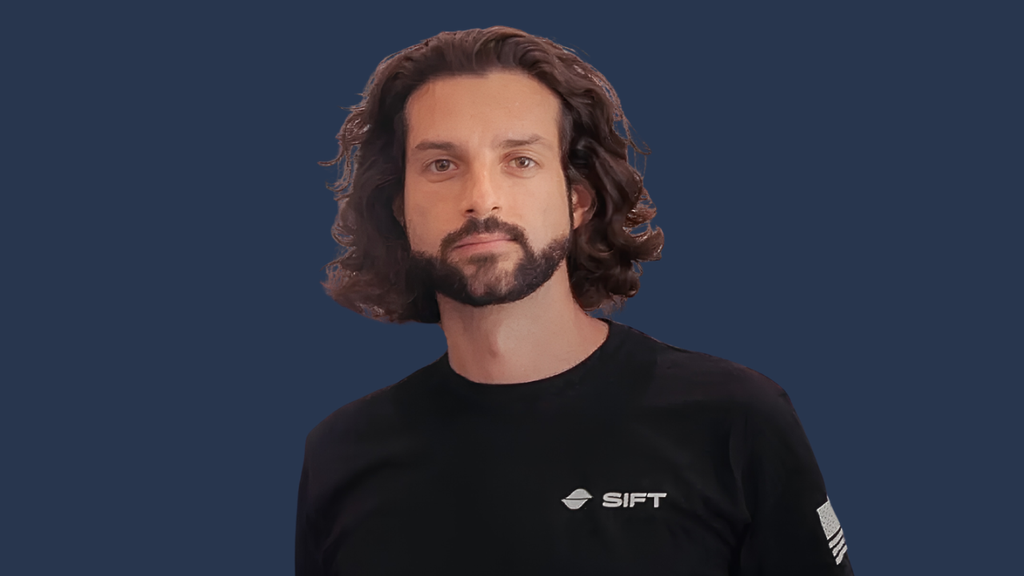
Austin Spiegel is Co-founder and Chief Executive Officer of Sift, which sells what it calls an observability layer for hardware. He spent nearly five years at SpaceX, where he led a team building manufacturing and test software for rockets and spacecraft and then worked on the Starlink telemetry platform, which he has said was collecting tens of terabytes a day by 2020. He left in 2020 and spent about a year as a software engineering manager at Riot Games before reconnecting with Karthik Gollapudi, a Dragon flight software engineer, to start Sift. The company raised a $42 million Series B in March led by StepStone Group, bringing it to $67 million raised. He became chief executive in May, when it counted eighty people across Los Angeles and San Francisco. It earned FedRAMP High authorization in June through Knox Systems, which opened federal and national security work to it, though no agency customer has been named publicly.
The program gives the brief a title and no description: mission software lessons of 2026. The year’s numbers are mostly about volume. In announcing that round, Sift said K2 Space went from roughly ten megabytes of test data across a summer to tens of terabytes a week, monitoring tens of thousands of channels at sub-second latency, and that Impulse Space runs more than a hundred live alert rules on its LEO-3 vehicle. The company lists Astranis, CX2 and the autonomous rail freight developer Parallel Systems among its customers, and says it reads at least eleven hardware-native data formats and keeps petabytes of historical test data queryable. High-fidelity tracking from the Space Surveillance Network can involve multi-hour processing delays. Mission Delta 2 presented software at the Advanced Maui Optical and Space Surveillance Technologies conference on September 29 that accepts less precise orbital solutions in exchange for faster updates, fusing commercial radar, optical and passive radio-frequency feeds, with operational integration planned for 2027. Satellite developers are trying to fit more spacecraft into each launch. Meridian Space’s reflectarray bus is designed to stack up to 250 satellites inside one Falcon 9 fairing, and its in-orbit demonstrator flew on Transporter-18. The 21 satellites the Space Development Agency launched on October 10 were the first half of a 42-spacecraft order Northrop Grumman is building under a $692 million contract.
Spiegel gives “Mission Software Lessons of 2026” on Tuesday, October 27, from 5:00 p.m. to 5:15 p.m. in the Hahn Auditorium at the Computer History Museum in Mountain View. He is the only speaker on it. It follows the panel on launch scarcity and the 2029 gap, and at 5:15 the room turns to a brief on the crowded highways of low Earth orbit, before the evening reception.
Silicon Valley Space Week runs Tuesday, October 27 through Thursday, October 29 at the Computer History Museum, with Satellite Innovation across the first two days and the MilSat Symposium across the last two. Spiegel has fifteen minutes late on the opening day. Meridian’s 250-satellite stack is a design capacity, not a demonstrated one.