

On August 31, 2026, Teledyne Space Imaging, a business unit of Teledyne Technologies Incorporated, announced that it surpassed 1,000 space-qualified scientific imaging sensors operating in orbit. The milestone was achieved following the August 30 launch of NASA’s Nancy Grace Roman Space Telescope aboard a SpaceX Falcon Heavy rocket from Kennedy Space Center in Florida.
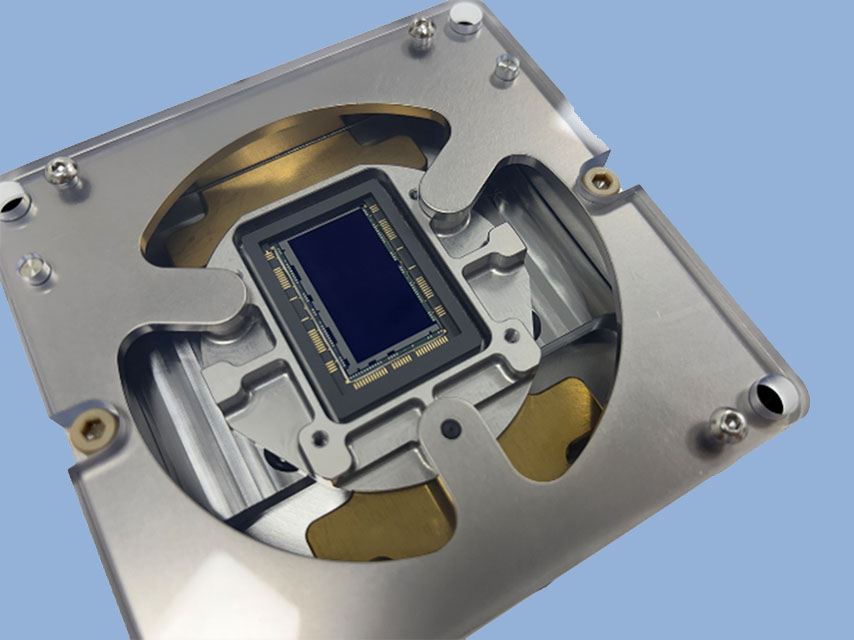
Sensor Hardware and Focal Plane Specifications
Teledyne supplied primary detector assemblies for both scientific instruments aboard the Roman Space Telescope observatory:
- Wide Field Instrument (WFI): Equipped with 18 H4RG-10 infrared detector arrays forming a mosaic of more than 300 million pixels. Each $4096 \times 4096$ pixel array contains over 16 million pixels, establishing the largest infrared focal plane flown in space.
- Coronagraph Instrument (CGI): Integrates three CCD311-20 electron-multiplying charge-coupled device (EMCCD) detectors. The technology operates alongside deformable mirrors and wavefront controls to suppress host-star glare for direct observation of exoplanets.
Contract History and Development Heritage
NASA originally awarded Teledyne a $23 million contract in 2018 to manufacture flight-quality sensor chip assemblies for the Roman mission. The delivery scope was subsequently expanded to 28 units. The delivered sensor chips demonstrated lower noise metrics, higher quantum efficiency, reduced image persistence, and enabled a 20 percent expansion in the instrument’s operational spectral bandwidth.
Executive Perspective
“Reaching more than 1,000 scientific, space-qualified imaging sensors in orbit is a proud achievement for everyone at Teledyne,” said Megan Tremer, President of Teledyne Space Imaging. “It reflects our long-standing commitment to advancing imaging technology and supporting the world’s most ambitious space missions. Roman is another important chapter in that story, and we are excited to see how it expands our understanding of the Universe.“
Heritage Programs and Operational Outlook
The Roman deployment adds to Teledyne’s four-decade history supplying focal plane arrays for civil space astronomy. Teledyne imaging sensors currently support science operations on the Hubble Space Telescope, James Webb Space Telescope, Euclid Space Telescope, ESA’s Sentinel Earth observation fleet, and the NOAA/NASA GOES weather satellite series.
