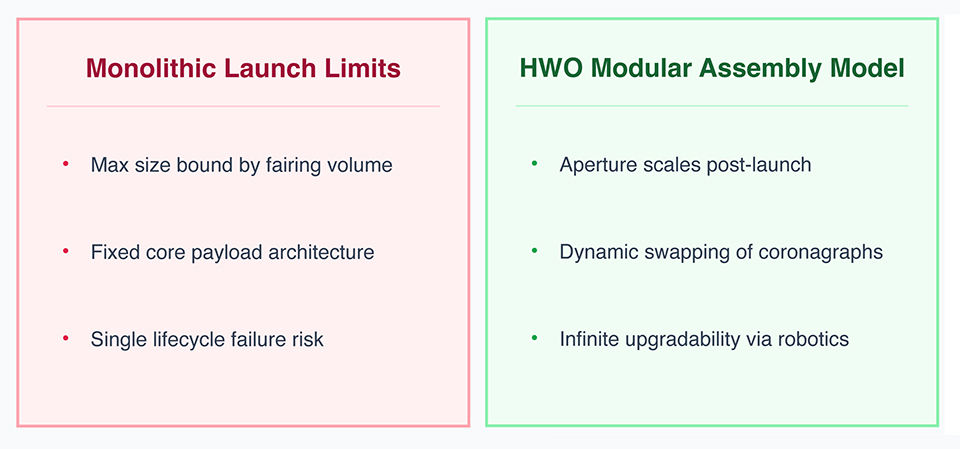
PASADENA, CALIFORNIA — Speaking during a technical briefing at the American Astronomical Society’s (AAS) 248th meeting in Pasadena, NASA astrophysics division director Shawn Domagal-Goldman confirmed that the agency’s upcoming flagship alien-hunting telescope, the Habitable Worlds Observatory (HWO), is being structurally engineered to mandate robotic in-space servicing, assembly, and maintenance (ISAM).
The strategic engineering pivot represents a fundamental departure from the fixed, single-lifecycle design philosophies of the James Webb Space Telescope (JWST), transforming the $11 billion optical instrument into an upgradable orbital asset destined for the Sun-Earth Lagrange point 2 (L2).
Technical Milestones and Structural Stability
Slated for launch in the late 2040s, the HWO represents an unprecedented leap in precision spaceborne instrumentation. The telescope’s primary objective is to directly image and spectroscopically analyze at least 25 Earth-like exoplanets orbiting sun-like stars within a 30-light-year radius, actively hunting for chemical biosignatures such as oxygen, ozone, and methane.
To isolate the reflection photons of an exo-Earth from the blinding glare of its host star, the HWO requires a specialized internal coronagraph capable of suppressing starlight by a factor of 10 billion. Achieving this level of starlight mitigation requires an unprecedented degree of structural stability. The instrumentation and mirror segments cannot fluctuate by more than a fraction of a picometer—roughly 1/50th the diameter of a single hydrogen atom—during multi-hour observation windows. This requires thousands of active control sensors and micro-actuators operating continuously to counteract microscopic structural warping induced by localized solar radiation gradients and mechanical reaction-wheel vibrations.
Modular Avionics and Robotic Maintenance Interfaces
Because the HWO will be positioned 1.5 million kilometers from Earth at the L2 Lagrange point, human servicing missions—like the Space Shuttle flights that repaired the low-Earth-orbiting Hubble Space Telescope—are logistically unviable. Instead, NASA is mandating a modular, robotically accessible hardware architecture from the project’s inception.
The design blueprint requires all critical electronic systems, command-and-control computers, and optical sensor arrays to be configured into standardized, line-replaceable units (LRUs). These modules will be fitted with specialized mechanical docking interfaces, self-aligning electrical connectors, and blind-mate guide pins optimized for robotic manipulation.
Rather than sending a human repair crew, NASA envisions utilizing autonomous or teleoperated robotic servicing spacecraft to latch onto the observatory, release mechanical locking collars, slide out degraded or obsolete scientific instruments, and insert next-generation sensors. Furthermore, if the telescope’s finalized primary segmented mirror configuration exceeds the volumetric fairing constraints of next-generation super heavy-lift rockets, the agency may utilize robotic servicers to execute the structural assembly and alignment of the 6-to-8-meter primary mirror segments directly in orbit.
The Rise of the Commercial Servicing Sector
The mandate to build the world’s most complex space telescope around an infrastructure-servicing model is expected to provide a powerful commercial driver for the nascent in-space servicing, assembly, and manufacturing (ISAM) industry. The decision occurs against a broader backdrop of military and civil technology maturation, following the impending launch of DARPA’s Robotic Servicing of Geosynchronous Satellites (RSGS) program, which aims to validate deep-space mechanical repair robotic arms in high orbits.
By integrating standardized commercial servicing slots into its premier civil space architecture, NASA is ensuring that future scientific capabilities can adapt to generational technological breakthroughs without requiring the multi-billion-dollar expense of launching entirely new flagship space observatories.
Operational Lifecycle Paradigm